MicroCloud Hologram Inc. (NASDAQ: HOLO) has achieved efficient quantum algorithm simulation with a dedicated processor built entirely from classical logic gates, AND, OR, NOT gates, adders, and multipliers, simulating quantum algorithms without quantum hardware. The company’s design addresses the exponential growth in simulation time for systems exceeding 20 qubits. This new hardware shifts from traditional to customizable architecture that directly simulates quantum state evolution and measurement. HOLO states that this approach will change how quantum computing research is conducted, allowing researchers to verify complex algorithms in a shorter time and supporting the development of future practical quantum hardware.
Customizable Hardware Accelerates Quantum Algorithm Simulation
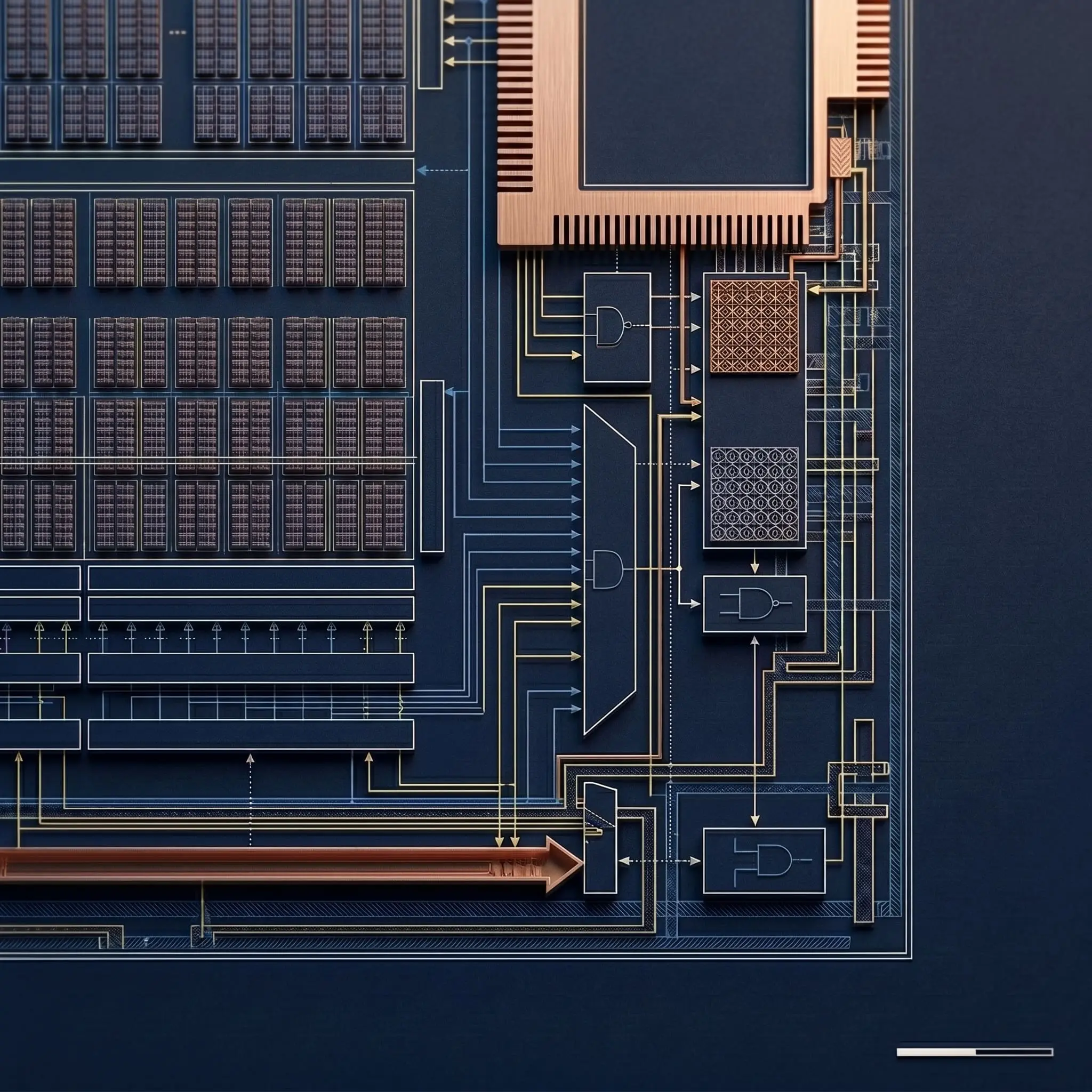
MicroCloud Hologram Inc. has achieved efficient quantum algorithm simulation using only classical logic gates, a feat previously considered unattainable and signaling a potential shift in how quantum research is conducted. This approach addresses the exponential growth in simulation time for systems exceeding 20 qubits; current software struggles to accurately model algorithms at this scale. Unlike conventional simulators reliant on general-purpose CPUs or GPUs, this new design transforms quantum simulation into a parallel and pipelined execution mode on classical hardware. The company comprehensively modeled the entire architecture using HDL hardware description language and validated its functionality on an FPGA platform, confirming its operational effectiveness. A key element is the quantum state memory, which compactly stores complex number representations of qubit states in high-speed SRAM, utilizing a dedicated address mapping mechanism and multi-port access logic to accelerate tensor product operations and avoid common software caching issues.
The control unit, described as the “brain of the entire system,” employs a microprogrammed design, pre-compiling quantum algorithm gate sequences into micro-instructions stored in control memory. This allows for dynamic loading of control codes for different algorithms, providing hardware customizability. For example, when executing the Grover search algorithm, the control unit first issues micro-instructions to load the initial uniform superposition state, then cyclically executes the matrix multiplication of the Oracle operator and the diffusion operator, and finally activates the measurement unit for result sampling, illustrating the system’s operational flow. Simulation results demonstrate a two-orders-of-magnitude speed increase in gate execution speed for 30-qubit systems compared to software simulators, alongside power consumption controlled within one-fifth of that of traditional GPU simulators.
Looking ahead, HOLO plans to integrate neural network accelerators with quantum simulation units, aiming to further enhance the efficiency of variational algorithms and incorporate programmable noise injection to realistically model NISQ devices, believing that classical logic gate-driven quantum simulation will accelerate progress in science and technology.
Classical Logic Gate Implementation of Quantum State Evolution
The pursuit of practical quantum computing currently relies heavily on software simulation, a method increasingly constrained by the complexity of modeling even modest quantum systems. Existing software struggles with the exponential growth in simulation time for systems exceeding 20 qubits. However, MicroCloud Hologram Inc. (NASDAQ: HOLO) is challenging this paradigm with a novel approach: a quantum algorithm simulator built entirely from classical logic gates. This departure from traditional methods, which simulate quantum algorithms without quantum hardware, is attracting attention for its potential to accelerate research and development in the field. HOLO’s design fundamentally alters how quantum simulations are performed. Rather than relying on the serial execution inherent in conventional software, the company has engineered customizable dedicated processor hardware to directly simulate quantum state evolution and measurement.
This hardware, constructed from standard components like AND, OR, and NOT gates, adders, and multipliers, accurately reproduces quantum processes. The company explains that the execution of quantum algorithms is essentially the multiplication of quantum state vectors and unitary matrices, as well as the final probabilistic measurement sampling, highlighting the mathematical basis for their approach. This design avoids frequent cache miss problems common in software, while also incorporating a state normalization module to maintain physical consistency. The company states that this flexibility of the microprogram allows users to dynamically load control codes for different quantum algorithms through external interfaces, thereby achieving hardware customizability. HOLO intends to further refine this technology, exploring integration with neural network accelerators and programmable noise injection logic to create a hybrid classical-quantum architecture and more realistically simulate noisy intermediate-scale quantum (NISQ) devices.
Dedicated Memory Architecture for Complex Quantum Data
MicroCloud Hologram Inc. (NASDAQ: HOLO) is tackling a challenge in quantum computing: the exponential growth in simulation time for systems exceeding 20 qubits. This approach, while seemingly counterintuitive given the nature of quantum simulation, circumvents bottlenecks imposed by conventional software and hardware architectures. The impetus behind this design stems from the fact that existing software struggles with modeling algorithms beyond 20 qubits. Central to this is a novel approach to quantum state memory, designed to compactly store the complex number data representing qubit states in high-speed SRAM. The company explains that for n qubits, the storage capacity precisely corresponds to complex amplitude values, highlighting the exponential scaling of memory requirements. This dedicated memory isn’t merely about capacity; it also incorporates a state normalization module, utilizing classical adders and multipliers to maintain the physical consistency of the quantum state in real time.
A carefully designed bus system, drawing on principles from classical multi-processor systems, ensures high-frequency operation data paths reduce arbitration overhead. Simulation results demonstrate a significant performance gain; the company reports that when processing systems containing 30 qubits, the hardware’s gate execution speed is two orders of magnitude faster than software simulators, and power consumption is controlled within one-fifth that of traditional GPU simulators. Looking ahead, MicroCloud Hologram Inc.
Simulation verification results show that when processing systems containing 30 qubits, the hardware’s gate execution speed is two orders of magnitude faster than software simulators, and power consumption is also controlled within one-fifth of that of traditional GPU simulators.
Hybrid Classical-Quantum Designs Target Variational Algorithms
The pursuit of practical quantum computation is increasingly focused on hybrid approaches, and MicroCloud Hologram Inc. (NASDAQ: HOLO) is staking a claim with an unconventional design. This architecture isn’t intended to replace quantum hardware, but to circumvent an issue hindering progress: the exponential growth in simulation time for systems exceeding 20 qubits. HOLO’s innovation directly addresses this, allowing researchers to verify complex algorithms in a much shorter time. Functional verification on FPGA platforms has confirmed the effectiveness and stability of the architecture.
This will completely change the paradigm of quantum computing research, allowing researchers to verify complex algorithms in a much shorter time and paving the way for the development of future practical quantum hardware.
MicroCloud Hologram Inc.


See today’s quantum computing news on Quantum Zeitgeist for the latest breakthroughs in qubits, hardware, algorithms, and industry deals.