NISQ stands for Noisy Intermediate-Scale Quantum, and it is the name for the era of quantum computing we are living in right now. A NISQ machine has enough qubits to be interesting, too many for a classical computer to easily imitate, but no error correction, so noise limits what it can reliably do. The term captures both the promise and the frustration of today’s hardware.
This guide explains where the term came from and why the word noisy is the whole point. It covers what these machines are actually good for, the two structural problems that cap them, and why the field now treats NISQ as a stepping stone. Understanding it is the quickest way to close the gap between quantum computing headlines and reality.
NISQ means noisy and uncorrected. The defining feature is the absence of error correction, so accumulated noise caps how deep a circuit can run.
It is an era, not a machine type. The term describes a stage that spans every hardware platform, from superconducting to trapped ions.
Intermediate scale is about size. Preskill’s paper points to roughly fifty to a few hundred qubits, too many for brute-force simulation but far too few for fault tolerance.
Its signature is hybrid algorithms. Variational methods that pair a shallow quantum circuit with a classical optimiser are the workhorses of the NISQ era.
Two walls cap it. Barren plateaus make training exponentially harder as qubit counts rise, and the number of measurement shots needed for useful precision is brutal.
The field is moving past it. The goal now is early error correction, with recent results showing that correction can finally beat the noise it introduces.
- Noisy, intermediate-scale, and with no error correction
- John Preskill named the era in a 2018 paper
- Errors accumulate because nothing removes them
- Fifty qubits is where brute-force simulation runs out of memory
- The useful work is scientific, not commercial
- Why barren plateaus break the scaling story
- Why sampling is a bottleneck of its own
- Error mitigation, the NISQ-era workaround
- Why many NISQ advantages did not survive
- Why the field is moving past NISQ
- The headline goal was missed and the control stacks got built
- A quantum advantage claim is a claim about the best classical method
- A million reliable operations is the new target
- What has to keep working, and what nobody can date
- The classical methods that kept moving the target
- Frequently asked questions
Noisy, intermediate-scale, and with no error correction
The letters spell out the two defining traits of today’s machines. Noisy means the qubits and the operations on them are error-prone, and because there is no error correction those errors simply accumulate as a computation proceeds. Intermediate-Scale refers to the number of qubits, large enough to be hard to simulate on a classical computer but far short of what a fully error-corrected machine would need.
Put together, a NISQ device is a genuine quantum computer that is powerful enough to be scientifically interesting yet too noisy to run long, reliable algorithms. That tension is the essence of the term, and it is why the same machine can be described both as a breakthrough and as not yet useful. The definition is also strict in one direction, since a machine that runs full error correction has by definition left the NISQ era behind.
John Preskill named the era in a 2018 paper
The physicist John Preskill coined the phrase. It appeared in a paper submitted in January 2018 and published as Quantum Computing in the NISQ era and beyond (Quantum 2, 79). The paper grew out of a keynote he gave at the Q2B conference in December 2017. He introduced it precisely to set expectations, arguing that the machines then arriving would be a significant step forward without changing the world right away.
That framing matters, because it means NISQ was pitched as a stepping stone from the very beginning rather than reinterpreted as one later. Preskill was explicit that the truly transformative applications would need error correction and far more qubits, and that the near-term value of these noisy machines would be mostly scientific rather than commercial. Reading the original paper is still the fastest cure for overheated expectations, because almost every caution it raised has held up.
Errors accumulate because nothing removes them
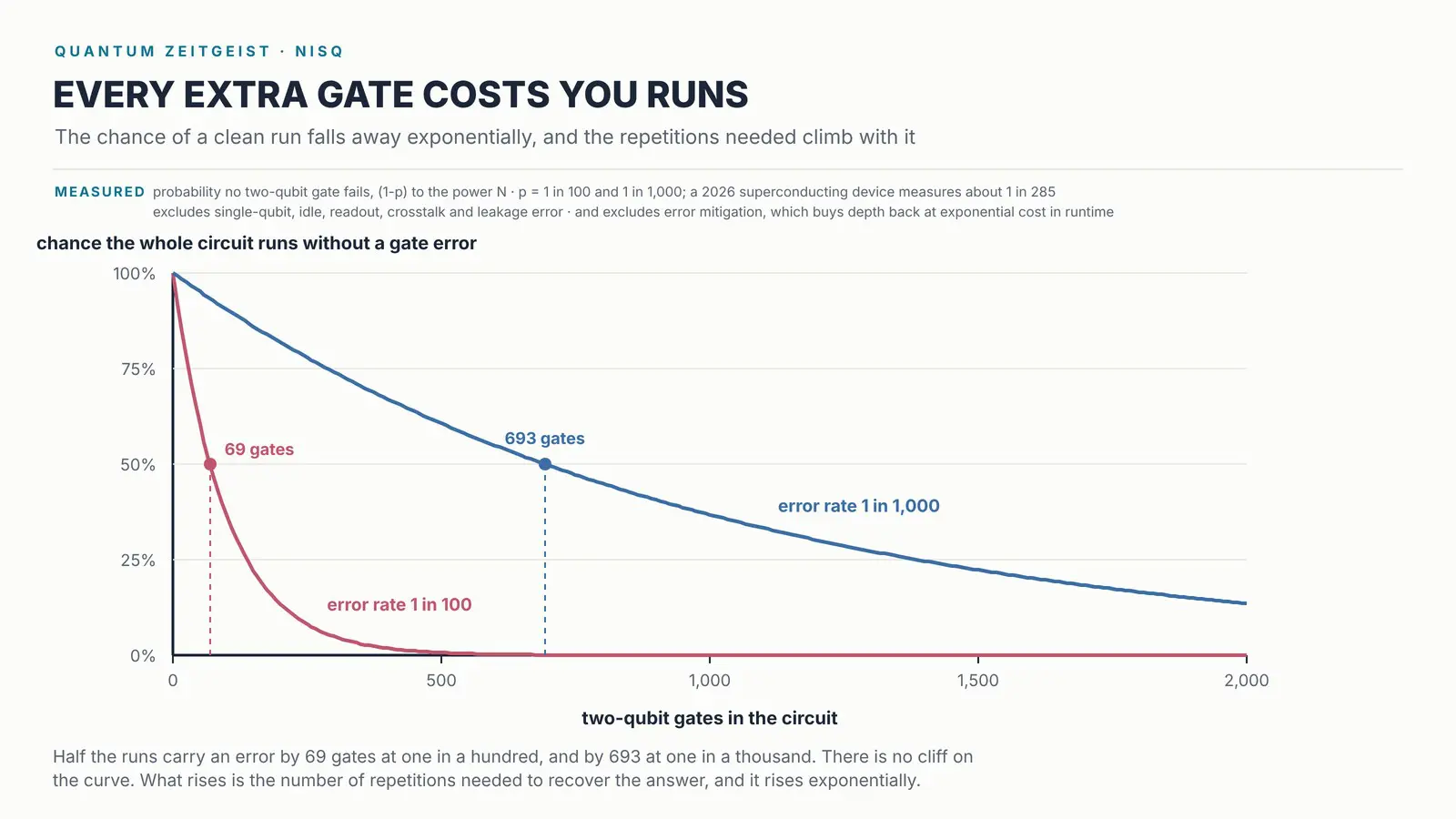
The word noisy is not incidental, it is the definition. Every gate on a real qubit has some chance of going wrong, and every qubit slowly loses its quantum state to the environment through decoherence. In a NISQ machine there is no mechanism to catch and fix these errors, so they pile up with each operation.
The arithmetic sets the scale of the problem. Say each two-qubit gate fails with probability p. A circuit containing N of them runs clean with probability (1-p) to the power N. That falls away exponentially in the product of N and p. Preskill put the ceiling at about a thousand two-qubit gates for the error rates of the time. Nothing snaps at that point. The signal shrinks, the repetitions needed to recover a given precision grow in step, and the limit is a price rather than a wall. He was careful to call the rule naive, because some algorithms tolerate faults at most of their circuit locations. Removing the price altogether, rather than pushing it back, is what quantum error correction is designed to do.
Fifty qubits is where brute-force simulation runs out of memory
The intermediate part of the name refers to a range of qubit counts. Preskill’s paper points to something like fifty to a few hundred qubits, and the lower end was chosen for a reason. Storing the full description of a fifty-qubit state takes over a quadrillion complex numbers. That is where the memory of even the largest supercomputers gives out, so brute-force simulation of an arbitrary circuit becomes impractical around that point.
That fifty-qubit figure is widely misquoted as a hard boundary, and it is not. It applies to brute-force simulation, the kind that stores every amplitude. Tensor network methods can handle hundreds or thousands of qubits when a circuit is shallow or generates little entanglement, which describes most of what NISQ machines actually run. The honest statement is that a large qubit count is necessary for classical hardness but nowhere near sufficient, and circuit structure decides the rest.
At the other end of the range sits a genuinely useful error-corrected machine. It is expected to need many thousands or even millions of physical qubits, because each protected logical qubit consumes hundreds or thousands of physical ones. Set against that, a few hundred is tiny. Intermediate is exactly the right word.
The useful work is scientific, not commercial
Because deep circuits are off-limits, the NISQ era developed its own style of algorithm. The signature approach is variational, pairing a shallow quantum circuit whose gate angles are adjustable with a classical optimiser that repeatedly tunes those angles to improve a measured quantity. The quantum computer prepares states and estimates energies, while the classical computer does the searching, which keeps each individual quantum circuit short enough to survive.
Two examples define the genre. The variational quantum eigensolver estimates the ground-state energy of a molecule by minimising a measured expectation value, first demonstrated on a photonic chip by Alberto Peruzzo and colleagues (Nature Communications 5, 4213, 2014). The quantum approximate optimisation algorithm, introduced by Edward Farhi, Jeffrey Goldstone and Sam Gutmann in 2014 (arXiv:1411.4028), applies alternating cost and mixing operations to attack combinatorial problems such as graph partitioning.
The most honest description of NISQ’s value is scientific rather than commercial. These machines are genuinely useful for studying quantum physics itself, simulating the dynamics of small many-body systems in regimes where classical methods struggle, and for learning the engineering that error correction will need. What they have not delivered is a practical advantage on a real-world useful problem that a classical computer cannot match.
Why barren plateaus break the scaling story
You might expect that adding qubits to a NISQ machine would steadily make it more capable, but the variational algorithms it relies on hit a surprising wall. For broad classes of randomly initialised parametrised circuits, the variance of the cost function’s gradient shrinks exponentially with the number of qubits, so the optimisation surface becomes exponentially flat in almost every direction. The problem was named the barren plateau by Jarrod McClean and colleagues (Nature Communications 9, 4812, 2018).
The practical consequence is severe. A gradient that is exponentially small is buried beneath the statistical noise of the measurements used to estimate it. Telling a genuine downhill direction from sampling error then takes an exponentially growing number of shots. Later work showed the problem is not confined to deep random circuits. It can depend on how the cost function is defined, and it afflicts shallow circuits with global cost functions (Cerezo et al., Nature Communications 12, 1791, 2021).
Scaling up a NISQ machine can therefore make its algorithms exponentially harder to train rather than easier, which inverts the usual intuition that more qubits are better. Strategies exist to dodge the plateau, using structured rather than random circuits, shallow local cost functions and careful initialisation. An unresolved debate hangs over all of them. Circuits tame enough to avoid barren plateaus may be exactly the circuits a classical computer can simulate, which would remove the advantage they were built to deliver.
Why sampling is a bottleneck of its own
Noise gets the attention, but statistics quietly impose a second ceiling. A quantum computer does not report an expectation value, it reports one random bitstring per run, so every number a variational algorithm uses has to be built up from many repetitions. The statistical error falls only as one over the square root of the number of shots, meaning that one extra decimal place of precision costs a hundred times more runs.
Chemistry shows how punishing that is. The energy of a molecule is expressed as a sum of terms, and that count grows roughly as the fourth power of the number of orbitals. Each term needs its own measurements, fine enough to resolve chemically meaningful energy differences. The best resource analysis puts numbers on it. Gonthier and colleagues estimated 1.9 days of sampling for a single energy evaluation of methane, and 71 days for ethanol. A full optimisation needs hundreds of such evaluations (Physical Review Research 4, 033154, 2022). Those figures already assume the best grouping methods available and no time lost to qubit reset or cloud latency. The authors’ own conclusion is that the improvements help and are not enough.
The point is worth stating plainly because it changes the diagnosis. A hypothetical noiseless NISQ machine with a few hundred qubits would still face the shot-count wall. Building better qubits alone does not fix it (Gonthier et al., Physical Review Research 4, 033154, 2022). Our guide to quantum measurement covers why one run yields only one number.
Error mitigation, the NISQ-era workaround
Between doing nothing about errors and doing full error correction sits a third option that has defined the last few years of practice. Quantum error mitigation does not encode or repair anything. It runs extra variants of a circuit and combines the results classically, so that the bias caused by noise partly cancels in the final expectation value. Zero-noise extrapolation deliberately amplifies the noise, measures how the answer degrades and extrapolates back to the zero-noise limit. Probabilistic error cancellation instead characterises the noise thoroughly, then samples from a signed combination of circuits that inverts it (Temme, Bravyi and Gambetta, Physical Review Letters 119, 180509, 2017).
The catch is the price. Mitigation buys accuracy by spending runtime. The number of samples required grows exponentially with circuit size and noise rate. The technique buys a worthwhile factor of extra depth and then hits a limit of its own (Cai et al., Reviews of Modern Physics 95, 045005, 2023). It also only recovers expectation values rather than protecting a quantum state mid-computation, so it cannot support an algorithm that needs a reliable state at the end.
Keeping mitigation and correction distinct matters, because vendor announcements often blur them. Error correction encodes information redundantly, measures syndromes during the computation and repairs damage as it happens, which allows arbitrarily long circuits once the physical error rate is below threshold. Mitigation is a statistical post-processing stopgap that leaves the machine as noisy as it was.
Why many NISQ advantages did not survive
The NISQ era has produced a string of headline claims that a quantum machine matched or beat classical methods on some task. Many did not survive contact with better classical algorithms. Improved tensor network methods and smarter heuristics repeatedly caught up with the quantum results, and sometimes overtook them. One was matched within a fortnight of publication.
A related lesson came from a body of work known as dequantization, which began when Ewin Tang, then an undergraduate, produced a classical algorithm matching a proposed quantum speedup for recommendation systems (arXiv:1807.04271). Subsequent results extended the technique to principal component analysis and low-rank linear systems. The nuance matters, because these results dequantized specific exponential speedups that had relied on strong assumptions about how classical data is loaded and structured, rather than debunking quantum machine learning as a whole.
One further confusion is worth clearing. Random circuit sampling and boson sampling did beat the classical simulations available at the time, though several of those margins later narrowed as the classical methods improved. Both are contrived tasks, chosen because they are hard to simulate rather than because anybody wants their answers. They are evidence about the classical simulation of quantum systems rather than about NISQ usefulness, and citing them as proof that NISQ machines are commercially ready confuses two separate arguments. As of today there is no agreed practical quantum advantage on a genuinely useful problem.
Why the field is moving past NISQ
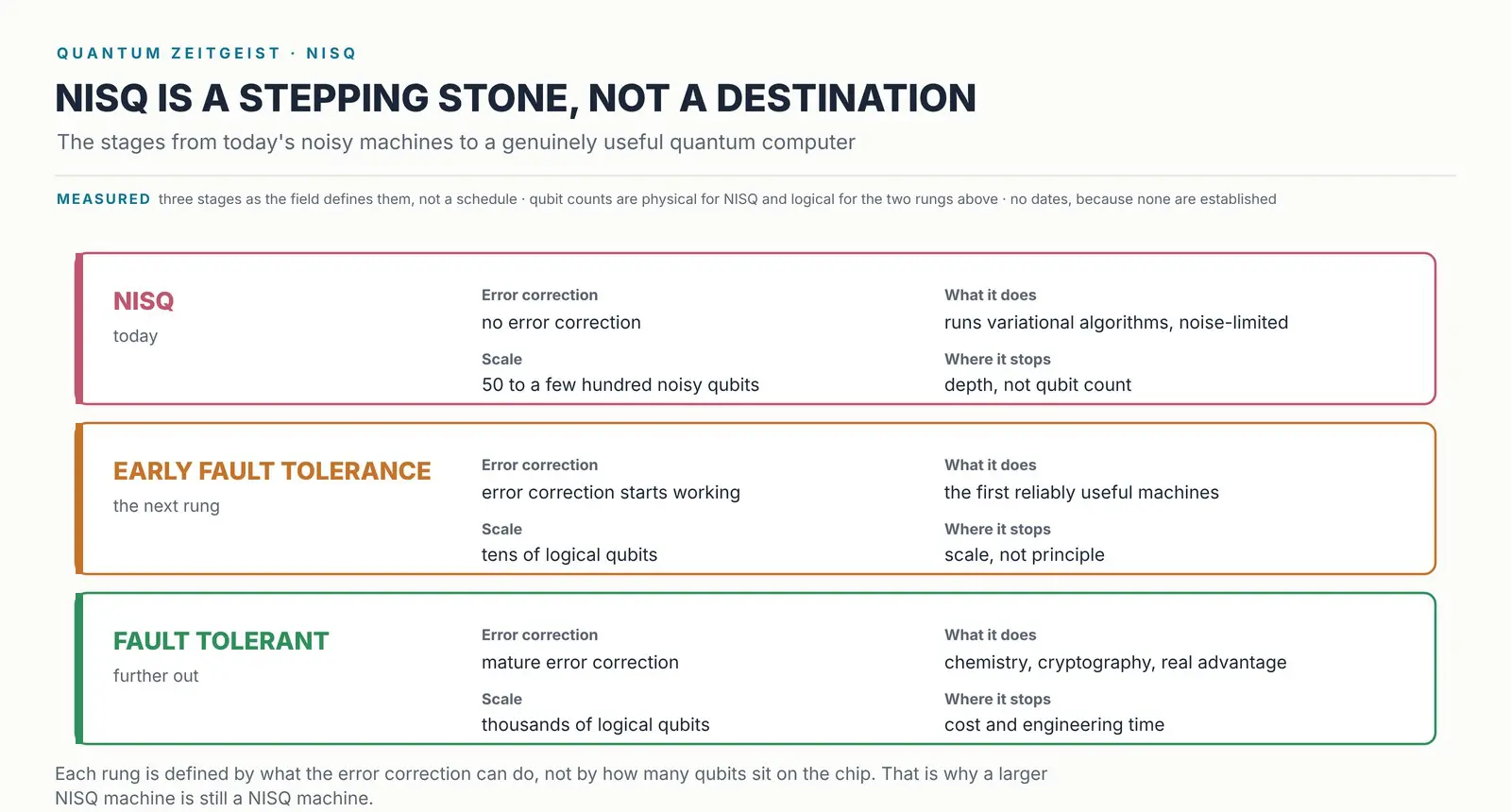
The most important shift in quantum computing is the move away from NISQ toward machines with working error correction. In December 2024 Google reported a result on its 105-qubit Willow processor. The team ran surface codes at distances three, five and seven. Each step of two in the distance cut the logical error rate by a factor of 2.14, to within 0.02 (Google Quantum AI and Collaborators, Nature 638, 920). Two caveats belong with that headline. The experiment stored a logical qubit as a memory rather than computing with it, and an earlier 2023 result had shown the effect too marginally to settle the question.
Researchers now describe a ladder of stages beyond NISQ, counted in operations rather than qubits. The next rung up is the megaquop machine, and the section below sets out what it is. Well above it sits the scale at which cryptography and industrial chemistry come into range. Factoring a 2,048-bit RSA key is estimated at roughly 2.6 billion Toffoli gates.
Two words get used for what the field is chasing, and they are worth separating. Preskill coined quantum supremacy in 2012 for a machine doing something no classical computer could match, useful or not. Many researchers now say quantum advantage instead, sometimes as a plain synonym and sometimes, as we do here, for the stricter thing: a useful problem solved better than classically. That stricter sense is not a rung on the hardware ladder. Sampling supremacy was claimed on a 53-qubit uncorrected machine in 2019, well below anything a megaquop would be, and useful advantage has not been claimed at any scale yet.
NISQ remains the first rung, valuable for the science it enables and the engineering lessons it teaches, but not the place where the technology pays off. The most accurate description of 2026 hardware is that it sits on the boundary. The leading machines are still noisy and mostly uncorrected, while the same laboratories demonstrate error correction on small numbers of logical qubits. For the wider picture, see our guide to quantum computing.
The headline goal was missed and the control stacks got built
The hope was that these machines would solve a useful problem faster than a classical computer. Judged against that, the era has not delivered. Saying so plainly is more useful than either the marketing or the backlash. The honest accounting is that the headline goal was missed and a great deal else was built along the way.
The control stacks are the clearest example. Running a variational algorithm means calibrating dozens of qubits and compiling a circuit onto real connectivity. It means dispatching thousands of jobs and getting results back inside the coherence window. A decade ago that infrastructure barely existed, and what did exist ran a handful of qubits. It is unglamorous and every fault-tolerant machine will need it.
Benchmarking is the second inheritance. The discipline of measuring what a machine actually does, rather than counting its qubits, grew out of the need to compare NISQ devices that were all imperfect in different ways. Randomised benchmarking predates the era, going back to Knill and colleagues in 2008 and to Magesan, Gambetta and Emerson in 2011. What the noisy era added was the pressure to use it, and to build on it with methods such as cycle benchmarking. The field is far better at reporting itself honestly than it was.
The third is people. A generation of researchers and engineers learned to work with real hardware rather than with idealised models, and the difference between those two skills is larger than it sounds. An era that trains the people who build the next thing has not been wasted, even when its own central promise went unmet.
A quantum advantage claim is a claim about the best classical method
The repeated pattern of a quantum result being matched classically within months has a methodological cause, and it is worth understanding rather than treating as bad luck. A quantum advantage claim is a claim about the best classical method, not about a particular classical method, and the best one is often not the obvious one.
Three questions decide whether a comparison is fair. The first is whether the classical baseline is a serious attempt or a naive implementation, since a general-purpose simulator will lose to a specialised algorithm that exploits the structure of the problem. The second is whether the classical side was allowed the same hardware budget, because a laptop is not the comparison for a machine built on a corporate research budget. The third is whether the problem was chosen for its usefulness or for being hard to simulate.
That third question is the one that has caused the most trouble. It is possible to define a task that a quantum device does easily and a classical computer finds awkward, demonstrate the gap honestly, and have proved nothing anybody wanted to know. Sampling problems of this kind are genuine scientific milestones and they are not applications, and conflating the two is how a reasonable result becomes an overstated headline.
The reader’s shortcut is to look for what the classical comparison was and who ran it. A paper that names the best known classical method, states the resources it was given, and reports the gap anyway is making a claim that might survive. One that compares against an unnamed simulation on unstated hardware is not yet making a claim at all.
A million reliable operations is the new target
The person who named the noisy era also named what comes after it. John Preskill proposed the megaquop machine in a keynote at the Q2B conference in Silicon Valley on 11 December 2024, published the following March as Beyond NISQ: The Megaquop Machine. A megaquop is a machine that can execute roughly a million quantum operations reliably. He was explicit that mega here means not precisely a million but somewhere in the vicinity of one.
He also dropped the naming format on purpose. Others had proposed successors that kept the ISQ ending of NISQ, and Preskill said he would rather leave ISQ behind. Counting operations gives a scale that keeps going. A gigaquop runs a billion, a teraquop a trillion. At the far end sits what he calls a FASQ machine, Fault-Tolerant Application-Scale Quantum, able to run a wide variety of useful applications, and he calls that a rather distant goal.
The modesty of a million is the point. It falls far short of the range a finished fault-tolerant computer works in. It is also far beyond anything the noisy era can reach.
The specification is concrete enough to argue with. Preskill puts the naive requirement at a logical error rate of order one in a million per logical gate, and says nobody expects to reach that without error correction and fault-tolerant operation. The rate might be allowed to slip somewhat, because error mitigation will still be worth using in the megaquop era as it is now. The task he has in mind is a circuit of order a hundred logical qubits at a depth of order ten thousand.
What that costs in hardware is a rough guess even from him. Tens of thousands of high-quality physical qubits could suffice. Today’s best physical two-qubit gates are wrong about once in three hundred, so the gap to one in a million is four orders of magnitude, and error correction rather than better physical gates is what closes it. Once the correction buys more than it costs, the coherence time stops setting the number of usable operations. What sets it instead is how many physical qubits can be spent protecting each logical one.
On timing he says plainly that he does not know. He does offer a guess about hardware: if a megaquop machine arrives within a few years, he expects the modality to be Rydberg atoms held in optical tweezers, on the assumption they keep improving in both scale and performance.
This is a different research programme from the one NISQ implied, and the change in target explains the change in what companies talk about. Announcements now concern logical qubits, code distances and correction cycles rather than variational chemistry, and that shift is not marketing drift. It reflects a settled judgement that the noisy shortcut did not work and the long route has to be taken.
Whether the intermediate machine finds a useful problem before the full one arrives is genuinely unknown, and Preskill says so himself. Asked what we will do with it, his answer is that he does not know, though he expects to learn valuable lessons about the dynamics of many-qubit systems by simulating them. Whether anything commercially valuable turns up at that scale he leaves open. The term marks a milestone worth aiming at, not a promise about what will be found there.
What has to keep working, and what nobody can date
The road past the noisy era is mapped in operations rather than years. Preskill’s ladder runs megaquop, then gigaquop at a billion operations, then teraquop at a trillion. At the far end sits a FASQ machine, able to run a wide range of useful applications, which he calls a rather distant goal. He puts no year on any rung of it. Anyone who does name a year is offering a forecast rather than a finding.
Three things have to keep working, and each is less settled than the coverage suggests. The first is that error suppression has to hold as the codes grow. Google’s Willow result showed it once, on one device, in one experimental campaign. No other laboratory has reproduced below-threshold scaling on different hardware, and the quoted margin on that factor of 2.14 measures the fit, not whether anyone else can repeat it.
The second is that the decoder has to keep up with the machine. A correction is worthless if it arrives after the calculation has moved on. Google demonstrated real-time decoding at code distance five, with an average decoder latency of 63 microseconds against an error-correction cycle of 1.1 microseconds. The larger distance-seven result, the one the headline rested on, was decoded afterwards.
The third is the assumption underneath the whole theory. Error correction works because errors are supposed to be largely independent, so a code can outvote them. The same team ran repetition codes out to distance 29 on a 72-qubit processor. Performance there was limited by rare correlated error events happening about once an hour, and correlated errors from the two-qubit gates were the largest single item in the error budget. That sits in the paper rather than in the coverage of it, and it is the one that would bite at scale.
Better algorithms cut the RSA estimate twentyfold, not bigger machines
Building more hardware is not the only lever, and the clearest recent progress did not use it. The published estimate for factoring a 2,048-bit RSA key fell from 20 million noisy qubits to under a million in four years, on identical assumptions about the machine (arXiv:2505.15917). The saving came from better arithmetic, from parking idle logical qubits in yoked surface codes, and from spending less area on manufacturing the special states a fault-tolerant computer consumes. It cost runtime, from about eight hours to under a week. None of it came from building anything.
What nobody can say is what the first machine of this kind will be used for. Preskill puts that question to the community rather than answering it, and says plainly that he does not know. He expects to learn something about the dynamics of many-qubit systems. Whether anything commercially valuable appears at that scale is open, and an article that told you otherwise would be guessing.
The classical methods that kept moving the target
One reason the noisy era’s advantage claims kept dissolving is that the classical side was improving at the same time, and the improvement came from a direction many people had not been watching. Tensor network methods do not try to store the full state of a quantum system, which is the thing that becomes impossible past fifty or so qubits. They store an approximation whose accuracy depends on how much entanglement the state actually contains.
That turns out to matter enormously for noisy machines. Noise destroys entanglement, so a device with realistic error rates produces a state less entangled than the ideal version. Less entanglement is exactly the condition under which the classical approximation works well. The noise that limits the quantum computer also makes the classical simulation easier, which is an uncomfortable symmetry.
Several prominent results were matched this way rather than by anyone building a bigger supercomputer. IBM reported a 127-qubit simulation of a kicked Ising model in June 2023 (Kim et al., Nature 618, 500, 2023). Twelve days later Joseph Tindall and colleagues posted a tensor network calculation that was more accurate than the quantum run (PRX Quantum 5, 010308, 2024). The quantum result was not wrong. The gap it claimed was smaller than it looked.
The lesson generalises past this era. A quantum advantage is a moving target. The classical baseline is a research field with its own funding and its own clever people, and a claim only settles once they have had a go at it. Waiting a year before believing a headline is not scepticism about quantum computing, it is how this particular comparison has always worked.
Frequently asked questions
What does NISQ stand for
NISQ stands for Noisy Intermediate-Scale Quantum. Noisy means the qubits and operations are error-prone with no error correction, and intermediate-scale means roughly fifty to a few hundred qubits. It describes the current era of quantum computing.
Who coined the term NISQ
The physicist John Preskill coined it in an influential paper published in the journal Quantum in 2018, based on a keynote he gave at the Q2B conference in December 2017. He introduced it to set realistic expectations, describing NISQ machines as a significant step forward that would not change the world right away.
Do NISQ computers use error correction
No, and that is the whole point. The absence of error correction is what the noisy in the name refers to. A machine that runs full error correction is, by definition, no longer a NISQ device.
How many qubits does a NISQ machine have
Roughly fifty to a few hundred. The lower end reflects where brute-force classical simulation of an arbitrary circuit runs out of memory, though shallow or weakly entangling circuits can still be simulated well past that. The upper end is far below the thousands or millions of physical qubits a useful error-corrected computer would need.
What are NISQ computers good for
Mainly scientific work, such as simulating small quantum systems, using variational algorithms that pair a shallow quantum circuit with a classical optimiser. They have not yet shown a practical advantage on a real-world useful problem that classical computers cannot match.
Does adding more qubits make a NISQ machine better
Not automatically. Because of barren plateaus, the gradients that variational algorithms train on shrink exponentially as qubits are added, so the shot count needed to find a downhill direction explodes. Without error correction, more noisy qubits run into the noise wall rather than past it.
Is error mitigation the same as error correction
No. Error mitigation runs extra copies of a circuit and combines the results classically so noise partly cancels in the final average, leaving the hardware as noisy as before. Error correction encodes information across many qubits and repairs errors during the computation. Mitigation costs exponentially more runs as circuits grow, so it extends useful depth without replacing correction.
Are quantum supremacy experiments NISQ applications
No. Random circuit sampling and boson sampling were chosen because they are hard to simulate classically, not because anyone needs their answers. They are evidence about the limits of classical simulation rather than demonstrations that NISQ machines are commercially useful.
Are we still in the NISQ era
Broadly yes, though the field is at the boundary. Leading machines are noisy and mostly uncorrected, but recent experiments have shown small-scale error correction beating the noise it introduces, which is the first step out of the NISQ era toward fault tolerance.
What comes after NISQ
Error-corrected quantum computing. The next milestone is early fault tolerance with a few reliable logical qubits, which Preskill has framed as the megaquop machine capable of about a million reliable operations, building toward machines that can run long algorithms for chemistry and cryptography.



See today’s quantum computing news on Quantum Zeitgeist for the latest breakthroughs in qubits, hardware, algorithms, and industry deals.