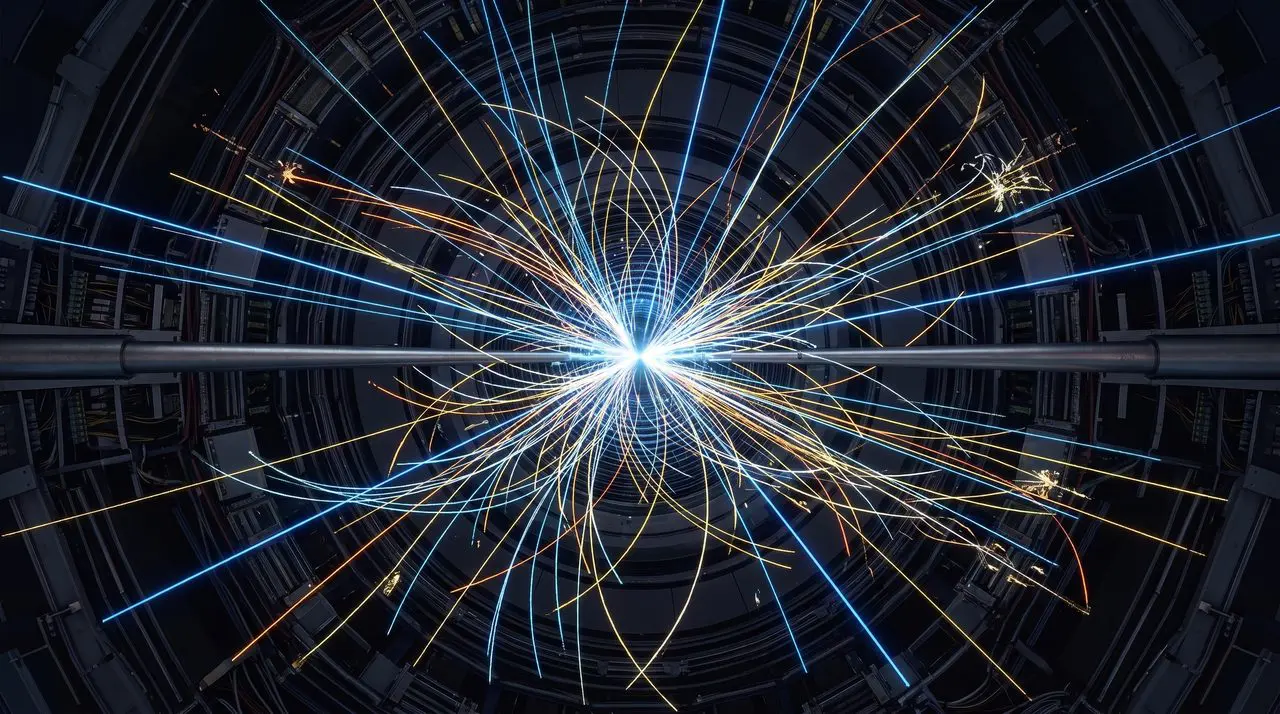
Scientists at the National Centre for Nuclear Research are leading a study using the Large Hadron Collider to investigate neutrino interactions, a pursuit that could break an impasse in research. The research focuses on “trident” neutrino scattering, a rare event where neutrinos produce two charged leptons simultaneously, and aims to better understand calculations that require approximations with significant uncertainties. Understanding these interactions will not only improve models of cosmic ray collisions but also refine the observation of neutrinos arriving from distant galaxies.
LHC Enables Search for Rare Trident Neutrino Scattering
This measurement, detailed in Physical Review D, builds upon initial neutrino observations made at the LHC as part of the FASER experimental collaboration, initiated by dr. Sebastian Trojanowski of the NCBJ’s Theoretical Physics Division. The research focuses on a specific challenge within strong interactions; standard calculations require approximations with significant uncertainties.
Understanding these rare neutrino interactions will allow for more precise modeling of cosmic ray collisions occurring in Earth’s atmosphere and refine the ability to observe neutrinos originating from outside our galaxy. The LHC’s capacity to generate these events offers a unique opportunity to probe beyond the Standard Model of particle physics, a goal driving the FASER𝜈2 detector upgrade currently under proposal.
Dr. Trojanowski explains the inherent difficulty in detecting these events: “Weak neutrino interactions are both their curse and their blessing. Attempting to detect them can drive us crazy, for example, we expect that only one in a billion neutrinos flying through the detector will leave any trace in it.” Typically, neutrino interactions result in the creation of a single charged lepton, such as an electron or muon, or produce no charged leptons at all.
However, the trident process involves the simultaneous production of two charged leptons, a combination of both charged and neutral currents that allows researchers to analyze their interference, Large Hadron Collider says. This interference provides a pathway to investigate potential “new physics” beyond the established Standard Model, as noted by dr. Toni Mäkelä, who conducted postdoctoral research at NCBJ before continuing at the University of California, Irvine, USA.
Previous attempts to observe trident neutrino scattering, recorded over 20 years ago, have faced scrutiny due to the difficulty in distinguishing the signal from background processes that can mimic the effect. The current research meticulously re-examines these background processes, presenting a measurement strategy for the proposed FASER𝜈2 detector designed to overcome these challenges. The team’s calculations suggest that, with the upgraded detector, a statistically significant discovery should be possible in the coming years.
The theoretical groundwork for this research extends back six decades, with Professor Wiesław Czyż of the IFJ PAN and the Jagiellonian University in Kraków authoring one of the first papers speculating on trident neutrino scattering “almost exactly 60 years ago,” according to dr. The current collaborative effort reflects a sustained international interest in this elusive phenomenon, with the team actively seeking contributions from leading research centers in Europe and the United States, according to Large Hadron Collider. “We have been waiting for quite a long time.
We invited current industry leaders from recognised centres in Europe and the USA to collaborate on this project. Their enthusiasm reassured us that finally this measurement could be successful.” The research, co-financed by the National Science Centre through the SONATA BIS programme, highlights the potential of the LHC not only as a high-energy collider but also as a source of neutrinos for dedicated studies.
The detailed results of the work are available in the publication Discovering neutrino tridents at the Large Hadron Collider, authored by W. Altmannshofer, T. Mäkelä, S Sarkar, S Trojanowski, K. Xie, and B. Zhou. This pursuit of rare neutrino interactions promises to provide new understanding of the fundamental forces governing the universe and refine our understanding of the cosmos, bridging the gap between terrestrial experiments and astronomical observations.
Weak neutrino interactions are both their curse and their blessing. Attempting to detect them can drive us crazy, for example, we expect that only one in a billion neutrinos flying through the detector will leave any trace in it.
Source: https://ncbj.gov.pl/en/aktualnosci/lhc-will-help-break-impasse-rare-neutrino-scattering-research



See today’s quantum computing news on Quantum Zeitgeist for the latest breakthroughs in qubits, hardware, algorithms, and industry deals.