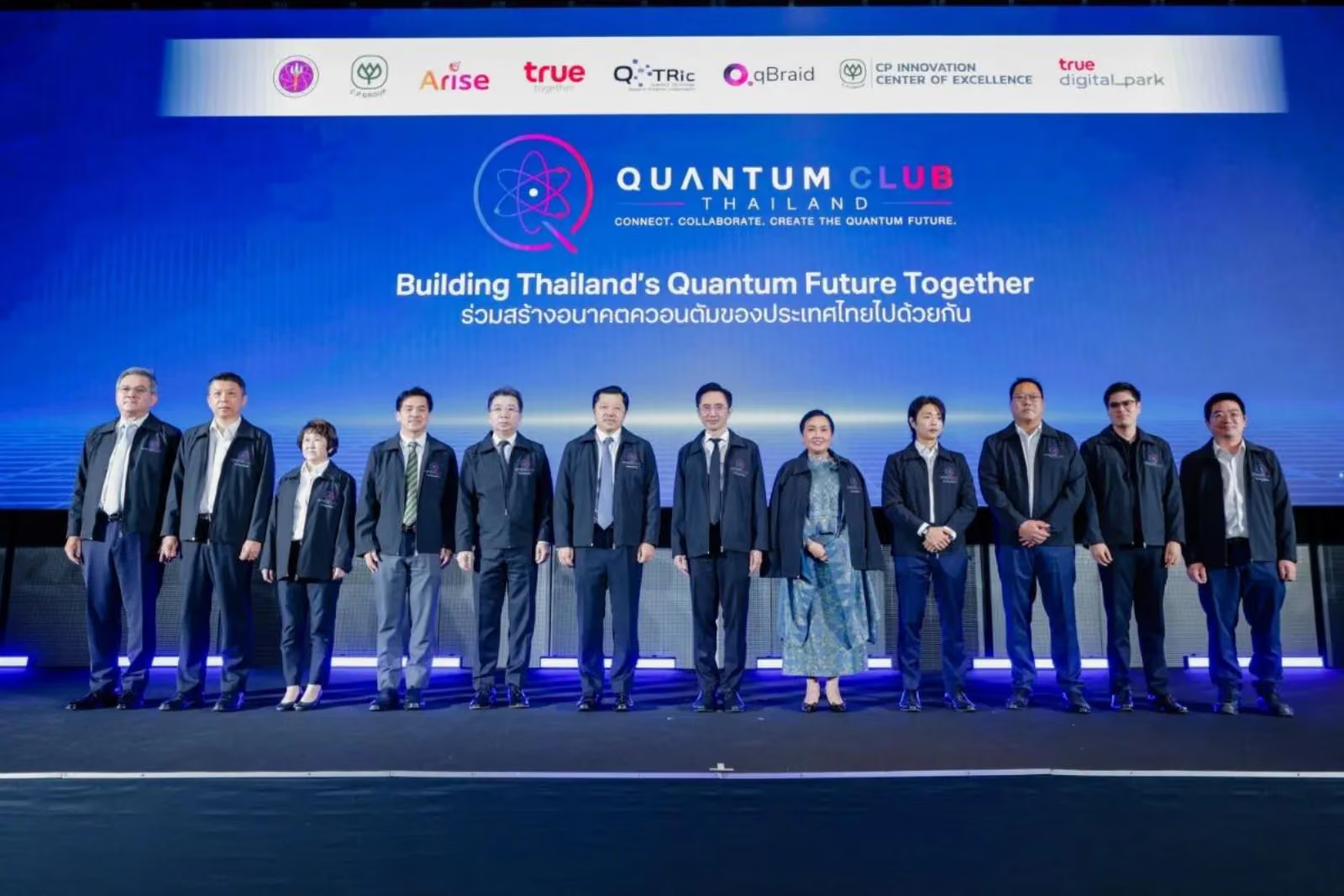
Thailand’s Deputy Prime Minister and Charoen Pokphand Group’s Senior Vice Chairman publicly launched Quantum Club Thailand on August 3, 2026, demonstrating commitment to the nation’s recently approved National Quantum Economy Strategy. Just six weeks after policy approval, the platform offers researchers, companies, and students access to over 26 quantum systems worldwide via qBraid’s cloud-based platform.
The country is prioritizing skill-building and practical applications over immediate hardware investment, a strategy the Deputy Prime Minister described as focusing on accelerating “talent development in parallel with the transition from research towards real-world industry applications.” True Corporation’s Chief Digital Officer, Ekaraj Panjavinin, stated that Thailand.
CP Group and qBraid Enable Thailand’s Cloud-First Quantum Access
Thailand quickly translated national quantum policy into a functioning platform, granting researchers access to over 26 commercially available quantum systems worldwide on August 3, 2026. The launch of Quantum Club Thailand at True Digital Park in Bangkok formalized a collaboration between the Ministry of Higher Education, Science, Research and Innovation, Charoen Pokphand Group (CP Group), Arise, True, the Quantum Technology Research Initiative Consortium (QTRiC), and qBraid. This rapid implementation occurred six weeks after the approval of Thailand’s National Quantum Economy Strategy on June 24, demonstrating a commitment to practical application over prolonged hardware development.
CP Group’s involvement is central to this accelerated approach; Suphachai Chearavanont, Senior Vice Chairman of CP Group and Chairman of True Corporation, emphasized the need to move beyond simply being a consumer of technology. “Quantum technology will be one of the key technologies transforming the world and many industries in the future. If Thailand seeks to build long-term competitiveness, the country should not merely be a buyer or user of technology, but must begin today to jointly develop its own knowledge, talent, and innovation,” he stated at the launch event.
True Corporation envisions Quantum Club Thailand as a platform connecting research with business challenges, focusing on skills development, applied research, and fostering Thai deep-tech start-ups. The qBraid platform provides access to hardware from companies including IonQ, QuEra, Rigetti, Pasqal, IQM, and AQT, alongside NVIDIA GPU clusters for hybrid quantum-AI workloads.
The cloud-first strategy addresses the significant costs and logistical challenges of owning and maintaining quantum computers, which can require investments exceeding tens of millions of dollars and quickly become outdated. Instead, qBraid’s software streamlines access to a fragmented quantum provider landscape; programs written using the qBraid SDK are designed to run on any gate-based device on the platform. “The qBraid SDK gives users open-source tools to focus on what they want to build instead of which framework they need to master,” explained Harshit Gupta of qBraid’s Quantum Software team.
This portability extends to education, allowing students to develop transferable skills and universities to benchmark multiple machines without managing numerous contracts. The launch included a live demonstration showcasing the platform’s capabilities; the team used qBraid Lab to analyze real network data from Bangkok’s Watthana district, mapping cell sites onto QuEra’s 256-atom Aquila processor.
Suphachai Chearavanont articulated the long-term vision, stating, “Our long-term objective is to position Thailand as ASEAN’s quantum hub.” This initiative builds on existing collaborations, including a June 17 memorandum of understanding between True Corporation, QTRiC, and qBraid focused on quantum-enabled industry applications and secure infrastructure, and three flagship programs: Quantum Academy Thailand, a Quantum Industry Lab, and a Quantum Innovation Challenge.
Quantum technology will be one of the key technologies transforming the world and many industries in the future. If Thailand seeks to build long-term competitiveness, the country should not merely be a buyer or user of technology, but must begin today to jointly develop its own knowledge, talent, and innovation.
Ekaraj Panjavinin, Chief Digital Officer at True Corporation
Quantum Club Thailand: National Strategy Pillars and Initial Programs
The country’s four-pillar National Quantum Economy Strategy, covering industrial applications, cybersecurity, workforce development, and eventual domestic hardware capability, guided the creation of Quantum Club Thailand, and the speed of implementation is noteworthy. Yodchanan Wongsawat stated this during the launch event. Beyond hardware access, qBraid’s software streamlines the process of working with diverse quantum providers.
Our long-term objective is to position Thailand as ASEAN’s quantum hub.
Suphachai Chearavanont, Senior Vice Chairman of CP Group and Chairman of True Corporation
qBraid SDK Facilitates Portable Quantum Skill Development
This focus on application is directly enabled by the qBraid SDK, a software development kit central to the platform’s functionality and Thailand’s broader quantum strategy. The SDK allows Quantum Club members to bypass the complexities of vendor-specific tools and concentrate on algorithm development rather than infrastructure management. Built-in transpilation and circuit compression further optimize resource utilization, allowing researchers to maximize the performance of each system.
This approach avoids being locked into a single technology or vendor, preserving Thailand’s options as the quantum landscape evolves. The benefits extend beyond immediate access and flexibility; the qBraid SDK is reshaping how quantum skills are cultivated. Students learn transferable skills applicable across the industry, rather than being limited to a single vendor’s toolchain.
Universities can benchmark diverse machines without the administrative burden of managing numerous contracts, and Thai start-ups gain a wider range of systems for testing and scaling their ideas. This same notebook, accessible through any web browser, allows a student in Thailand to replicate the experiment on the same hardware, underscoring the platform’s commitment to democratizing quantum access and fostering a robust quantum workforce.
The qBraid SDK gives users open-source tools to focus on what they want to build instead of which framework they need to master.
Harshit Gupta of qBraid’s Quantum Software team




See today’s quantum computing news on Quantum Zeitgeist for the latest breakthroughs in qubits, hardware, algorithms, and industry deals.