
MIT physicists are directly observing how electrons rebuild phases within the rare-earth material erbium tritelluride, revealing a surprising parallel to everyday phenomena like ice and water coexisting in a glass. The research team used “pump” and “probe” laser beams to watch photoemitted electrons assemble and reassemble into distinct, overlapping patterns.
This ability to study multiple phases, as reported in Nature Physics, could illuminate the emergence of superconductivity and aid in the design of advanced quantum devices. “People believe the cornerstone of replacing silicon lies in quantum materials that have multiple coexisting phases,” says co-author Alfred Zong PhD ’20, now an assistant professor at Stanford University.
Erbium Tritelluride Reveals Coexisting Charge Density Wave Phases
Researchers led by Nuh Gedik at MIT detailed observations of this behavior, reporting their findings in Nature Physics and offering new insight into the emergence of complex quantum phenomena. The team’s work centers on understanding how these coexisting phases form and interact, a question central to developing materials with advanced electronic properties. The investigation focused on erbium tritelluride, a rare-earth material synthesized into atomically thin sheets.
Cooling the material to -8 degrees Celsius initiates the formation of a charge density wave (CDW), where electrons arrange themselves into a wave-like pattern. Further cooling to -113 degrees Celsius introduces a second CDW, oriented perpendicularly to the first, creating an intricate, checkerboard-like arrangement of electron phases.
To observe this transition, the researchers employed a sophisticated “pump” and “probe” laser technique, using the laser pulses to disrupt and then monitor the re-establishment of these phases. “This is how we ‘shake’ and then ‘listen’ to the system,” explains Gedik, detailing the method used to observe the electron behavior. Crucially, the team discovered that the two phases emerge through fundamentally different mechanisms. The dominant phase reforms uniformly, aligning with established theories of second-order phase transitions, similar to a magnet gradually losing its magnetism when heated.
However, the subdominant phase exhibited unexpected behavior; electrons reorganized first in isolated pockets that then expanded, mirroring the crystallization of water into ice. “The mechanism responsible for the emergence of this second phase has long been debated, and our approach provides a powerful new way to uncover the hidden physics behind phase transitions in quantum materials,” Gedik states.
This first-order transition, where the phase appears abruptly in localized regions, challenges conventional understanding of CDW formation. Understanding how these phases interact is vital, as similar complex arrangements of electron behavior are found in high-temperature superconductors and other materials with potentially revolutionary applications. As Yifan Su, the first author, explains, “The power of CDWs is that they are a much simpler form of matter compared to superconductivity. They offer a playground for fundamental understanding,” suggesting that insights gained from studying these simpler systems can be applied to unlock the secrets of more complex quantum materials.
The mechanism responsible for the emergence of this second phase has long been debated, and our approach provides a powerful new way to uncover the hidden physics behind phase transitions in quantum materials.
Nuh Gedik, the Donner Professor of Physics at MIT
“Pump-Probe” Laser Technique Visualizes Phase Transitions
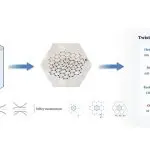
Researchers directly visualized the emergence of competing electron phases within erbium tritelluride, a rare-earth material exhibiting complex quantum behavior. This method allowed for a time-resolved observation of phase transitions, revealing unexpected differences in how each phase forms. An illustration of the experimental concept shows uniform blue stripes representing the dominant order, contrasted by subtle red stripe patches indicating the subdominant order phase, with red and purple rays denoting the laser beams used in the experiment.
The experimental setup involved cooling atomically thin samples of erbium tritelluride to extremely low temperatures, around -230 degrees Celsius, where two charge density wave (CDW) phases emerge. These CDW phases represent organized patterns of electron density, akin to waves rippling through a material. The team then disrupted these patterns with a powerful laser pulse, effectively “shaking” the system, before using a second laser pulse to monitor the recovery of the electron phases.
By analyzing the energy and momentum of the electrons ejected by the second pulse, they were able to capture snapshots of the phase transitions as they occurred. “One of the biggest questions in physics is why some materials host multiple phases while others do not, and when multiple phases do exist, how do they interact? Do they reinforce one another, compete, or coexist independently?” Gedik adds, suggesting the insights gained from studying these coexisting phases could be applied to more complex materials exhibiting superconductivity and magnetism.
When the material is further cooled to -113 degrees Celsius, a second, “subdominant” charge density wave emerges, perpendicular to the first, creating a checkerboard of coexisting electronic phases.
Dominant Phase Emerges Uniformly, Subdominant Phase Crystallizes
This gradual re-establishment mirrors the smooth transition seen when a liquid transforms into a vapor. “We see the destroying of these phases, and then if we wait long enough, they come back,” explained Nuh Gedik, the Donner Professor of Physics at MIT, detailing the observation of phase recovery. This first-order transition, where the phase emerges through localized nucleation and growth, had not been previously observed in this context.
This distinction in reformation mechanisms is significant because it addresses a long-standing question in condensed matter physics. Zong added, “Our experiment provides a clear way to study these multiple phases,” emphasizing the clarity offered by their method. Gedik concluded that the lessons learned from this material could be instrumental in designing future quantum devices.
Understanding CDWs Aids Exploration of Superconductivity
Erbium tritelluride, a relatively simple quantum material, served as the focal point for a recent investigation into the emergence of coexisting electronic phases, offering insights that extend far beyond its own properties. This detailed observation provides a crucial stepping stone toward understanding the more complex phenomenon of superconductivity. The team’s approach involved disrupting the established CDW patterns within erbium tritelluride and then meticulously tracking their reformation.
They discovered that the dominant charge density wave consistently re-established itself uniformly, mirroring the expected behavior of a liquid transitioning to a vapor. “And depending on how you hit them, the two phases respond differently,” explained Gedik, highlighting the differing reformation dynamics. The researchers believe this detailed understanding of phase behavior in a simpler system like erbium tritelluride will unlock pathways to controlling more complex materials, suggesting a potential link between the interaction of these coexisting phases and the emergence of exotic properties like high-temperature superconductivity.
One of the biggest questions in physics is why some materials host multiple phases while others do not. And when multiple phases do exist, how do they interact? Do they reinforce one another, compete, or coexist independently?
Nuh Gedik, the Donner Professor of Physics at MIT
Just like superconductivty, charge density waves are a collective phenomena where electrons move together in certain ways.


See today’s quantum computing news on Quantum Zeitgeist for the latest breakthroughs in qubits, hardware, algorithms, and industry deals.