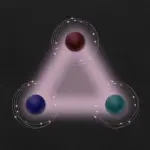
Researchers at the Massachusetts Institute of Technology have identified an unexpected quantum phase of matter within bilayer semiconductor quantum wells: an electronic quasicrystal formed by Wigner crystals with a striking 30° twist. This state, discovered using neural-network variational Monte Carlo calculations, challenges classical predictions by emerging from a regime dominated by quantum fluctuations.
The work demonstrates that zero-point motion stabilizes this unusual structure, establishing a route to spontaneous moiré physics driven by many-body quantum effects. The team’s analytical framework reveals how these fluctuations reshape energy levels, selecting the quasicrystalline ground state over the classically favored honeycomb arrangement.
Zero-Point Motion Stabilizes Bilayer Electronic Quasicrystal
Quantum fluctuations fundamentally reshape the energetic landscape of bilayer electron systems, selecting a 30° twisted configuration as the ground state over a broad range of parameters. Unlike classical bilayer arrangements of point charges which favor crystalline structures like a honeycomb, this newly identified electronic quasicrystal emerges when quantum fluctuations dominate, defying conventional expectations. The work demonstrates that this stability originates from the zero-point motion of electrons, establishing the quasicrystal as a genuinely quantum phase of matter.
This analytical framework quantifies the zero-point energy of collective fluctuations around potential bilayer configurations, revealing how these fluctuations destabilize the classically favored honeycomb structure. Researchers found that sufficiently strong zero-point motion stabilizes twisted electronic structures, a result confirmed by comparison with unbiased neural-network variational Monte Carlo (NN-VMC) simulations.
The resulting phase diagram aligns with previous NN-VMC results for wide quantum wells, validating the robustness of these conclusions. “We identify a broad region of parameter space in which the ground state is the electron quasicrystal, and elucidate its quantum mechanical origin,” the paper states. The competition between energy and entropy gives rise to a rich variety of phases of matter as a function of temperature, but the electronic quasicrystal is unique. It has no classical analogue and disappears as quantum fluctuations diminish.
This finding identifies zero-point motion as the key mechanism driving the formation of the electronic quasicrystal, a genuinely quantum phase of matter stabilized by the inherent uncertainty in electron positions. The analysis confirms that the 29.84° twist, an approximation of the quasicrystalline arrangement, minimizes total energy, solidifying its role as the true ground state.
Neural-Network Variational Monte Carlo Discovers 30° Twisted Phase
The emergence of a gapless neutral mode, a type of excitation known as an optical plasmon, within the quasicrystal further supports its stability. This mode exhibits linear behavior at low momentum, resembling a monolayer plasmon and indicating a divergent speed of sound as the system approaches a specific condition.
The presence of this optical plasmon contributes to the lowering of the zero-point energy and reinforces the preference for the twisted configuration. Previous neural-network variational Monte Carlo results for wide quantum wells corroborate the robustness of this finding, aligning the current analytical framework with prior computational observations.
Quantum Fluctuations Reshape Bilayer Energetic Landscape
Semiconductor quantum wells offer a versatile environment for exploring fundamental physics, and recent analysis reveals a surprising outcome for bilayer electron systems. This transition occurs even across a broad range of system parameters, indicating a robust quantum effect. The emergence of this quasicrystalline state challenges conventional understanding of bilayer electron gases, where classical models predict a preference for crystalline structures like the honeycomb arrangement.
Unlike these classical predictions, the observed quasicrystal arises when quantum fluctuations dominate, fundamentally changing the hierarchy of competing energy states. This work extends beyond simply identifying a new state of matter; it details the mechanism driving its formation.
Researchers computed zero-point energy corrections for various bilayer Wigner crystal configurations, revealing that sufficiently strong quantum fluctuations stabilize the 30° twist. Analysis of the classical energy landscape, as depicted in supporting figures, shows that the honeycomb structure is indeed favored in the absence of quantum effects. However, the inclusion of zero-point energy dramatically alters this picture, favoring the quasicrystalline arrangement. The team’s calculations show a clear energy difference between the honeycomb and twisted configurations, demonstrating the strength of the quantum stabilization.
The ability to create and control these quasicrystalline states could open new avenues for exploring exotic quantum phenomena and developing novel electronic devices. The stability of the quasicrystal, independent of parameter variations, suggests its potential for realization in a variety of experimental settings.
Classical vs Quantum Ground States in Bilayer Electron Systems
Confinement within semiconductor quantum wells introduces a new dimension to electron interactions, moving beyond simple metallic states and triangular Wigner crystals at low densities. This layered structure allows electrons to arrange in either monolayer or bilayer configurations, expanding the possibilities for ground state formations and creating a more complex interplay of competing energies. The recent discovery of an electronic quasicrystal within these bilayer systems challenges conventional understanding of how these states arise, demonstrating a departure from classically predicted arrangements.
These fluctuations fundamentally reshape the energetic landscape, favoring twisted arrangements that have no classical counterpart. “The electronic quasicrystal has no classical analogue; it is stabilized by zero-point motion and disappears in the classical limit,” the researchers state, highlighting the distinctly quantum nature of this newly observed state.
Wigner Crystal Formation in Confined Semiconductor Quantum Wells
Semiconductor quantum wells enable exploration of correlated electron phases, and recent calculations reveal a surprising ground state emerges when electrons form a bilayer Wigner crystal twisted by precisely 30 degrees. The work details how calculating corrections for zero-point energy, the lowest possible energy due to quantum fluctuations, reveals a reshaping of the energetic landscape that favors this unusual arrangement. Calculations show that quantum fluctuations do not simply perturb the classical picture, but fundamentally alter it, destabilizing the honeycomb structure typically expected in bilayer systems.
The analytical framework developed demonstrates that the energy difference between the honeycomb and quasicrystalline phases is directly linked to these zero-point energy corrections, with the quasicrystal exhibiting a lower total energy under specific conditions. Classical calculations, as shown in Figure S4, predict a different energy landscape, demonstrating the importance of quantum mechanics in stabilizing this quasicrystalline arrangement.
Analytical Framework Quantifies Zero-Point Energy Corrections
The research team found that the quantum correction to energy exhibits a weaker dependence on twist angle at larger angles, where interlayer coupling is minimal. The findings provide a physical explanation for observations made using neural-network variational Monte Carlo calculations and confirm the role of quantum effects in stabilizing this unusual state.
Interlayer Interaction and the 30° Quasicrystalline Arrangement
The interlayer interaction energy per particle exhibits a scaling proportional to one over the Wigner-Seitz radius, a key characteristic revealed by analysis of bilayer stackings. This scaling applies at fixed interlayer separation divided by the Wigner-Seitz radius, and is composed of intralayer terms minimized by triangular lattice geometry alongside an interlayer component. The research details how the Fourier components of charge density in each layer contribute to this interaction, with the interlayer term defined by a summation over reciprocal lattice vectors.
This shift leads to a negative contribution to the interlayer interaction for a honeycomb stacking configuration. The reciprocal lattice vector G governs this interaction, spanning the monolayer lattice shared by both layers. Calculations show that, to first order, the interlayer interaction is dominated by cross terms arising from relaxation wavevectors with magnitudes inversely proportional to the moiré length scale.
Further analysis of the phonon spectrum reveals that fully decoupled layers exhibit two copies of the monolayer Wigner crystal spectrum. However, the research highlights how relaxation affects the contribution of each reciprocal lattice vector to the interlayer interaction.
Specifically, the study found that the intralayer interaction contributes at a higher order in the layer displacement, but still shares the same scaling as the dominant cross terms. The work establishes that the mechanism underlying the angle dependence of the energy is rooted in these interlayer interactions and their response to layer relaxation, offering a detailed picture of how quantum effects shape the electronic structure of these bilayer systems.
Energy Minimization Reveals Twisted Ground State Stability
Semiconductor quantum wells enable exploration of electron behavior at low densities, where interactions between electrons and their kinetic energy compete to define the system’s state. For large values of the Wigner-Seitz radius, a measure of electron spacing, interactions dominate, leading to electron crystals. When the interlayer separation is large relative to the Wigner-Seitz radius, intralayer Coulomb energy prevails, causing electrons on each layer to form triangular Wigner crystals.
Mechanical stability dictates the allowed configurations, with twisted layers relaxing to honeycomb structures when interlayer interaction is strong. However, the study demonstrates that the 30° twist remains stable under these conditions, highlighting the importance of quantum effects in selecting this unusual ground state.
👉 More information
🗞 Quantum electron quasicrystal
✍️ Pierre-Antoine Graham, Filippo Gaggioli and Liang Fu
🧠 DOI: http://link.aps.org/doi/10.1103/zspr-vyv3




See today’s quantum computing news on Quantum Zeitgeist for the latest breakthroughs in qubits, hardware, algorithms, and industry deals.