Medical image segmentation frequently relies on deterministic methods, hindering adaptability to nuanced instructions and limiting the exploration of multiple interpretations. Yuan Lin, Murong Xu, and Marc Hölle, from Friedrich-Alexander-Universität Erlangen-Nürnberg, alongside Chinmay Prabhakar (University of Zurich) and colleagues, address this challenge in their new research, ProGiDiff. They present a novel framework leveraging pre-trained diffusion models , traditionally used for image generation , and adapting them for detailed medical image segmentation, overcoming the need for extensive training datasets. This work is significant because ProGiDiff not only enables natural language prompting for precise control over segmentation, extending beyond simple binary outputs, but also demonstrates impressive cross-modality transferability, successfully adapting to both CT and MR images with minimal retraining.
Medical image segmentation frequently relies on deterministic methods, hindering adaptability to nuanced instructions and limiting the exploration of multiple interpretations
Yuan Lin, Murong Xu, and Marc Hölle, from Friedrich-Alexander-Universität Erlangen-Nürnberg, alongside Chinmay Prabhakar (University of Zurich) and colleagues, address this challenge in their new research, ProGiDiff. They present a novel framework leveraging pre-trained diffusion models, traditionally used for image generation, and adapting them for detailed medical image segmentation, overcoming the need for extensive training datasets. This work is significant because ProGiDiff not only enables natural language prompting for precise control over segmentation, extending beyond simple binary outputs, but also demonstrates impressive cross-modality transferability, successfully adapting to both CT and MR images with minimal retraining. Researchers have identified limitations in existing image generation methods, noting they are primarily deterministic and poorly suited to natural language prompts, struggling to estimate multiple proposals, facilitate human interaction, and enable cross-modality adaptation. Recently, text-to-image diffusion models have demonstrated potential to address this gap; however, training them from scratch necessitates a large dataset, a significant limitation for medical imaging applications.
ProGiDiff framework for CT image segmentation offers promising results
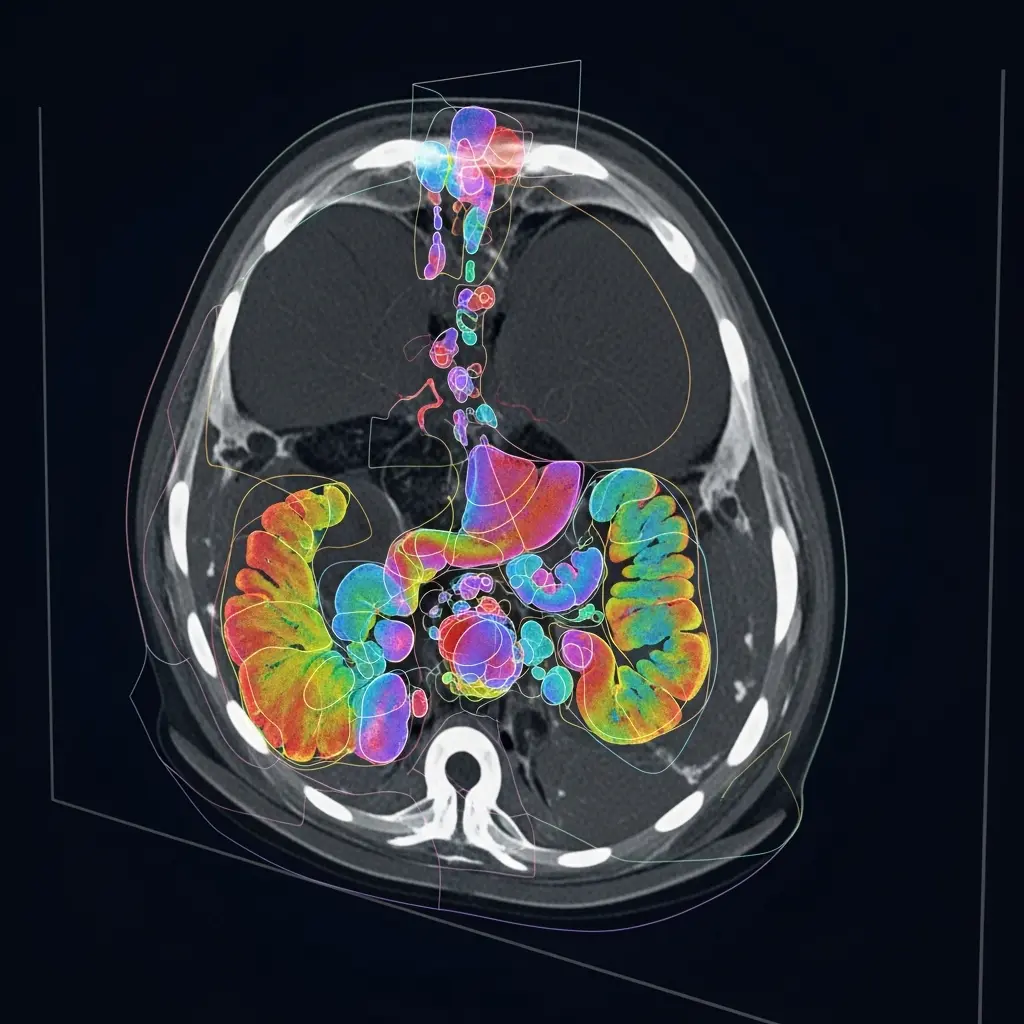
Scientists developed ProGiDiff, a novel framework that harnesses pre-trained image generation models for medical image segmentation, addressing key limitations of existing deterministic approaches. The study pioneers a ControlNet-style conditioning mechanism that incorporates a custom encoder for image-based conditioning, enabling precise steering of a pre-trained diffusion model toward the generation of accurate segmentation masks. This design naturally extends to multi-class segmentation by simply prompting the model with the target organ, allowing flexible and scalable anatomical analysis across different clinical scenarios. Experiments conducted on CT images demonstrate that ProGiDiff achieves strong performance compared to prior segmentation techniques, underscoring its potential utility within expert-in-the-loop workflows where multiple segmentation proposals can be iteratively refined and validated.
The conditioning mechanism was carefully engineered to support efficient transfer learning, employing low-rank, few-shot adaptation to enable MR image segmentation and demonstrating robust cross-modality generalization. The methodology centers on embedding semantic prior information into the diffusion process, providing language-driven interpretability and strengthening the alignment between textual prompts and visual medical representations. A custom encoder translates medical image features into representations compatible with the pre-trained diffusion backbone, effectively guiding the segmentation process without requiring retraining of the core model. This strategy enables multi-class segmentation while significantly reducing computational and data requirements.
Furthermore, the research introduces a low-rank adaptation strategy that fine-tunes only a small subset of model parameters, allowing rapid adaptation to new imaging modalities such as MRI. By transferring learned conditioning mechanisms rather than retraining full models, ProGiDiff minimizes dependence on large, modality-specific annotated datasets. Validation experiments on abdominal CT organ segmentation confirm competitive performance, while few-shot domain adaptation experiments on MR images further demonstrate the framework’s generalizability and its promise for broad clinical deployment.