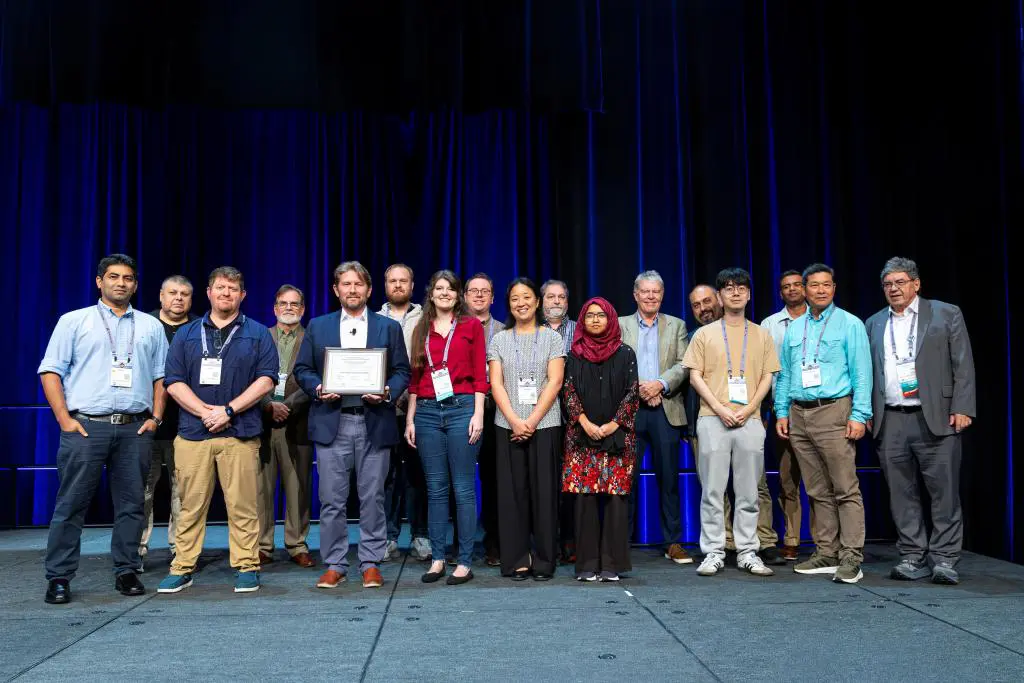
Travis Humble, director of the Department of Energy’s Quantum Science Center and an ORNL distinguished scientist, accepted the IEEE Quantum Technical Community Distinguished Award on September 17th at IEEE Quantum Week in Toronto. The award recognizes Oak Ridge National Laboratory’s unique collaborative approach, uniting government, industry, and academia to accelerate advancements in quantum materials, computing, networking, and sensing.
ORNL’s strength, according to ORNL Director Stephen Streiffer, “has always been rooted in bringing together exceptional people, capabilities and partners to pursue challenges that no single institution can solve alone.” These collaborations are actively pushing quantum technologies, including hybrid quantum-classical computing and quantum networking, toward practical applications.
ORNL’s Quantum Ecosystem Unites Sectors for Accelerated Discovery
The award specifically acknowledges ORNL’s success in uniting government, industry, and academic institutions, rather than celebrating a singular breakthrough in a specific quantum field, highlighting a deliberate strategy of collaborative ecosystem building. Decades of leadership across quantum materials, computing, networking, and sensing have positioned ORNL to connect diverse disciplines and institutions, creating a breadth of expertise important for tackling complex challenges.
This collaborative environment extends beyond simply bringing people together; it uses ORNL’s unique facilities and programs to address shared scientific hurdles. The Quantum Computing User Program, Quantum Computing User Forum, and Quantum Accelerated Internet Testbed all serve as platforms for researchers from various sectors to collaborate, while user facilities like the Spallation Neutron Source and High Flux Isotope Reactor provide powerful tools for investigating quantum materials at a fundamental level.
The Oak Ridge Leadership Computing Facility further enhances this connection by connecting high-performance computing with emerging quantum processors, enabling exploration of hybrid quantum-classical approaches to scientific computing. “By bringing together leadership-class computing, emerging quantum technologies and expertise from across ORNL and our partners, we are helping define how hybrid quantum-HPC systems can tackle scientific challenges that neither technology could address as effectively alone,” said Gina Tourassi, associate laboratory director for ORNL’s Computing and Computational Sciences Directorate.
The impact of this interconnectedness is evident in advances across the quantum landscape, including research into quantum spin liquids and application benchmarks designed to evaluate the performance of quantum computers in chemistry and materials science.
ORNL’s commitment to shared capabilities is a long-standing tradition, exemplified by the accessibility of its neutron sources and materials science facilities, which allow researchers to synthesize, characterize, and manipulate materials at the atomic scale. “Quantum information science sits at the intersection of many disciplines, and progress depends on bringing those communities together,” said Nicholas Peters, head of ORNL’s Quantum Information Science Section. ORNL’s influence extends beyond fundamental research, actively working to translate quantum technologies from discovery into practical deployment.
The laboratory pioneered hybrid quantum-high-performance computing and has advanced quantum communications over deployed fiber networks demonstrating a commitment to real-world applications. A long-standing partnership with Chattanooga-based telecommunications provider EPB has been particularly fruitful, culminating in the launch of the first commercial quantum network in the United States built upon technological foundations established through ORNL’s networking demonstrations.
This collaboration continues, with ongoing efforts to explore quantum networking technologies for critical infrastructure protection. “ORNL has built an environment where materials scientists, physicists, computer scientists, engineers and industry partners can combine their expertise, test new ideas using unique capabilities and carry promising technologies forward. That ability to connect people and disciplines is central to how we approach quantum research,” stated a laboratory representative.
The IEEE award recognizes this comprehensive contribution, acknowledging that ORNL’s strength lies not in a single technology or discovery, but in a collaborative ecosystem that consistently enables advancements across multiple quantum disciplines. This sustained approach has strengthened the nation’s capacity to transform quantum science into tangible impact, positioning ORNL as a central hub for innovation and collaboration in the rapidly evolving field of quantum information science. The laboratory’s infrastructure, multidisciplinary communities, and sustained partnerships work in concert to accelerate discovery and move scientific advances toward real-world application, solidifying its role as a leader in the quantum revolution.
By bringing together leadership-class computing, emerging quantum technologies and expertise from across ORNL and our partners, we are helping define how hybrid quantum-HPC systems can tackle scientific challenges that neither technology could address as effectively alone.
Gina Tourassi, associate laboratory director for ORNL’s Computing and Computational Sciences Directorate




See today’s quantum computing news on Quantum Zeitgeist for the latest breakthroughs in qubits, hardware, algorithms, and industry deals.