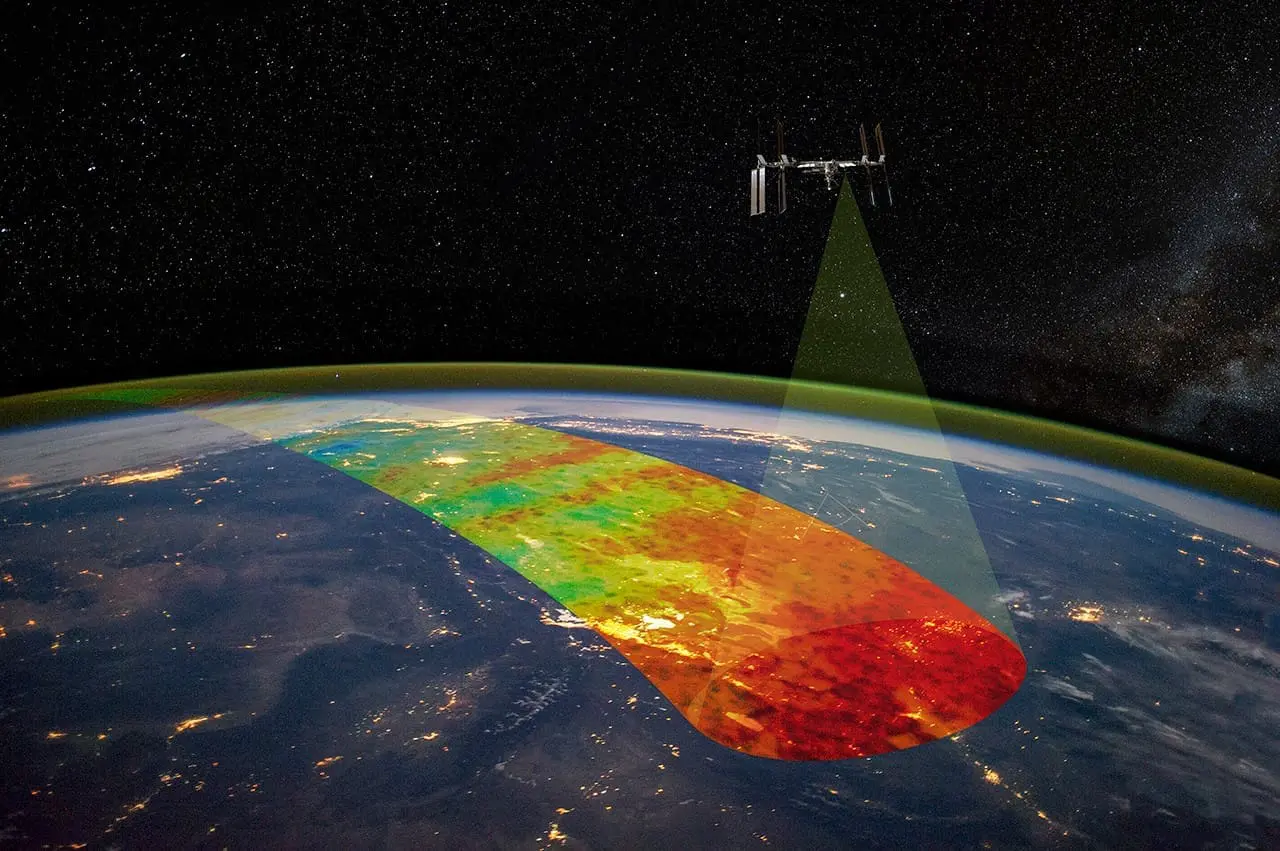
Funded by NASA’s Heliophysics Division, the Atmospheric Waves Experiment (AWE) has altered our understanding of how Earth’s atmosphere interacts with space. Installed on the International Space Station, AWE spent 30 months capturing over 80 million images of airglow, bands of green and red light, to study atmospheric gravity waves, ripples caused by events ranging from tornadoes to hurricanes. These waves, previously thought contained within the atmosphere, were revealed to propagate upwards, impacting space weather and potentially disrupting satellites and communications. “The AWE mission has proven that our atmosphere is not a ceiling, but a living, breathing ocean in the sky,” said Joe Westlake, director of NASA’s Heliophysics Division.
AWE Mission: Mapping Atmospheric Gravity Waves from ISS
Funded by NASA’s Heliophysics Division, AWE investigated how atmospheric gravity waves propagate upward to space and contribute to space weather, conditions in space that can disrupt satellites, as well as navigation and communications signals. During AWE’s 30-month residency on the station, the instrument captured four images every second, totaling more than 80 million nighttime images, when airglow is visible. It observed atmospheric gravity waves from numerous extreme weather events, including a tornado outbreak across the central U.S. in May and Hurricane Helene impacting the gulf coast of Florida in September. On May 26, when AWE viewed atmospheric gravity waves generated by a thunderstorm in north Texas, it found they were smaller and more irregular, with a notable asymmetry from north to south, compared to waves created by storms in the same area earlier that month.
These events revealed variations in the types of atmospheric gravity waves created by different kinds of storms. Understanding variations in the density of plasma, electrically charged gas, in Earth’s upper atmosphere is crucial because these variations can disrupt radio signals traveling between satellites and the ground, and from satellite to satellite, degrading the accuracy and reliability of systems used for navigation, timing, and communications. A recent study using AWE measurements also revealed that gravity waves with the greatest influence on the upper atmosphere have small horizontal wavelengths, ranging from 30 to 300 kilometers, a range AWE was specifically designed to measure.
Airglow Observations Reveal Storm-Driven Upper Atmosphere Variations
Following years of theoretical modeling, the Atmospheric Waves Experiment (AWE) has delivered observational evidence linking terrestrial weather events to disturbances high above Earth, altering understanding of the atmosphere’s upper reaches. Before AWE, atmospheric gravity waves, ripples generated by powerful forces like major storms, were largely inferred from indirect measurements; now, detailed observations are reshaping models of space weather interactions. Funded by NASA’s Heliophysics Division, AWE utilized a unique method of tracking these waves through airglow, the faint emission of light in the upper atmosphere, capturing over 80 million nighttime images during its 30-month residency. AWE’s observations revealed that events once considered confined to the troposphere demonstrably propagate upwards, impacting the ionosphere and beyond.
The AWE mission has proven that our atmosphere is not a ceiling, but a living, breathing ocean in the sky.
Joe Westlake, director of NASA’s Heliophysics Division at NASA Headquarters
AWE Instrument Measures Gravity Wave Wavelengths (30-300km)
Utah State University researchers, led by principal investigator Ludger Scherliess, have refined understanding of atmospheric gravity waves through data collected by NASA’s Atmospheric Waves Experiment (AWE) instrument, which recently concluded its 30-month residency on the International Space Station. Beyond simply observing these waves, ripples caused by weather events and terrain, AWE specifically quantified their wavelengths, revealing that those with the greatest impact on the upper atmosphere fall within a narrow band of 30 to 300 kilometers. This focused measurement capability was a key design element of the instrument, enabling a more precise assessment of how these waves influence space weather. AWE’s data is valuable because variations in upper atmospheric density, caused by these gravity waves, can disrupt radio signals crucial for satellite navigation, timing, and communications. “Data from AWE will continue to be made public for both professional researchers and citizen scientists,” Scherliess said, ensuring ongoing analysis and discovery from the mission’s extensive dataset, now accessible through interactive visualizations on Utah State University’s website.
For the first time, we can see how a thunderstorm in the Midwest, a hurricane over Florida, or a wind gust over the Andes sends invisible ripples – atmospheric gravity waves – crashing into the edge of space like waves hitting a shoreline.
Joe Westlake, director of NASA’s Heliophysics Division at NASA Headquarters
Data Accessibility & Transition to CLARREO Pathfinder
This commitment to open science ensures the investment by the Heliophysics Division will continue to yield insights long after the instrument’s operational phase concluded on May 21. The transition from AWE isn’t a cessation of research, but rather a planned handover to the CLARREO Pathfinder mission. This new instrument will build upon AWE’s work by focusing on significantly more precise measurements of sunlight reflected from Earth and the Moon, aiming for accuracy five to ten times greater than current sensors. This exchange, facilitated by the International Space Station’s robotic arm Canadarm2, underscores the orbiting laboratory’s versatility in accommodating diverse scientific endeavors. Interactive visualizations of AWE’s observations are already available online, allowing users to explore atmospheric gravity waves from various perspectives. The AWE instrument itself will be deorbited aboard a SpaceX Dragon spacecraft, completing its lifecycle while its legacy endures through accessible data and the foundation it provides for CLARREO Pathfinder’s future observations.
We’ve seen atmospheric wave signatures associated with major terrestrial events, which provided a clear example of how intense weather systems can generate measurable upper-atmospheric responses.




See today’s quantum computing news on Quantum Zeitgeist for the latest breakthroughs in qubits, hardware, algorithms, and industry deals.