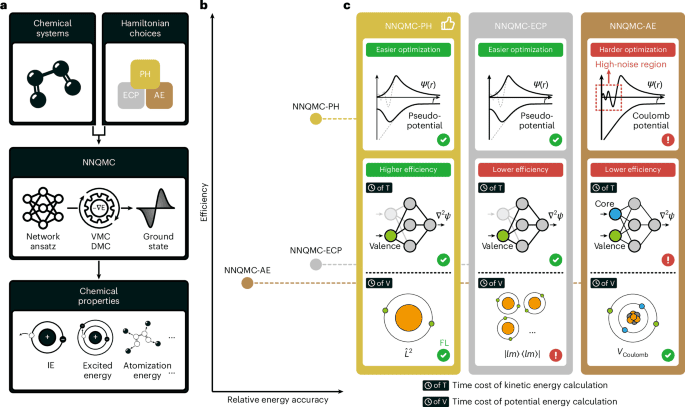
Researchers have expanded the reach of neural network-based quantum Monte Carlo (NNQMC) calculations to significantly larger and more complex systems by incorporating local pseudopotentials, a method that achieves better relative energy accuracy than all-electron NNQMC for challenging materials. Previously limited to smaller systems due to demanding computational requirements, NNQMC can now reliably model structures like the Fe4S4(SCH3)4 iron, sulfur cluster, opening new avenues for studying complex chemical processes. This improvement, according to the researchers, is made possible by characteristics inherent to NNQMC. The approach is more efficient than widely used semilocal counterparts by avoiding costly integration terms, demonstrating a powerful synergy between method and implementation.
Neural Network Quantum Monte Carlo with Local Pseudopotentials
The ability to accurately model complex quantum systems has taken a significant leap forward. Researchers have successfully integrated local pseudopotentials within NNQMC calculations, enabling the study of systems previously considered intractable. This advancement addresses a key limitation of NNQMC, which, until recently, has been mainly applied to small systems owing to demanding computation requirements. A team of researchers demonstrated this capability by accurately simulating the Fe4S4(SCH3)4 iron, sulfur cluster, a notoriously difficult system for computational chemistry. The core of this improvement lies in the implementation of local pseudopotentials, a technique designed to simplify calculations by reducing the number of electrons explicitly treated in the NNQMC framework.
Surprisingly, this simplification did not compromise accuracy; in fact, the researchers found that using local pseudopotentials achieves better relative energy accuracy than all-electron NNQMC calculations for complex systems. This result stems from characteristics inherent to NNQMC, allowing the method to effectively represent the physics even with fewer electrons directly accounted for. The team’s work builds on existing methods like valence quantum Monte Carlo, which has previously utilized ab initio effective core potentials, but pushes the boundaries of scale and accuracy through the neural network approach. Beyond improved accuracy, this new framework offers substantial efficiency gains. Our implementation of NNQMC with the PH approach in the JaQMC repository is available via GitHub at https://github.com/bytedance/jaqmc, and the specific version code is available via Zenodo, facilitating further research and development within the quantum computational community. Data supporting the findings are also available on Zenodo, ensuring transparency and reproducibility.
NNQMC Efficiency Gains via Pseudopotential Incorporation
This new framework doesn’t simply offer incremental improvements; it fundamentally alters the efficiency of NNQMC. One might anticipate that fewer electrons would diminish accuracy, but the unique characteristics of NNQMC allow it to maintain, and even improve, precision with this approach. The key to this efficiency lies in how the method handles mathematical complexities. By avoiding costly integration terms, the new approach sidesteps a major bottleneck present in traditional NNQMC and semilocal methods. This isn’t merely about speed; it’s about a fundamental shift in computational cost, making previously intractable problems solvable. This advancement has already been demonstrated with the successful modeling of the Fe4S4(SCH3)4 iron, sulfur cluster, a complex system that was beyond the reliable reach of standard NNQMC techniques. The implications extend beyond specific molecular systems.
The researchers emphasize that the synergy between NNQMC and local pseudopotentials substantially expands the scope of accurate ab initio calculations, opening doors to more detailed investigations of materials science, chemistry, and potentially even drug discovery. Data supporting these findings are openly available, ensuring transparency and reproducibility for the wider scientific community. The implementation of NNQMC with the pseudopotential approach is available via JaQMC on GitHub, further promoting collaboration and innovation in the field.
The team has successfully integrated local pseudopotentials into the NNQMC framework, dramatically expanding the scale of systems amenable to accurate modeling. This leap in scale is not simply a matter of increased computing power; it’s a result of a refined computational strategy. However, the results demonstrate the opposite. Our implementation of NNQMC with the PH approach in the JaQMC repository is available via GitHub, and the specific version code is available via Zenodo, underscore their commitment to transparency and reproducibility. Further validation of the method’s versatility comes from its successful application to phosphorus- and chlorine-containing clusters, as well as trimethylsilanes.
Application to Iron, Sulfur Clusters and System Generalizability
The ability to accurately model complex chemical systems is fundamental to advances in materials science, drug discovery, and catalysis; recent work demonstrates a significant expansion in the scale of systems amenable to detailed quantum mechanical study. This achievement highlights a substantial leap in the size and complexity of systems that can be accurately modeled, opening new avenues for understanding the behavior of these crucial biological and industrial catalysts. The incorporation of local pseudopotentials not only improves computational efficiency but also yields surprisingly accurate results. This suggests that the unique characteristics inherent to NNQMC allow it to effectively leverage the benefits of pseudopotentials without sacrificing accuracy, a departure from traditional quantum chemistry methods where increased computational cost often correlates with improved precision. Testing across phosphorus-containing, chlorine-containing clusters, and trimethylsilanes (TMSs) confirms the method’s robustness and adaptability to diverse chemical environments.
This versatility is crucial for extending the reach of accurate ab initio calculations, those based on first principles without empirical parameters, to a wider range of materials and molecules. The researchers emphasize that their findings pave the way for more reliable predictions of material properties and chemical reaction mechanisms.




See today’s quantum computing news on Quantum Zeitgeist for the latest breakthroughs in qubits, hardware, algorithms, and industry deals.