
Ilana Wisby spent about six years as the founding chief executive of Oxford Quantum Circuits. Cambridge Innovation Capital says the company raised more than one hundred million dollars under her. She is now an entrepreneur in residence at the same firm.
She was the founding chief executive of Oxford Quantum Circuits, the Oxford spin-out that Peter Leek founded in 2017. Ilana Wisby held the job from the company’s earliest days until she stepped down in May 2024. Before OQC the United Kingdom had university research groups in superconducting circuits and, on the company’s own account, no company selling time on a machine.
Her training is in experimental physics rather than in management. She holds a PhD in quantum physics from Royal Holloway, University of London, and did much of the work at the National Physical Laboratory. OQC was built by someone who had worked on the devices at the bench rather than only read about them.
The Coaxmon was a bet that a different chip geometry would scale further. OQC built its qubits with a three-dimensional coaxial design rather than the flat planar layout most of its rivals use. The company’s claim was that bringing the control wiring in from below eases the crowding as chips grow.
Quantum as a service arrived before the machines were ready. OQC sold access over the cloud while its hardware was still early, so customers paid for time on a machine rather than for a machine. That model is now common across the sector.
She left OQC in May 2024 and by April 2025 was chief executive of Moth Quantum. The second company put her in the software and applications layer rather than in hardware, the other side of the industry from the machines she had built. Few people in the field have led a company on each side of that divide.
She is a public voice as well as an operator. Wisby speaks on British quantum strategy and on who gets into the field, and she now advises founders, boards and policymakers. That has made her one of the more visible figures in British deep tech.
- The founding chief executive of Oxford Quantum Circuits
- She spent much of her doctorate inside the national measurement lab
- From an Oxford spin-out to a company selling time on its machines
- The Coaxmon takes the wiring off the chip surface
- She stepped down from OQC and moved to the consumer side
- A public voice for British quantum, and for who gets into it
- The problems she took on are the ones the whole field is stuck on
- The founder and the physicist turned out to be the same person
- Frequently asked questions
The founding chief executive of Oxford Quantum Circuits
Ilana Wisby is a British experimental physicist who spent about six years as the founding chief executive of Oxford Quantum Circuits, the University of Oxford spin-out known as OQC. She took the company from Peter Leek’s laboratory design for a superconducting qubit to a business selling time on its own machines over the cloud. She stepped down from the post in May 2024.
Her training was in the laboratory rather than the boardroom. She holds a doctorate in experimental quantum physics from Royal Holloway, University of London. She carried out much of that research at the National Physical Laboratory in Teddington, on superconducting circuits of the same family her company went on to sell.
Under her leadership OQC raised more than one hundred million dollars across two funding rounds, according to Cambridge Innovation Capital, the firm that has since hired her. The same announcement says the company’s valuation rose fifty-five fold in that time. That money paid for the move from prototypes on a bench to machines a customer could book, which is the step where most hardware start-ups fail.
Since 10 July 2026 she has been an entrepreneur in residence at Cambridge Innovation Capital, where she says she is developing her next venture in deep technology. Between the two posts she was chief executive of Moth, a venture that aims to put quantum technology into products for media and entertainment, joining in April 2025 according to the company’s own announcement.
She spent much of her doctorate inside the national measurement lab
Ilana Wisby took a BSc in physics with a minor in music at Royal Holloway, University of London, an unusual combination noted in a Physics World profile of her. She stayed at Royal Holloway for a PhD in experimental quantum physics, working on the coupling between locally doped spin ensembles and superconducting quantum circuits.
A large part of that doctoral work was carried out away from the university bench. She spent much of her PhD as a student researcher at the National Physical Laboratory in Teddington, the United Kingdom’s national measurement institute, working on superconducting quantum systems.
She learned to fabricate and measure the devices herself
At the National Physical Laboratory she worked directly on the fabrication and measurement of superconducting devices. That is the daily practice of superconducting hardware, and it is a different skill from the theory taught in a lecture course.
Working at a national institute also put her early against the gap between a device that works on a bench and a product a customer can buy. Closing that gap became the central problem of the company she went on to found.
From an Oxford spin-out to a company selling time on its machines
Ilana Wisby became the founding chief executive of Oxford Quantum Circuits, known as OQC, a superconducting quantum computing company that emerged from research at the University of Oxford. She joined at the earliest stage and led the business through the move out of the university and into commercial operation.
Under her leadership, Cambridge Innovation Capital says OQC raised more than one hundred million dollars across its Series A and Series B rounds and increased its valuation fifty-five fold. That capital funded the move from laboratory prototypes toward machines that customers could actually use, a transition that defeats many hardware startups.
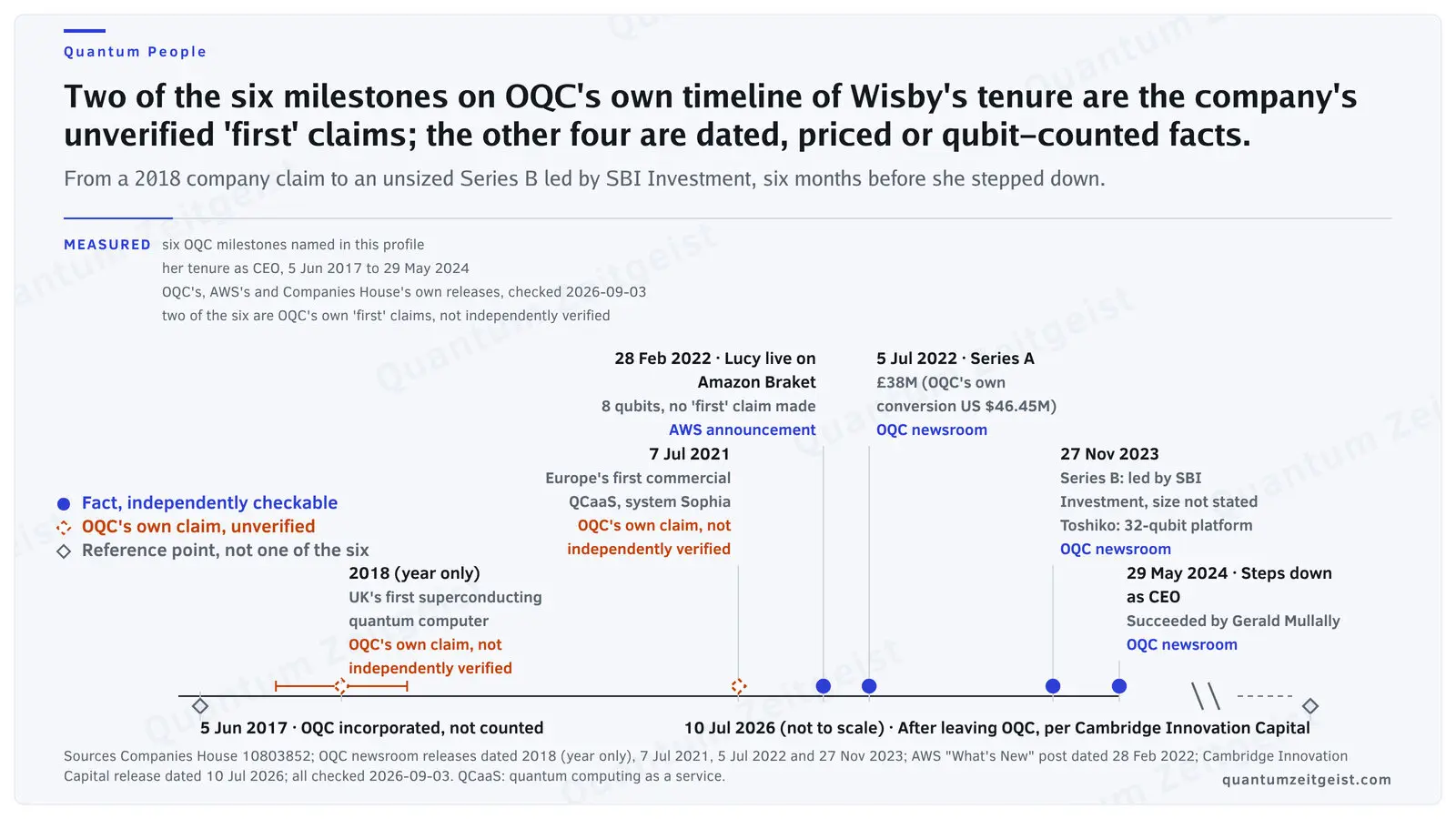
The company’s own newsroom gives the sequence. It says it built the United Kingdom’s first superconducting quantum computer in 2018. On 7 July 2021 it launched what it called Europe’s first commercially available quantum computing as a service, on a system named Sophia. On 28 February 2022 Amazon Web Services added an eight-qubit OQC machine named Lucy to its Braket cloud service. On 5 July 2022 the company announced the first close of a £38 million Series A led by Lansdowne Partners and the University of Tokyo Edge Capital Partners.
On 27 November 2023 OQC announced Toshiko, a 32-qubit platform, and said SBI Investment was leading an ongoing Series B round, which it called the United Kingdom’s largest ever Series B in quantum computing. The company did not state the size of that round, and it was still describing the raise as in progress when it announced her departure in May 2024. Toshiko machines then went into Equinix commercial data centres, including the Equinix TY11 site in Tokyo, which OQC described in a November 2024 post.
She held the job for about six years and left in May 2024
Building a quantum hardware company means solving problems in physics, engineering and operations at the same time, with the same small team. The device that works once for a graduate student has to work every day for a paying customer, and closing that distance is engineering work.
OQC announced her departure on 29 May 2024, and the Companies House register records her resignation as a director five days earlier. In the company’s release she said that “as we progress our Series B fundraise, it is the right moment for me to step down and embark on a new journey”. The chair, Peter George, thanked her for her dedication. The company’s own release counted her tenure at six years, while Cambridge Innovation Capital’s announcement two years later counted seven. Quantum Zeitgeist has not established which start date each was counting from, and this article follows the company’s own figure.
Two funding rounds in deep technology are a test of endurance as much as of vision. An investor in a quantum hardware company is asked to believe both that the physics will hold and that the revenue will arrive, at a point when neither has been shown. That is the argument every founder in this sector has to make, and OQC made it twice.

The Coaxmon takes the wiring off the chip surface
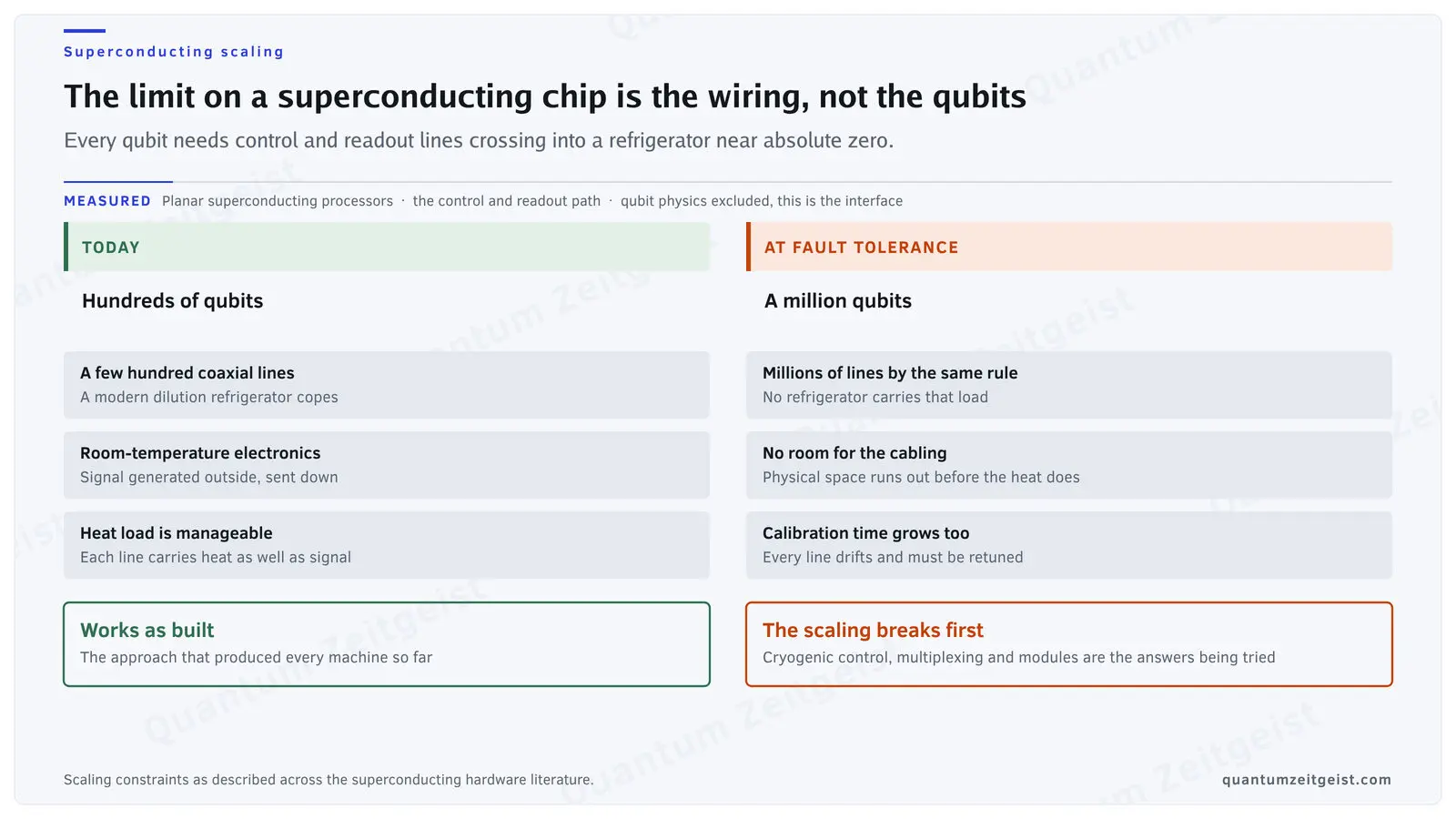
The technology at the heart of Oxford Quantum Circuits, built during Ilana Wisby’s tenure, is a proprietary superconducting qubit design the company calls the Coaxmon. It is a three-dimensional variant of the widely used transmon qubit, arranged so that control and readout wiring approach the qubit from a different plane than the qubit itself.
This geometry is meant to reduce the crowded in-plane wiring that limits conventional two-dimensional chips. By separating the control circuitry from the qubit plane, the design aims to make it easier to add more qubits without the wiring becoming unmanageable, a problem the whole field is wrestling with.
Customers rented machine time instead of buying a refrigerator
OQC paired this hardware with a quantum computing as a service model, letting customers run workloads on its machines remotely rather than buying and housing a quantum computer themselves. In February 2022 its eight-qubit machine Lucy became available through Amazon Braket, the cloud quantum service run by Amazon Web Services.
The choice put OQC in two businesses at once, as a manufacturer of machines and as a seller of time on them. It also meant the company was selling something years before its processors were good enough to do useful work.
She stepped down from OQC and moved to the consumer side
In May 2024 Ilana Wisby stepped down as chief executive of Oxford Quantum Circuits, having led the company for about six years. The board appointed Gerald Mullally as interim chief executive, and OQC now lists him as chief executive, and Wisby moved on to a new chapter in quantum technology.
She then moved to Moth, a consumer-facing quantum venture working on quantum-powered products for media, entertainment and the creative industries rather than for enterprise data centres. Moth announced on 8 April 2025 that she had joined as chief executive. By 1 June 2026 the company’s own releases named Sean Harpur in that role. Neither company has published a date for the change, so the length of her time there is not on the public record.
On 10 July 2026 Cambridge Innovation Capital announced that she had joined its deep tech team as an entrepreneur in residence, exploring real-world uses for quantum computing. The title places her at the beginning of a venture again rather than at the head of an existing one.
Moth sells to people rather than to data centres
Moth describes itself as a quantum-to-customer company, aiming to put quantum-enabled products directly in front of everyday users rather than research labs. That is an unusual destination in a sector whose customers are almost all research organisations and large enterprises.
OQC built the engine, and Moth is meant to build things that people can hold and use. The two roles together cover the distance from a refrigerator in a laboratory to a product on a shelf, and very few people in quantum have worked at both ends.
A public voice for British quantum, and for who gets into it
Beyond running companies, Ilana Wisby has become a prominent public advocate for the United Kingdom’s quantum sector and for deep technology more broadly. She speaks regularly at international conferences and has appeared in national and international media as a commentator on quantum technology.
Who gets into deep technology is the second subject she speaks on. Cambridge Innovation Capital’s announcement records her service on councils for the World Economic Forum and the UK Government, and as a board adviser to the National Physical Laboratory. A founder who has run a hardware company is heard differently on that subject in a heavily male industry.
Alongside the executive roles she works as a board advisor and counsel to founders, boards and policymakers across deep technology and adjacent fields. Advisory work of that kind is how a founder’s experience gets reused after the company is handed on.
The problems she took on are the ones the whole field is stuck on
Ilana Wisby belongs to the generation of leaders who took quantum computing out of the university and into the market. Scaling qubit counts, taming the wiring and selling machine time are not her problems alone, and every superconducting company is working on the same three.
The British cluster she helped build now spans hardware, software, error correction and applications, and several of its companies came out of the same university system. Her career runs through more of those threads than most, from superconducting machines to consumer products.
The founder and the physicist turned out to be the same person
Ilana Wisby matters because she showed that the person who trained on the experiment can also raise the money and run the company. Taking Oxford Quantum Circuits from a university spin-out to a funded business with paying customers made the case that quantum computing could be sold as well as studied. For anyone backing a hardware start-up, the lesson of her record is that the founder’s laboratory training was not the risk, and the years between a working device and a paying customer were.
The move to a consumer company took the same argument a step further, since a machine nobody outside a laboratory can use is not yet a product. She is building again as an entrepreneur in residence at Cambridge Innovation Capital. In the firm’s announcement she said she was “excited to start building again” and wanted “to build a company that turns world-class science into meaningful global impact”.
She also matters as a model and an advocate. A woman who led a frontier hardware company and now speaks for the sector broadens the picture of who builds this technology, and that picture has been narrow for a long time.
Frequently asked questions
Who is Ilana Wisby?
Is Ilana Wisby still the CEO of Oxford Quantum Circuits?
What is Wisby’s current role?
What did Ilana Wisby study?
What is Oxford Quantum Circuits known for?
What is the Coaxmon qubit?
How much funding did OQC raise under Ilana Wisby?
What is Moth Quantum?
Why is Ilana Wisby important to quantum computing?



See today’s quantum computing news on Quantum Zeitgeist for the latest breakthroughs in qubits, hardware, algorithms, and industry deals.