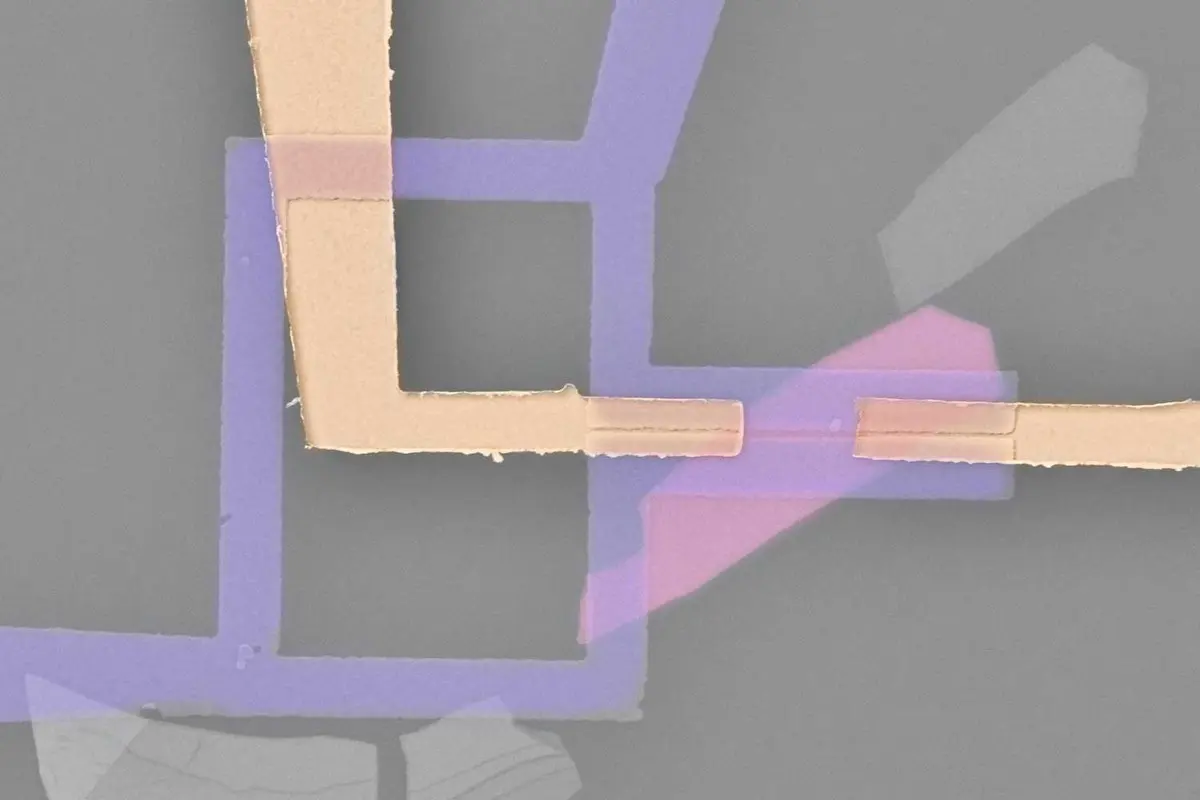
A Josephson junction combining a topological insulator and a superconductor, featuring a closed loop for magnetic phase control, is at the heart of new findings from the University of Cologne. Their work, published in Science Advances under the title “Tunneling spectroscopy of topological insulator Josephson junctions,” directly supports theoretical predictions about how superconductivity interacts with topological insulator surfaces. “It is super exciting to see our experimental results align so well with theoretical predictions,” adds Nikodem, offering encouragement for future quantum computing applications.
Topological Insulator Josephson Junctions Demonstrate Predicted Andreev States
The University of Cologne team observed highly transmissive Andreev states across a range of charge-carrier densities within a Josephson junction, a finding directly consistent with theoretical predictions for electrons residing on the surface of a topological insulator. These states, formed when electrons and holes interact at a superconducting junction, appeared as predicted during tunneling spectroscopy experiments probing the device’s quantum states while varying the phase difference between the two superconductors.
The observed behavior suggests that combining topological insulators with conventional superconductors could enable a pathway to topological superconductivity, a necessary step towards building more stable quantum bits. When a magnetic field was applied, the team found these Andreev states concentrated in specific regions of the junction, again aligning with established theoretical models.
This concentration of states is a key signature predicted by the model proposed by Liang Fu and Charles Kane in 2008, and further validated by numerical simulations conducted by Professor Fabian Hassler’s group at RWTH Aachen University. The agreement between experimental observations and these theoretical frameworks strengthens confidence in the potential of this material system for topological quantum computing. Professor Yoichi Ando of the University of Cologne emphasizes that understanding the interaction between superconductivity and the unique electronic properties of topological insulators is essential for evaluating their viability in quantum computing applications.
This work builds on a collaborative effort between experimental physicists at the University of Cologne and theoretical researchers at RWTH Aachen University, both members of the Matter and Light for Quantum Computing (ML4Q) Cluster of Excellence, established in 2019. This cluster unites researchers from the universities of Cologne, Aachen and Bonn, alongside Forschungszentrum Jülich, to accelerate fundamental research in quantum computing.
Ella Nikodem (M.Sc.) expressed enthusiasm about the alignment between experimental results and theoretical predictions, noting the encouraging implications for future quantum computing applications. While the observation of Andreev states is a significant step, a critical question remains: do these states exhibit the predicted closing and reopening of an energy gap? This transition is considered a hallmark of topological superconductivity, indicating the potential for quantum states protected from local disturbances, a key feature for robust qubits.
Currently, confirmation of this transition requires more precise measurements, specifically improvements in the experiment’s energy and time resolution. Jakob Schluck explains that enhancing these capabilities is the next priority for the Ando lab. “To demonstrate the topological phase transition in this system, we need to improve the experiment’s energy and time resolution — this is the next step on the roadmap of the Ando lab,” he said.
Understanding how superconductivity interacts with the distinctive electronic properties of topological insulators is essential for assessing their potential for topological quantum computing.
Professor Yoichi Ando, Institute of Experimental Physics, University of Cologne




See today’s quantum computing news on Quantum Zeitgeist for the latest breakthroughs in qubits, hardware, algorithms, and industry deals.