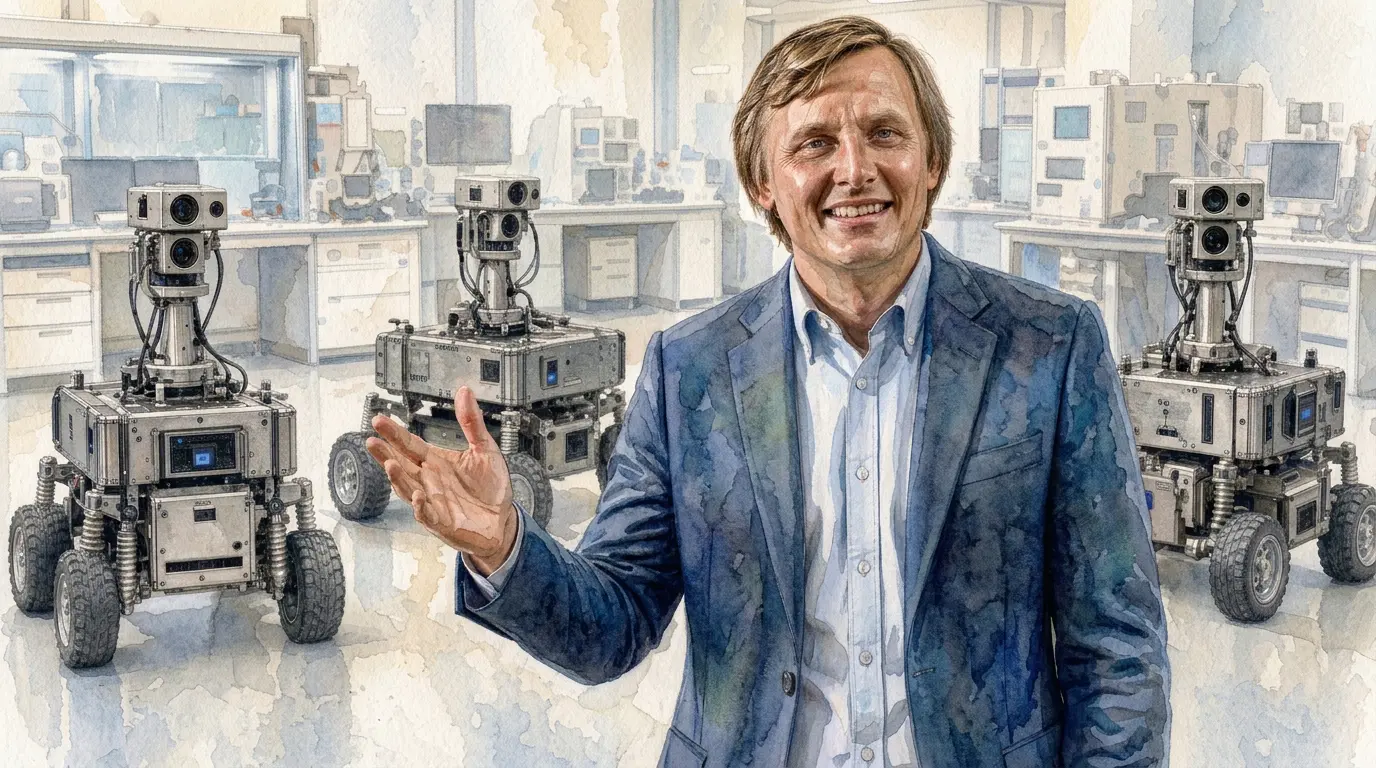
Hans Moravec is the Carnegie Mellon roboticist who spent his career getting robots to see and move, and whose name is attached to an observation that turns common sense inside out. The things humans find effortless are the hardest things to give a machine. Recognising a face and walking across a room sit in that column, while chess and arithmetic, which people find hard, are the easy ones, and that inversion is now called Moravec’s paradox.
The paradox came out of a working life. Hans Moravec spent that life on the hard side of it, starting with a Stanford doctorate in which a television-equipped robot, run from a large computer, took about five hours over an obstacle course. With Alberto Elfes he later worked out how a machine could build a map of its surroundings from noisy sonar readings. Then came the books, two of them, from 1988 and 1998, which took the growth of computing power and extrapolated it into forecasts of machine intelligence far beyond our own.
Moravec’s paradox inverts common sense. Perception and movement, which feel effortless to humans, are the hardest things for machines, while abstract reasoning is comparatively easy.
The lesson is about intuition. What a new kind of machine finds easy or hard rarely matches expectation, so predictions based on human intuition are unreliable.
Quantum computers have the same inversion. They make some famously hard problems tractable and offer nothing on many easy ones, in a pattern no intuition would guess.
He extrapolated computing trends boldly. Moravec extended Moore’s Law into sweeping forecasts of machine superintelligence, which are a useful case study in the risks of extrapolation.
His career was spent on the hard problem. He worked on robot perception and navigation, the genuinely difficult half of his own paradox, for decades.
- Robot perception was the day job and forecasting the sideline
- A robot that took hours on an obstacle course
- Reasoning turned out cheap, seeing turned out expensive
- Evolution hid the cost of seeing and moving
- A quantum computer has its own inverted profile
- Factoring and simulation gain, everyday computing gains nothing
- Occupancy grids, the part that was not forecasting
- Mind Children, and extrapolating a curve too far
- Extending Moore’s Law too far
- Do not read a resource trend as a capability trend
- Take the trend seriously and doubt the leap
- Landauer’s floor is real and nothing today is near it
- Forecasts date the hardware and miss the capability
- Embodiment, not mechanics, was the part that stayed hard
- Quantum mechanics neither rescues nor forbids mind uploading
- Frequently asked questions
Robot perception was the day job and forecasting the sideline
Hans Moravec took his doctorate at Stanford in 1980. The thesis is titled Obstacle Avoidance and Navigation in the Real World by a Seeing Robot Rover, and it is dated May 1980. The following year UMI Research Press published Robot Rover Visual Navigation. He spent most of the career that followed at Hans Moravec’s page at Carnegie Mellon University’s Robotics Institute, where the subject never changed. He worked on giving a machine a usable sense of the space around it, which is the half of his own paradox that nobody has finished.
He is known in two rather different registers. Within robotics he is a serious researcher who made real advances in how a machine represents and navigates its surroundings. Beyond robotics he is a futurist, the author of popular books that extrapolate the growth of computing into striking predictions about the future of machine intelligence.
A robot that took hours on an obstacle course
The doctoral work of Hans Moravec centred on the Stanford Cart, a television-equipped robot run from a large computer. On his curriculum vitae, its cluttered obstacle courses took about five hours. It was still an early attempt at vision-guided movement, at a time when almost nothing of the kind existed.
His 1993 essay puts a date and a place on the mismatch. It records that AI research groups at MIT and Stanford attached television cameras and robot arms to their computers in the early 1970s. The essay calls the result a shock. Reasoning programs performed about as well as college freshmen, while the machines that had to see and grasp were beaten by an infant. That contrast, not any single experiment of his own, is what the paradox names.
Reasoning turned out cheap, seeing turned out expensive
Moravec’s paradox is the observation that high-level reasoning requires relatively little computation, while low-level sensory and motor skills require enormous computation. His essay draws it from the AI laboratories of the early 1970s at MIT and Stanford. The reasoning programs there kept pace with college freshmen. The robots could not manage what a small child does without thinking about it.
While the pure reasoning programs did their jobs about as well and about as fast as college freshmen, the best robot control programs took hours to find and pick up a few blocks on a table. Often these robots failed completely, giving a performance much worse than a six month old child.
That is the paradox in its original form. The comparison comes from his June 1993 essay The Age of Robots, where the machines held their own against educated adults at abstract reasoning and an infant beat them at seeing and moving.
The paradox has held up remarkably well. Decades after Moravec stated it, machines can beat any human at chess and Go and pass professional examinations, and machine learning has made large gains in vision and language. Reliable general-purpose robotic manipulation is still hard, and so is walking over rough ground, and so is understanding a cluttered visual scene. The profile of what is easy and hard for a machine is close to the mirror image of what is easy and hard for a person.
Evolution hid the cost of seeing and moving
The explanation he offered is evolutionary. Human perception and movement are the products of many hundreds of millions of years of evolution, refined relentlessly because survival depended on them. The enormous computation they involve is hidden beneath the surface, and it feels like nothing at all.
Abstract reasoning is evolutionarily recent and thinly developed. Hans Moravec puts it plainly in the same essay. He writes that “The survival of human beings (and their ancestors) has depended for hundreds of millions of years on seeing and moving in the physical world”. Moravec sets that against “rational thinking, as in chess, is a newly acquired skill, perhaps less than one hundred thousand years old”. So the things that feel hard to us are hard because we are bad at them, not because they take much computation. The things that feel easy conceal a staggering amount of processing that evolution has optimised into invisibility.
The deeper point is about intuition. Human intuition about difficulty is calibrated to human strengths and weaknesses, so it is a terrible guide to what a machine will find difficult. That is the piece of the paradox that transfers directly to quantum computing.
A quantum computer has its own inverted profile
A quantum computer has its own profile of easy and hard problems, and like the machines in Moravec’s paradox that profile does not match intuition at all. The temptation is to imagine a faster classical computer. That picture fails in the same way as expecting a chess computer to walk across a room, because a quantum machine is not simply better at everything hard.
The reality is specific and counterintuitive. A quantum computer can, in principle, factor huge numbers that defeat classical machines, and it is a natural fit for simulating quantum systems like molecules, both genuinely hard classical problems. Yet it offers no advantage at all on a vast range of ordinary tasks, cannot simply read out large results, and for many problems that sound difficult it provides nothing useful.
Factoring and simulation gain, everyday computing gains nothing
The defence against the intuition trap is concrete cases. Factoring and quantum simulation sit in the tractable column, and unstructured search gets a modest square-root improvement, while sorting a list, adding numbers and the overwhelming majority of everyday computation gain nothing. Reading a large answer out of a quantum computer is often impossible to do cheaply, as our coverage of quantum algorithms sets out.
None of this follows from intuition, and all of it follows from the specific structure of the problems and the machine. Just as Moravec’s paradox forces a robotics researcher to abandon the assumption that human-easy means machine-easy, honest quantum computing forces the reader to abandon the assumption that classically-hard means quantum-easy. The two lessons are the same lesson in different hardware.
This is why quantum advantage has to be assessed one problem at a time. There is no general rule that a quantum computer is better at hard things, only a specific and limited set of places where its particular strengths line up with a problem’s structure.
Occupancy grids, the part that was not forecasting
Behind the futurism there is substantial technical work, and it grounds the paradox in practice. His mobile robot laboratory developed methods for a machine to build a map of its surroundings from noisy sensor data. With Alberto Elfes he set one method out in High Resolution Maps from Wide Angle Sonar, dated July 1984 and presented at the IEEE robotics conference in March 1985. The paper describes a grid of cells and the probability that each cell is occupied. His later curriculum vitae calls that family of maps occupancy grids.
This was a serious answer to the hard half of his own paradox, the problem of turning a stream of imperfect measurements into a usable model of the world. The shape of that problem is familiar. It is filtering and estimation, of the kind that runs through the whole history of computing under noise. That puts his work in the same lineage as the business of pulling signal out of noise in quantum measurement and control.
Mind Children, and extrapolating a curve too far
The other half of his public work is the forecasting. That half is contentious. Mind Children came from Harvard University Press in October 1988. The Harvard page says he expected human equivalence in machines within forty years, and that he did not treat that equivalence as a ceiling. His publication list dates Robot to Oxford University Press in November 1998. His page for that book says robots will match human intelligence in less than fifty years, and that they could perform better than a person can.
The 1993 essay is where the dates are. In it he put a first generation of universal robots, with general-purpose perception, manipulation and mobility, in the years 2000 to 2010. A second generation was to follow between 2010 and 2020. He called its processing mammal-class, and its distinguishing feature accommodation learning, which means the machine would adjust its behaviour from the results of its own actions.
Extending Moore’s Law too far
Hans Moravec built his forecasts on an extended version of Moore’s Law. He generalised the trend of doubling computer power and projected it far into the future, to estimate when machines would match the raw processing of a human brain. It is an instructive move to examine, because it is the same move that quantum computing roadmaps make.
The trend itself holds. The leap from that trend to a capability is where the forecast fails. Counting raw operations, or raw qubits, is not the same as counting capability, and a projection that assumes the two are equivalent inherits all the risk of that assumption. Moravec’s paradox is, in a sense, the refutation of his own forecasting method, since it shows that raw computation does not straightforwardly translate into the abilities that matter.
For quantum computing the caution is direct. A roadmap projecting ever more qubits is extrapolating a real trend, but capability depends on error rates and on logical qubits. Raw physical counts do not carry it. The leap from the one to the other is the leap his own paradox warns against.
Do not read a resource trend as a capability trend
The combined lesson is a discipline for assessing any claim about a new computing technology. It has two parts. Do not trust intuition about what the machine will find easy or hard, because that intuition is calibrated to human abilities and will mislead you about a machine built on different principles. And do not confuse a trend in raw resources with a trend in useful capability, because the two can diverge sharply.
Quantum computing offers both temptations at once. One is to assume a quantum computer will be good at whatever is currently difficult, and the other is to read a rising qubit count as rising capability. Both are versions of the mistake Moravec spent his career documenting, and avoiding them is most of what careful assessment requires.
Take the trend seriously and doubt the leap
His paradox and his forecasts pull against each other. Held together they give a posture worth borrowing, which is to take the underlying trends seriously, since computing really does grow exponentially and quantum hardware really is improving. What that posture refuses is the assumption that either the machine’s strengths or its future capabilities will match intuition. It is curious about the trend and sceptical about the leap.
On 20 February 2003 Hans Moravec and Scott Friedman founded Seegrid. His announcement of 16 June 2003 says the company would commercialise thirty years of work in robot perception and navigation. The company was built on the hard half of the paradox, the work of seeing and moving.
Landauer’s floor is real and nothing today is near it
Anyone projecting computing forward for decades, as Hans Moravec did, runs into the question of what physics eventually forbids. The answers are real, not speculative. The floor is set by Landauer’s principle, which says that erasing a bit of information must dissipate a minimum quantity of heat. That ties computation to thermodynamics and puts a lower bound on the energy cost of any irreversible operation.
That floor is remarkably low. Present-day processors dissipate many orders of magnitude more per operation than the principle requires, so the limit is not what constrains current engineering. It does mean that indefinite improvement by the current route is not available, and it is why reversible computing has been studied since the 1970s as a way around the erasure cost.
Quantum computing connects to this more directly than most people realise. Quantum gates are reversible by construction, since the evolution they implement is unitary and therefore undoable, which means the erasure cost applies only at measurement. That does not make these machines energy-free. A machine that has to be held near absolute zero spends a great deal of energy on refrigeration, and the reversible gates sit on a different thermodynamic footing.
The practical relevance is modest and worth stating honestly. No computer built today is limited by Landauer’s principle. The constraints that bind are heat removal, wiring and error rates. The thermodynamics of bit erasure is not what limits a machine built today, and long-run projections of smooth exponential improvement describe engineering. They are not a law of physics.
Forecasts date the hardware and miss the capability
Forecasts of when machines will match human capability, the genre Hans Moravec worked in, have a poor record. The failure mode is consistent enough to be useful. They extrapolate one quantity that is improving smoothly, usually a measure of raw computing power, and assume the missing capability arrives once enough of it accumulates.
The assumption is doing far more work than it appears to. Having enough operations per second to match a brain says nothing about knowing what to compute. The history of artificial intelligence is largely a history of that gap being wider than anyone expected. Hardware arrived roughly on schedule in several of these forecasts and the capability did not.
Quantum computing invites the same error in a new form. A count of physical qubits improving steadily suggests a curve to extrapolate. The useful quantity is logical qubits, which depends on error rates and on the overhead of correction. The physical count does not settle it. A projection built on the visible number will be wrong in whichever direction the invisible one moves.
The defensible version of forecasting is conditional. Dates are not. Saying what becomes possible if error rates reach a given threshold is a claim that can be checked and reasoned about. Saying it will happen in a particular year requires knowing how fast a research problem gets solved, which is the one thing nobody has ever been able to estimate.
Embodiment, not mechanics, was the part that stayed hard
The hard half of Moravec’s paradox has a name in robotics. It is embodiment. Robotics spent decades discovering something that looks obvious now and was not obvious then, which is that reasoning about a world arriving with a clean description is one problem. Obtaining the description yourself is a different and much harder one, and almost all the difficulty lives in that second step.
A robot in a factory cell works because the world has been arranged to suit it. Parts arrive in known orientations, the lighting is controlled and nothing unexpected enters the workspace. Move that machine into a kitchen and it fails. The manipulation is no harder there, but the world has stopped being described in advance, and every assumption that made the factory version tractable has to be replaced by perception.
This is why progress in robotics has tracked progress in perception. The actuators have been good enough for a long time, and what changed recently is the ability to look at an unfamiliar scene and work out what is in it. The remaining gap is largely about contact. Predicting how an object will behave when touched involves friction, deformation and material properties that are difficult to observe and harder to simulate.
The parallel with quantum computing is closer than it first appears. Both fields spent years working on the part that could be formalised, control theory in one case and algorithms in the other, and both found the binding constraint was somewhere less tractable. For robots it was perception and contact. For quantum computers it was noise, fabrication variation and the wiring, none of which appear anywhere in the theory of quantum algorithms.
Quantum mechanics neither rescues nor forbids mind uploading
The genre that Moravec’s later books belong to keeps returning to the idea of moving a mind onto a machine. That idea touches quantum physics at exactly one point. The argument for uploading assumes the relevant information about a brain is classical. It assumes, in other words, that the information could be measured and copied without disturbing whatever it is that makes the person who they are.
If any of it is quantum, the no-cloning theorem gets in the way. An unknown quantum state cannot be copied. A scan-and-transfer procedure would therefore destroy what it was reading, which rules out the comfortable version in which the original survives the process.
The scientific consensus is that this is not the obstacle. A brain is warm and wet, and decoherence at body temperature is extraordinarily fast. The timescales on which quantum states survive there are vastly shorter than the timescales of neural signalling. Proposals for quantum effects in cognition exist and have not found supporting evidence, and the mainstream position is that neurons are classical for every purpose that matters.
The interesting consequence is that quantum mechanics neither rescues nor forbids these arguments. The obstacles to reading a brain in enough detail are practical and enormous. Resolution is one of them, the scale of a brain is another, and the third is that the reading destroys the tissue it reads. None of the three is quantum, and invoking quantum physics in this debate usually signals that the practical difficulty is being skipped over.
Frequently asked questions
Who is Hans Moravec?
Hans Moravec is an Austrian-born roboticist and futurist long associated with Carnegie Mellon University’s Robotics Institute. His curriculum vitae lists his nationality as Canadian. He is known for Moravec’s paradox, for work in mobile robot navigation, and for books on the future of machine intelligence.
What is Moravec’s paradox?
It is the observation that high-level reasoning takes relatively little computation while low-level perception and movement take enormous computation. In practice, machines find chess and arithmetic easy but find the perception and mobility of a small child extremely hard, the reverse of what humans find difficult.
How does Moravec’s paradox relate to quantum computing?
A quantum computer has its own counterintuitive profile of strengths and weaknesses, just as the machines in Moravec’s paradox do. It makes some famously hard problems tractable and offers nothing on many easy ones, so assuming it will be good at whatever is currently difficult is a version of exactly the mistake Moravec identified.
Why is perception harder for machines than reasoning?
Moravec’s explanation is evolutionary. Human perception and movement were refined over hundreds of millions of years and involve enormous hidden computation that feels effortless, while he dates rational thinking to well under a hundred thousand years. So the things that feel hard to us are hard because we are bad at them, not because they need much computation.
What did Moravec predict about the future?
In Mind Children he expected human equivalence within forty years, and his page for Robot, which his list dates to 1998, says robots will match human intelligence in less than fifty years. His essay from June 1993 is where those robot dates sit. It puts universal robots with general-purpose perception in the years 2000 to 2010. A second generation, with what he called accommodation learning, was set between 2010 and 2020.
What is the Stanford Cart?
The Stanford Cart was a television-equipped robot, run from a large computer, that negotiated cluttered obstacle courses in about five hours for his doctorate. It was an early attempt at vision-guided movement, of the kind his 1993 essay contrasts with the reasoning programs of the same period.
What is the lesson of Moravec’s work for quantum claims?
Two things. Do not trust intuition about what a new machine will find easy or hard, because it is calibrated to human abilities. Do not confuse a trend in raw resources, such as qubit counts, with a trend in useful capability. Both are mistakes Moravec’s work warns against and both appear constantly in quantum computing coverage.



See today’s quantum computing news on Quantum Zeitgeist for the latest breakthroughs in qubits, hardware, algorithms, and industry deals.