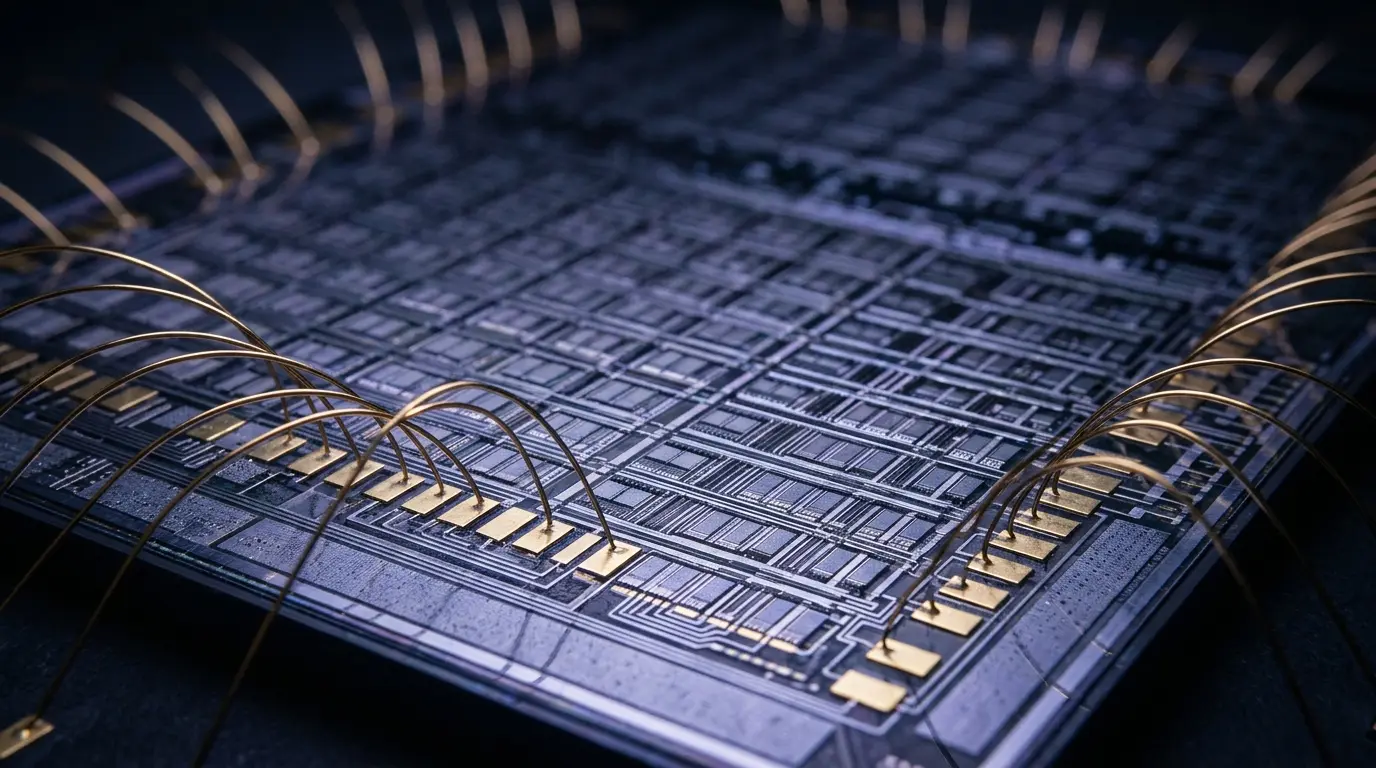
Google Quantum AI researchers have achieved a tenfold reduction in physical qubit overhead for quantum error correction through a new modular design. The team constructed modular hyperbolic surface and color codes by wiring planar modules with sparse connections, demonstrating a significant leap beyond current surface code approaches.
This modular memory design, incorporating a syndrome extraction system approximately 4.5 times smaller than the code itself, enables efficient storage in a universal fault-tolerant architecture. The work shows modular codes with a rate of k/n = 1/16 and distance d ≥ 22, exceeding the performance of the [[288, 12, 18]] two-gross bivariate bicycle code.
Boundary-Connected Modules Reduce Qubit Overhead
These layouts use sparse, static boundary connections between modules to construct hyperbolic surface and color codes, representing a departure from traditional surface code approaches. The team’s work centers on new families of semi-hyperbolic codes, enabling this improved efficiency even when accounting for errors occurring at the connections between modules. Projecting to larger system sizes, the researchers find modular codes with encoding rate k/n = 1/16 and distance d ≥ 22.
Hyperbolic and Color Codes Enable Modular Design
Modular hyperbolic color codes use multi-rate circuits to optimize logical error rates. High-weight intermodule stabilizers are measured less frequently, specifically once every three quantum error correction rounds. This approach allows for slower inter-module gates while simultaneously improving performance, a key element in scaling quantum memory.
The team developed a variant of the decoder to efficiently decode these modular hyperbolic color codes, demonstrating a commitment to full-stack optimization beyond the code construction itself. Simulations employing an SI1000 noise model with a physical gate error rate of 0.1% and adjusted inter-module CZ gates, with a noise strength of 1%, reveal the efficacy of this modular design.
Encoding Rate of 1/16 Achieved with Distance ≥ 22
This advancement suggests a potential reduction in physical qubit overhead exceeding 30 times that of traditional surface codes, a critical step toward scalable quantum computing. The design’s efficiency stems from a focus on planar modules and boundary connections, minimizing the complexity of inter-module interactions. A key innovation lies in the modular extractor system, which is approximately 4.5 times smaller than the code itself, representing a substantial gain in efficiency for the essential syndrome extraction process.
This compact extractor, coupled with fault-tolerant walking circuits for implementing logic via code automorphisms, enables the construction of semi-hyperbolic codes with optimized performance. The team’s work demonstrates that these codes can retain a constant-factor density advantage in kd²/n over the surface code, a significant advantage for building practical quantum computers.
The design allows for benchmarking the performance of these codes, focusing on minimizing physical qubit requirements for reliable quantum computation.
10x Overhead Reduction at 10^-10 Logical Error Rate
Circuit-level simulations demonstrate a 10-fold reduction in physical qubit overhead, reaching a logical error rate of under conditions mirroring near-term experiments with a physical error rate of 0.1% and a ten-fold increase in noise for inter-module gates. Extrapolating to larger system sizes, simulations indicate this reduction increases to 15-fold, even with inter-module gates exhibiting significantly higher error rates than those within the modules.
While not as dense as comparable color codes, these modular hyperbolic surface codes offer the advantage of compatibility with fast and accurate minimum weight perfect matching (MWPM) decoding. The circuits demonstrate high tolerance to noisy inter-module gates, with even a ten-fold increase in seam errors only modestly affecting the overall logical error rate, a finding detailed in Figure M4. “We find that our circuits for both hyperbolic color and surface codes are highly tolerant to noisy inter-module gates,” the researchers report, highlighting the robustness of the approach.
Fault-Tolerant Logic via Code Automorphisms
This performance is achieved through a design that prioritizes efficient logical operations alongside robust error correction, offering a pathway to more scalable quantum computing architectures. The team’s approach differs from traditional methods by using symmetries inherent in the hyperbolic tiling to implement logic gates. Fault-tolerant walking circuits are central to this logic implementation, using code automorphisms to manipulate quantum information. These circuits, co-designed with low-weight logical bases, allow for operations to be performed on the encoded data without disrupting the error correction process.
The modular extractor system is ≈ 4.5× smaller than the code itself. The modular extractor system is ≈ 4.5× smaller than the code itself.
Near-Term Error Rates and Inter-Module Coupler Tolerance
The simulations used a noise model with a two-qubit gate error rate of 0.1% and assumed inter-module gates were ten times noisier, with an error rate of 1%. This performance demonstrates a pathway toward more efficient quantum computation despite imperfect hardware connections. This approach minimizes the impact of noisy connections, as only a small fraction of gates cross module boundaries. The resulting tolerance to elevated error rates stems from boundary connectivity, a key feature of the design. The team’s work demonstrates that modular designs can effectively mitigate the impact of noisy inter-module gates.
👉 More information
🗞 Low-Overhead Quantum Error Correction with Boundary-Connected Planar Modules
✍️ Oscar Higgott et al.
🧠 ArXiv: https://arxiv.org/pdf/2610.03682


See today’s quantum computing news on Quantum Zeitgeist for the latest breakthroughs in qubits, hardware, algorithms, and industry deals.