
David E. Shaw is usually introduced as the billionaire who built one of the most secretive quantitative hedge funds on Wall Street. That description is accurate and it buries the more interesting fact, which is that he left the firm bearing his name to go back to building computers.
The through line across four decades is unusually consistent. Shaw has spent his career arguing that if you care enough about one specific calculation, you should stop buying general-purpose computers and design silicon shaped around that calculation instead. He made that argument as a young academic in the 1980s, he applied it to securities markets in between, and he has spent the years since building machines that simulate molecules faster than anything else on Earth.
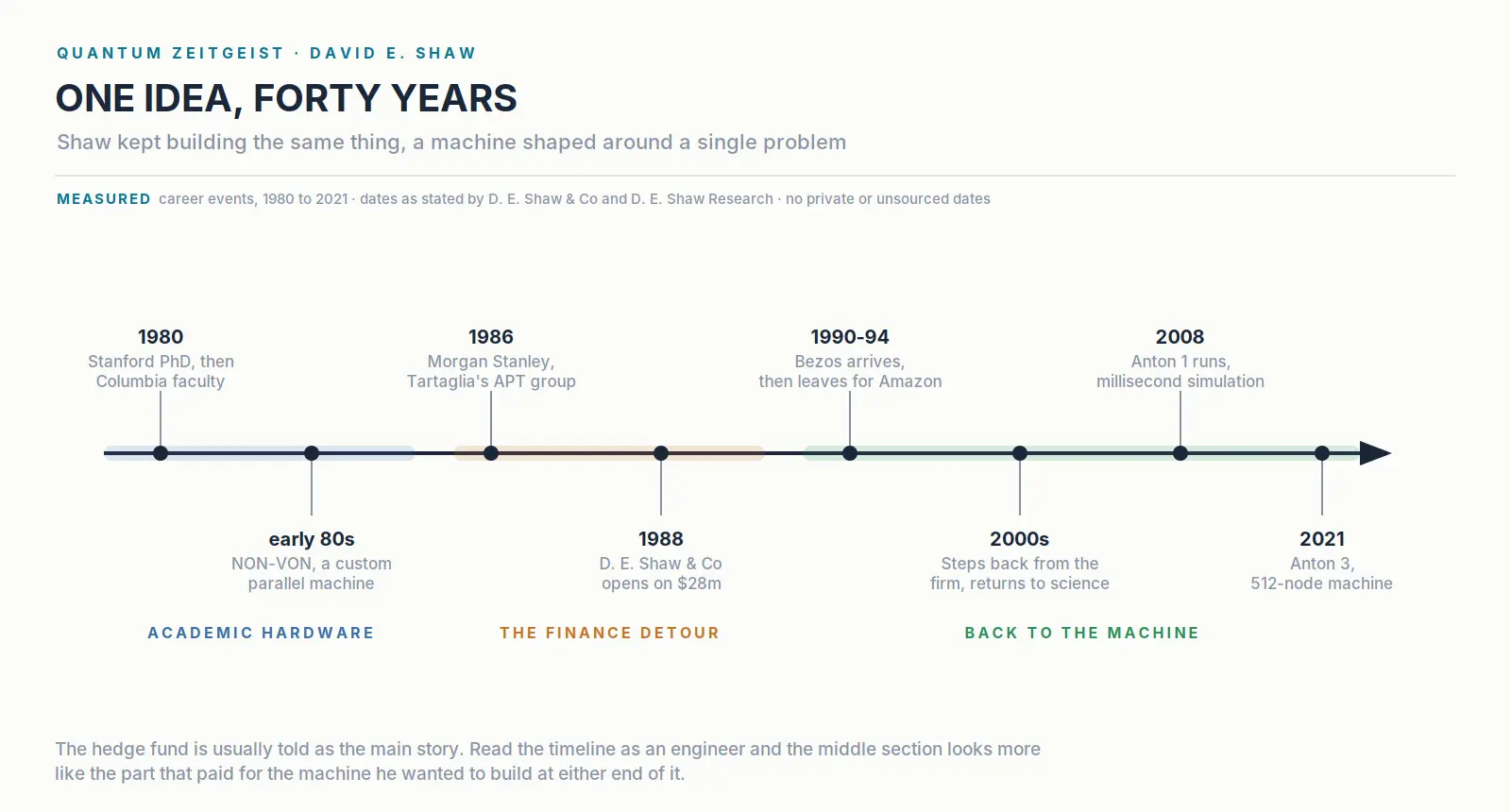
The hedge fund was the detour, not the destination. Shaw was building custom parallel hardware at Columbia before Wall Street and returned to building custom parallel hardware afterwards. The finance years funded the machine.
Anton is the argument for special-purpose silicon, made in hardware. By spending every transistor on one calculation, it reached simulation timescales that general-purpose machines could not approach.
He hired Jeff Bezos, who left to start Amazon. Bezos joined D. E. Shaw & Co in 1990, became its youngest senior vice president in 1992, and left in 1994 with an idea about selling books online.
Anton solves the half of chemistry that quantum computers do not. It runs classical molecular dynamics at enormous scale, treating the quantum behaviour of electrons as an approximation baked into a force field.
That makes Anton the benchmark quantum chemistry has to beat. Claims that a quantum computer will transform drug discovery are competing against a machine that already exists and already works.
The architectural lesson transfers directly. A quantum processor is another bet that a device built for one class of problem beats a general-purpose one, which is the wager Shaw has made his whole career.
- The six academic years most profiles skip
- NON-VON, the first custom machine
- Why a computer scientist went to Wall Street
- The firm that ran on algorithms
- Statistical arbitrage, and what the phrase conceals
- The Bezos footnote that became Amazon
- Leaving finance for biochemistry
- The folding problem and why it is hard
- Anton and the case for special-purpose silicon
- Three generations of the machine
- Watching a protein fold rather than calculating it
- AlphaFold answered a different question
- Where quantum computing fits
- Where the force field runs out
- Why Anton is the benchmark to beat
- Advising on science policy
- No grant agency funds a decade of custom silicon
- General-purpose computing treated as a compromise
- Desmond and the software half
- Testing advantage against a classical opponent who tried
- The other quantum connection, in finance
- One firm keeps its secrets, the other publishes
- Frequently asked questions
The six academic years most profiles skip
David E. Shaw received his doctorate from Stanford University in 1980 and, in the same year, joined the faculty of Columbia University’s computer science department, where his research concerned massively parallel machine architecture. He stayed there until 1986, when, in his firm’s own words, he left to pursue the emerging field of computational finance.
That academic career lasted six years and it is the part most profiles skip. It is also the part that explains everything afterwards, because the questions Shaw was asking at Columbia are the questions he is still asking now.
NON-VON, the first custom machine
At Columbia, David E. Shaw led work on a machine called NON-VON, a name that announces its own thesis. Von Neumann architecture, the standard design where a processor fetches instructions and data from a shared memory, is what almost every computer uses. NON-VON was a deliberate departure from it.
The design was a massively parallel machine built as a tree of small processing elements, intended for fast searching of relational databases. Rather than making one processor faster, it made thousands of tiny ones work on different parts of the problem, in a topology chosen to suit the specific access pattern of the task.
NON-VON did not become a commercial product. The idea behind it survived intact, and it is worth stating plainly because it recurs. If you know exactly what calculation you need, you can beat a general-purpose computer by a wide margin by building hardware whose shape matches the problem.
Why a computer scientist went to Wall Street
In 1986 David E. Shaw left academia for Morgan Stanley, joining the automated proprietary trading group run by Nunzio Tartaglia. The group was doing what would later be called statistical arbitrage, using computers to spot transient pricing relationships between securities and trade against them.
The appeal to someone with Shaw’s background is easy to see. Markets generate enormous quantities of data, the patterns worth finding are statistical rather than obvious, and the work is fundamentally a computing problem rather than a finance one. It was a place where a computer scientist had a genuine edge over the incumbents.
The firm that ran on algorithms
David E. Shaw left Morgan Stanley in 1988 and founded D. E. Shaw & Co. The firm’s own account says it began over a small bookstore in downtown New York City, with six employees and $28 million in capital. It applied mathematical models and proprietary algorithms to securities trading, and it hired accordingly, recruiting mathematicians, physicists and computer scientists rather than traditional traders.
The approach is now standard across the industry, which makes it easy to forget how unusual it was at the time. D. E. Shaw & Co became one of the defining quantitative firms, and it remains among the largest, with the culture of technical recruitment it established copied throughout the sector.
What matters for this profile is what the firm made possible rather than what it traded. It generated the capital and the independence that let Shaw fund a long, expensive and commercially uncertain hardware project on his own terms, answerable to nobody’s product roadmap.
Statistical arbitrage, and what the phrase conceals
Statistical arbitrage is worth explaining properly, because the phrase does a lot of concealing. The idea is that securities move in relationships to one another, that those relationships are usually stable, and that when one drifts out of line it tends to return. A model that can spot the drift and size the position correctly can make money on a very small edge, provided it does so thousands of times.
Nothing about that is a finance insight in the traditional sense. There is no view on whether a company is well run, and no meeting with management. It is a signal processing problem wrapped in a risk management problem, run over more data than a person can hold in their head, and it rewards whoever has the better model and the faster infrastructure.
That is why a computer scientist with a background in parallel architecture had an advantage in 1986, and why the firms that followed hired physicists rather than MBAs. The competitive frontier had moved to a place where the incumbent skill set did not reach.
The Bezos footnote that became Amazon
In 1990 the firm hired a young computer scientist named Jeff Bezos, who became its youngest senior vice president in 1992. Part of his brief involved investigating commercial opportunities in the still-new internet, and one of the ideas he examined was selling books online.
Bezos left in 1994 to pursue it himself, moving to Seattle and launching Amazon, which sold its first book in 1995. The episode is usually told as an Amazon origin story. Read from the other direction it says something about D. E. Shaw & Co, which was a firm that put a senior person to work on internet commerce years before most of the industry had noticed the internet.
Leaving finance for biochemistry
Having built one of the most successful quantitative firms on Wall Street, Shaw stepped back from its day-to-day management to return to scientific research. He began work on computational biochemistry in 2001 and built the scientific team the following year. He still takes part in higher-level strategic decisions at the investment business, but the firm says the vast majority of his time now goes to his role as chief scientist of D. E. Shaw Research. He resumed his affiliation with Columbia in 2005 and holds appointments there as a senior research fellow and as an adjunct professor of biochemistry and molecular biophysics.
The chosen problem was molecular dynamics, meaning the simulation of how proteins and other biological molecules move and fold over time. This is a problem of enormous practical importance, since almost every drug works by binding to a protein, and understanding that binding requires understanding motion rather than a static structure.
It is also brutally hard computationally. Biologically interesting events such as a protein folding or a drug molecule finding its binding site happen on timescales of microseconds to milliseconds, while the simulation timestep must be a few femtoseconds to capture atomic vibration. That gap spans about twelve orders of magnitude, which means billions upon billions of sequential steps.
The folding problem and why it is hard
A protein is a chain of amino acids that folds into a specific three-dimensional shape, and that shape determines what the protein does. Getting the shape wrong is the mechanism behind a number of diseases, and getting a drug to bind to the right part of the shape is the mechanism behind most medicines.
Cyrus Levinthal pointed out in 1969 that the chain has an astronomical number of possible configurations. If a protein searched them at random it would take longer than the age of the universe to find the right one, yet real proteins fold in microseconds to seconds. The resolution is that folding is not a random search but a guided descent down an energy landscape, and simulating that descent is what molecular dynamics is for.
The arithmetic of the simulation is what makes it a hardware problem. Atomic vibrations force a timestep of a few femtoseconds, one quadrillionth of a second, while the events worth watching take microseconds to milliseconds. Covering that span means hundreds of millions to billions of sequential steps, and each step requires computing the forces between every relevant pair of atoms in the system.
Sequential is the operative word. You cannot compute step one thousand until you have computed step nine hundred and ninety-nine, so throwing more processors at the problem stops helping once each individual step is already spread thin. What Anton attacks is the time per step rather than the number of steps, which is exactly the regime where custom silicon beats a larger cluster.
Anton and the case for special-purpose silicon
The response was to build a machine that does nothing else. Anton, named after Antonie van Leeuwenhoek, the microscopist who first observed micro-organisms, first ran in 2008. It is built from application-specific integrated circuits designed solely for molecular dynamics, connected by a specialised three-dimensional torus network.
The design philosophy is the NON-VON argument again, now with a much better target. A general-purpose processor spends most of its transistor budget on facilities that a molecular dynamics inner loop never uses, including branch prediction, instruction decoding and deep cache hierarchies built for unpredictable access patterns. Anton spends its budget on computing the forces between pairs of atoms, and on moving those results to the right place fast.
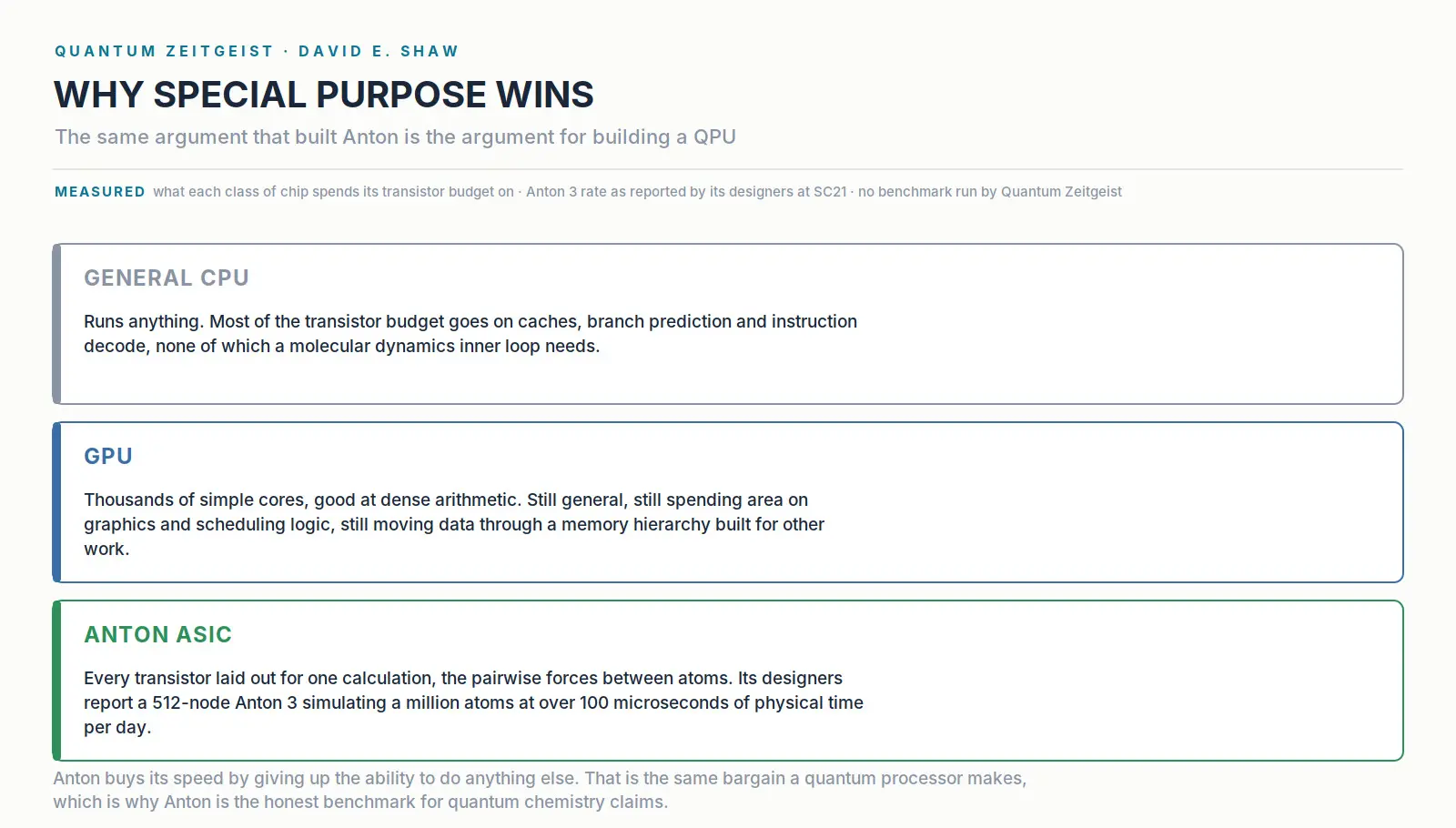
The result was a step change rather than an increment. Anton made it possible to simulate proteins at atomic detail for periods on the order of a millisecond, roughly two orders of magnitude beyond what was previously achievable. Timescales that had been permanently out of reach became routine.
Three generations of the machine
The programme did not stop with the first machine. Anton 2 was presented at the 2014 supercomputing conference under a title that promised to raise the bar on both performance and programmability. It extended the approach from single proteins to the larger assemblies that need millions of atoms.
Anton 3 followed in 2021 and is the most striking as a piece of engineering. Its designers report that a 512-node machine simulates a million atoms at over 100 microseconds of physical time per day. That is more than a hundred times faster than any other then-available supercomputer, on an order of magnitude less energy per simulated microsecond. Like its predecessors it was designed from scratch around a new custom chip.
| Machine | First running | What changed |
|---|---|---|
| NON-VON | Early 1980s | Tree-structured massively parallel research machine at Columbia, aimed at database search |
| Anton 1 | 2008 | Custom MD ASICs and a 3D torus network, reaching millisecond-scale protein simulation |
| Anton 2 | 2014 | Extended the approach to assemblies of millions of atoms |
| Anton 3 | 2021 | A 512-node machine runs a million atoms at over 100 microseconds per day |
Watching a protein fold rather than calculating it
The machines exist to produce results rather than benchmarks. Anton simulations have shown how proteins fold, how drug molecules find and occupy their binding sites, and how membrane proteins change shape when they transport a substance. They also show how a mutation alters a protein’s behaviour, which a structural snapshot cannot reveal.
Two categories of result stand out. The first is folding itself, where long simulations let researchers watch small proteins fold and unfold repeatedly, turning a process previously inferred from indirect evidence into something observable. The second is drug binding, where a candidate molecule can be followed as it approaches a target, tries several orientations, and settles into a pocket, with the intermediate states often mattering as much as the final one.
The practical importance lies in the word motion. A crystal structure gives a single frozen configuration, while a drug binding to a target is a process involving approach, rearrangement and settling. Watching it unfold changes what a medicinal chemist can reason about, and D. E. Shaw Research has published extensively while also pursuing its own drug discovery programmes.
AlphaFold answered a different question
Any discussion of computational biology since 2021 has to address AlphaFold, DeepMind’s neural network for predicting protein structure from sequence. It was a genuine breakthrough, and it is reasonable to ask whether it made machines like Anton redundant.
It did not, and the reason clarifies what Anton is for. AlphaFold predicts a structure, meaning the folded shape a protein settles into, and it does so in seconds where experimental determination took months. What it returns is essentially a single static model, a photograph rather than a film.
Biology mostly happens in the film. A transporter protein changes shape to move a molecule across a membrane, and an enzyme flexes as it binds. A drug candidate approaches its target through a series of intermediate arrangements, and a disordered region samples many configurations rather than settling into one. Structure prediction and dynamics simulation are complementary, and the standard workflow now uses both, with predicted structures increasingly serving as starting points for simulation.
The comparison is instructive for quantum computing too. AlphaFold succeeded by finding a shortcut, learning statistical regularities across a large body of solved structures rather than computing physics from first principles. That is worth remembering whenever a problem is described as requiring exponential resources, since the classical world has a habit of producing shortcuts that nobody expected.
Where quantum computing fits
Anton is a classical machine, and understanding exactly which approximation it makes is what connects this story to quantum algorithms. Molecular dynamics treats atoms as classical particles interacting through a force field, a set of equations fitted in advance to reproduce known behaviour. Newton’s equations are then solved for every atom at every timestep.
That works remarkably well for the questions Anton targets, and it has a hard boundary. A force field cannot describe chemical bonds breaking and forming, nor electronic excited states, nor situations where the quantum behaviour of electrons is the thing you actually want to know. Those effects have been approximated away before the simulation starts.
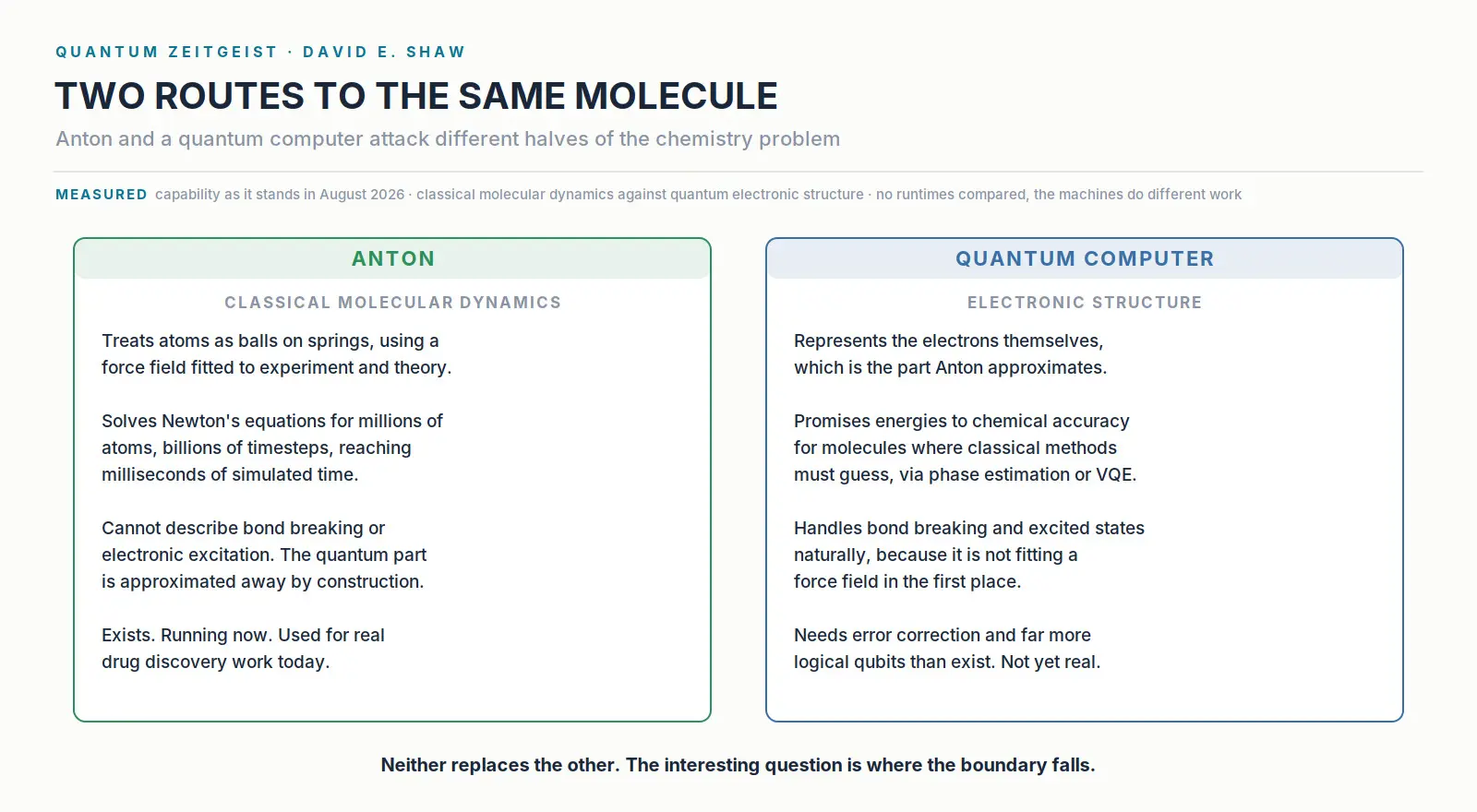
Electronic structure is precisely the territory quantum computers are supposed to claim. Richard Feynman’s original argument for quantum computing was that simulating quantum systems on classical hardware is intractable because the state space grows exponentially. Algorithms such as quantum phase estimation and the variational methods developed for noisy hardware target exactly the calculation a force field sidesteps.
Where the force field runs out
An honest account of Anton has to include what it cannot do, and the limitation is not speed. It is the force field, the set of parameters describing how atoms push and pull on each other, which is fitted in advance to experimental data and quantum chemical calculations on small systems.
A simulation is only as good as those parameters. If the force field misrepresents a particular interaction, running it a thousand times faster produces the wrong answer sooner. That has been a live issue for disordered proteins, and for unusual chemistry where the fitted parameters were never validated. Force field development is a serious research field in its own right, and D. E. Shaw Research has contributed to it precisely because faster hardware makes the parameters the binding constraint.
There is also a category of question that no force field can answer. Bond formation and breaking, electron transfer, photochemistry and metal centres in enzymes all involve electronic behaviour that the classical approximation removes by construction. For those, you need quantum chemistry, which is where the exponential scaling that motivates quantum computing enters.
This is the sharpest way to state the relationship. Anton did not solve chemistry, it industrialised one well-defined approximation to it, and the part it approximated away is exactly the part a quantum computer is being built to compute.
Why Anton is the benchmark to beat
This is where the profile becomes relevant to anyone assessing quantum computing claims. Molecular simulation is the application most often cited as quantum computing’s first commercial win, and the pitch usually contrasts a future quantum computer against ordinary classical methods.
That comparison is too generous. The honest benchmark is the best classical approach available, and for molecular dynamics that means purpose-built silicon running for years on exactly this problem. Any claim of quantum advantage in chemistry has to clear what already exists rather than what a general-purpose cluster manages.
The picture is not one of straightforward competition, since the two attack different halves of the problem and the likeliest outcome is a division of labour. A quantum processor computing electronic structure could produce better force fields, which classical machines like Anton would then run across many molecules. Understanding what quantum advantage requires means being specific about which calculation is being claimed.
Advising on science policy
David E. Shaw has served on the President’s Council of Advisors on Science and Technology under two administrations. His firm records that he was appointed by President Clinton in 1994 and again by President Obama in 2009, and the council advises the president on matters where science and technology intersect with policy.
One episode is characteristic. Shaw chaired the panel behind the March 1997 Report to the President on the Use of Technology to Strengthen K-12 Education in the United States. It was a concrete deliverable rather than an open-ended committee, which suits someone who would rather produce a result than debate one. It is the same instinct visible in Anton, which is that if you can see a way to remove an obstacle, you remove it.
The advisory work matters here for a reason beyond biography. Someone who has built both a trading firm and a scientific instrument has an unusually direct view of where computing investment pays and where it does not. That is precisely the judgement governments are now trying to make about quantum technologies. The questions are the same ones Shaw has answered privately for decades, namely how long to fund something before it works, and how to tell a hard problem from an impossible one.
No grant agency funds a decade of custom silicon
The Anton programme is unusual less for its engineering than for its funding. Designing a custom ASIC is expensive before it computes anything, since it requires a specialist team, multi-year timelines, and a fabrication run that costs millions with no guarantee the first silicon works. Anton 3 uses a 7nm process, which is among the most expensive places in the industry to make a chip.
No conventional funding source supports that. A grant agency will not commit a decade to one machine for one field, and a venture investor needs a market larger than the world’s molecular dynamics researchers. The programme exists because Shaw made a fortune in finance and chose to spend it on the machine he wanted, answering to nobody.
That dependency is worth sitting with, because quantum computing faces the same shape of problem at a larger scale. The timelines run past normal investment horizons, the hardware is expensive before it is useful, and the payoff is uncertain in its timing even where it is not in doubt. Some of the field is funded by governments and some by very large technology companies, which are the two other institutions that can hold a position that long.
General-purpose computing treated as a compromise
There is a reason a quantum publication should care about a man who builds classical machines. Shaw’s entire career is a sustained argument that general-purpose computing is a compromise, and that when a problem matters enough, you build the device around the problem.
A quantum processor is a version of the same bet. It is not a better general-purpose computer, it is useless for the overwhelming majority of tasks, and it justifies itself only on a narrow class of problems where its structure matches theirs. That is the Anton argument transposed into a different physics, and the industry now converging on quantum processors as accelerators attached to classical machines is describing something Shaw has been building for forty years.
The other lesson concerns patience. Anton took years of design work before it computed anything useful, funded by someone who did not need it to show a return on a quarterly schedule. Quantum computing is in a comparable position now, needing sustained investment across a period longer than most funding cycles tolerate. Shaw’s career is a reminder that the approach can work, and also that it took a personal fortune to make it possible.
Desmond and the software half
Custom silicon is only half the programme. D. E. Shaw Research also built Desmond, a molecular dynamics package designed to run fast on ordinary commodity clusters, GPUs and general-purpose supercomputers rather than on Anton hardware. The paper describing its parallel algorithms was presented at the 2006 ACM/IEEE supercomputing conference.
Building both is a more interesting decision than it looks. Anton answers the question of how fast this calculation can possibly go if cost is no object, while Desmond answers how fast it can go on hardware that laboratories already own. The two together mark out the frontier and the floor, and having both means the team knows precisely how much of Anton’s advantage comes from the architecture rather than from tuning.
Desmond is licensed commercially through Schrödinger and available free for academic use, which has put the software half of the programme into laboratories worldwide. The result is that the group’s methods have spread considerably further than its machines.
Testing advantage against a classical opponent who tried
The pattern is directly relevant to how quantum computing should be judged. A great deal of claimed quantum advantage rests on comparisons against classical software that was not written by anyone trying very hard, and the honest test is against the best available classical implementation running on hardware someone actually optimised.
David E. Shaw’s group holds itself to that standard by building both sides. When they report what Anton achieves, the comparison is against Desmond, which is a serious piece of engineering rather than a straw man. Quantum computing needs the same discipline, and the dequantization results in machine learning showed what happens when the field skips it.
The other quantum connection, in finance
There is a second link between Shaw’s world and quantum computing, and it runs through the trading side rather than the laboratory. Quantitative finance is one of the most frequently named early applications for quantum hardware, and the firms cited as future customers are precisely the kind that D. E. Shaw & Co helped create.
The specific proposals cluster around two ideas. Amplitude estimation offers a quadratic improvement in the number of samples a Monte Carlo calculation needs, and Monte Carlo is the workhorse of derivative pricing and risk. Portfolio optimisation is a combinatorial problem, which puts it in reach of approaches such as QAOA and of quantum annealing.
The same scepticism applies here as everywhere else. A quadratic speedup has to pay for error correction before it wins, market data has to be loaded into the machine, and the classical baseline is not naive since these firms employ some of the best numerical programmers alive. Trading also runs on latency, and a quantum processor requiring a dilution refrigerator and a queue is a poor fit for anything time-critical.
The plausible near-term uses are the slower ones, such as overnight risk calculations and portfolio construction, where a few hours is acceptable. That is a narrower claim than the marketing usually makes, and it is the one worth watching. The firms in question have a long history of adopting expensive computing early when the numbers work, which is why their silence or interest is a better signal than most vendor announcements.
One firm keeps its secrets, the other publishes
There is a contradiction in how David E. Shaw operates that is worth naming. D. E. Shaw & Co is famously private, declining to discuss its methods and treating its models as trade secrets, which is ordinary practice in its industry. D. E. Shaw Research behaves in the opposite way, publishing its architecture, its methods and its results in the open literature, including detailed papers on how Anton is built.
That is not inconsistency so much as a clear reading of what each activity is. A trading edge is worth exactly as much as its exclusivity, while a scientific instrument is worth more the more people use it and check it. Anton time has been made available to outside researchers through the Pittsburgh Supercomputing Center, where a 64-node Anton 3 became operational on 1 April 2025 and allocations are awarded by a review process run by the National Academies. That is not how a proprietary advantage is normally handled.
The career resists the usual summary. Shaw is not a financier who took up science as a retirement project, and he is not an academic who got rich by accident. He is a computer architect who has spent forty years on one conviction, that the right machine for a problem is one built around that problem. He was also willing to go and earn the money required to prove it on his own terms.
For anyone following quantum computing, that is the useful frame. The industry is making the same architectural bet with different physics, on a timescale that also outruns ordinary funding, against classical competition that keeps improving. Shaw’s work is evidence that the bet can pay and a caution about what it costs to place it.
The scientific establishment has taken the same view of it. Shaw has won the ACM Gordon Bell Prize twice, and he was elected to the American Academy of Arts and Sciences in 2007, to the National Academy of Engineering in 2012 and to the National Academy of Sciences in 2014. Biographical details in this profile are drawn from the founder page for David E. Shaw at the D. E. Shaw group and from D. E. Shaw Research.
Frequently asked questions
Who is David E. Shaw?
David E. Shaw is an American computer scientist and financier, born in 1951. He founded the quantitative hedge fund D. E. Shaw & Co in 1988 and later returned to scientific research, and he is now chief scientist of D. E. Shaw Research, where he designs special-purpose supercomputers for simulating molecules.
What is the Anton supercomputer?
Anton is a family of special-purpose supercomputers built by D. E. Shaw Research for molecular dynamics simulation. First running in 2008, it uses custom application-specific integrated circuits connected by a specialised three-dimensional network, and it made simulations of proteins at millisecond timescales possible for the first time.
Is Anton a quantum computer?
No. Anton is an entirely classical machine that treats atoms as classical particles moving under a force field. It solves Newton’s equations at enormous scale, and the quantum behaviour of electrons is approximated in advance rather than computed directly.
Did Jeff Bezos work for David Shaw?
Yes. Bezos joined D. E. Shaw & Co in 1990 and became its youngest senior vice president in 1992. He left in 1994 to found Amazon in Seattle, which sold its first book in 1995.
Why did David Shaw leave his hedge fund?
He stepped back from day-to-day management in the early 2000s to return to scientific research, which had been his original field. He founded D. E. Shaw Research to work on computational biochemistry and has concentrated on that since.
How does Anton compare to a quantum computer for chemistry?
They address different parts of the problem. Anton simulates the motion of large molecular systems over long timescales using a classical approximation for the electrons, while a quantum computer would compute the electronic structure directly. Anton exists and runs today, whereas quantum hardware capable of useful chemistry does not yet exist.
What was NON-VON?
NON-VON was a massively parallel research computer that Shaw worked on at Columbia University in the early 1980s. It was built as a tree of many small processing elements for fast relational database search, and its name refers to its departure from standard von Neumann architecture.
What is D. E. Shaw & Co known for?
It is one of the firms that established quantitative investing, applying mathematical models and proprietary algorithms to securities trading from its founding in 1988. It became known for recruiting mathematicians, physicists and computer scientists rather than traditional traders, an approach now standard across the industry.
Can anyone use Anton?
Time on Anton has been made available to outside academic researchers through the Pittsburgh Supercomputing Center, which has run a 64-node Anton 3 since April 2025 and awards allocations to faculty and staff at United States academic and not-for-profit institutions. The group’s molecular dynamics software, Desmond, is separately available free for academic use and runs on ordinary clusters and GPUs.
What is special-purpose hardware and why does it matter?
Special-purpose hardware is designed for one class of calculation rather than for general computing, which lets every part of the chip serve that task. It can outperform general-purpose machines by orders of magnitude on its target problem, at the cost of being useless for anything else, and it is the same trade a quantum processor makes.
Legal disclaimer
Quantum Zeitgeist does not provide personal investment or financial advice, and does not act as a personal financial, legal, or institutional investment adviser. We do not individually advocate the purchase or sale of any security or investment, or the use of any particular financial strategy, and all investment strategies carry the risk of loss for some or even all of your capital.
Before pursuing any financial strategy discussed here, or relying on information within this website, you should always consult a licensed financial adviser. Any analysis we provide is for informational purposes only, does not take your circumstances into account, and should not be treated as an individualised recommendation, since the securities mentioned may not be suitable for all investors.




See today’s quantum computing news on Quantum Zeitgeist for the latest breakthroughs in qubits, hardware, algorithms, and industry deals.