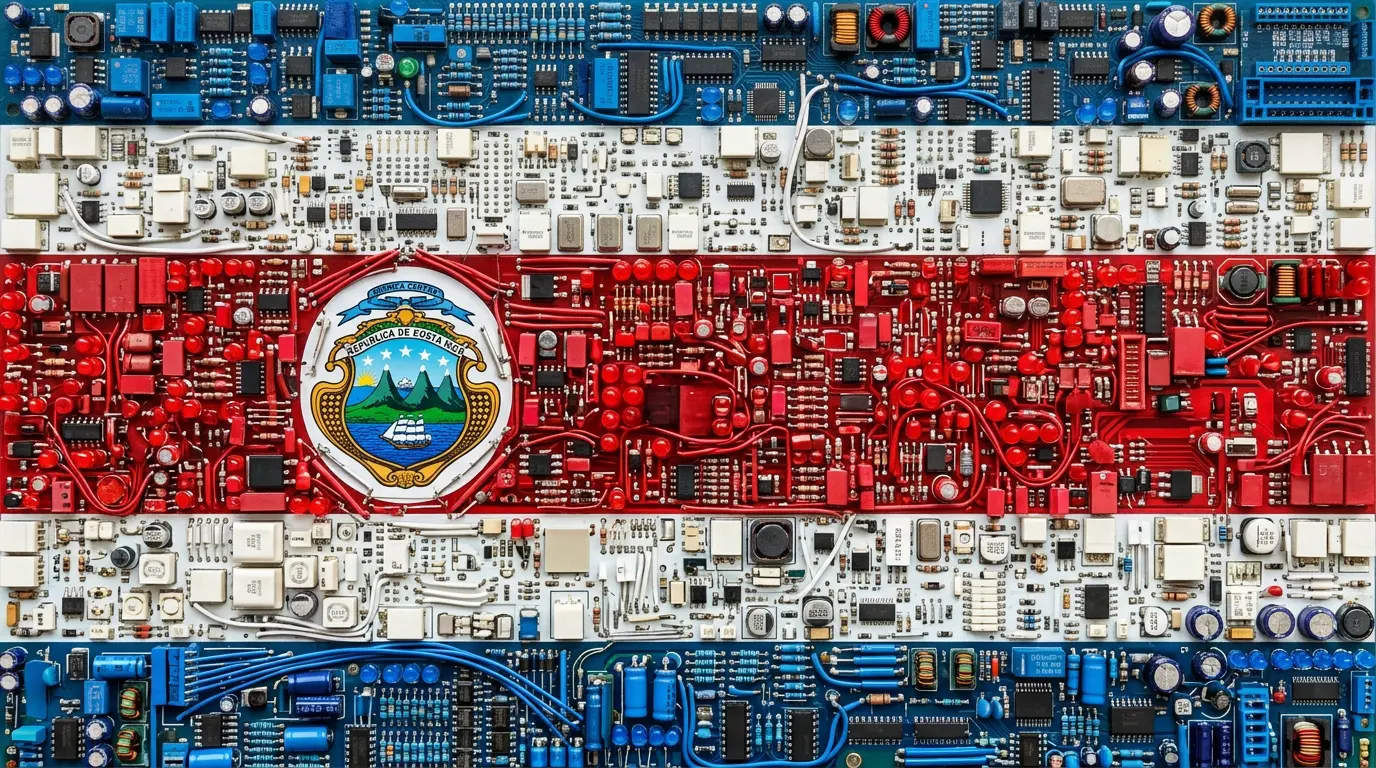
The leading costa rica quantum computing companies and institutions in 2026 form a very small, emerging ecosystem, and it is best to be honest about that from the start. Costa Rica has no commercial quantum companies at all. What the country has is a university with genuine quantum-physics research, a national advanced-computing centre, a growing quantum-education effort, and a major semiconductor industry that could one day become relevant. Seven organisations define the costa rica quantum computing companies landscape in this guide: the University of Costa Rica and its CICANUM and CICIMA research centres, the Universidad Nacional, the Instituto Tecnologico de Costa Rica, CNCA-CeNAT, and the science ministry MICITT.
Why Costa Rica has no quantum companies yet
Costa Rica’s quantum landscape is, honestly, very thin, and it is important to say so plainly. Costa Rica is a country of around five million people, and it has no commercial quantum companies, no quantum-hardware or quantum-software startups, and no national quantum programme. The country does not appear in international databases of quantum companies, and that absence is accurate rather than an oversight.
What Costa Rica does have is the early beginnings of a research and education base. The University of Costa Rica carries out genuine quantum-physics research, mostly in quantum optics and quantum metrology, the country runs a national advanced-computing centre, and there is a growing effort to teach quantum computing to students. Costa Rica also has a significant semiconductor industry. The costa rica quantum computing companies landscape is therefore best understood not as a vendor list but as an honest picture of a small country with research foundations, an education effort, and an industrial base, from which a quantum effort might one day grow.
The semiconductor industry and quantum
One genuinely distinctive feature of Costa Rica is its semiconductor industry. The country hosts a large operation by the chip company Intel, with semiconductor assembly and test work and a research-and-development centre employing several thousand people, and Costa Rica has been positioning itself within the global semiconductor supply chain.
It is important to be honest about how this connects to quantum technology. Intel’s own quantum-chip research is carried out at its laboratories elsewhere, not in Costa Rica, so there is no direct quantum-hardware activity in the country’s semiconductor plants today. What the semiconductor industry does give Costa Rica is a pool of engineering talent, real manufacturing experience, and a place in the chip supply chain. Some quantum-hardware approaches, such as silicon-based qubits, are closely related to conventional chip manufacturing. The honest framing is that the semiconductor base gives the costa rica quantum computing companies a foundation that could become relevant to quantum hardware in the future, though that link is aspirational rather than actual today.
The top costa rica quantum computing organisations
Seven organisations define the costa rica quantum computing companies landscape covered in this guide. Because Costa Rica has no commercial quantum companies, all of them are universities, research centres, or a government ministry. The University of Costa Rica, with its CICANUM and CICIMA research centres, is the main research base, the Universidad Nacional and the Instituto Tecnologico de Costa Rica add further academic capability, and CNCA-CeNAT provides advanced computing. MICITT is the science ministry. The CNCA-CeNAT centre provides advanced computing for the costa rica quantum computing companies.
The organisations below are the ones with a genuine, verifiable connection to quantum science and computing in Costa Rica. The profiles cover each one in depth, and note honestly where the quantum link is direct and where it is a foundation rather than active work today.






What the landscape reveals
The first pattern is the honest one: Costa Rica has no commercial quantum sector. There are no quantum companies, no startups, and no national quantum programme. The Costa Rica quantum companies landscape is, for now, a research-and-education picture rather than an industry.
Research is concentrated in one university
The second pattern is that genuine quantum research is concentrated at the University of Costa Rica, and it is research physics, mainly quantum optics and quantum metrology, rather than quantum computing. The Costa Rica quantum companies landscape has a single real research anchor, supported by a few research centres.
Education and the semiconductor base are the strengths
The third pattern is that Costa Rica’s realistic strengths are quantum education and its semiconductor industry. A growing effort teaches quantum computing to students, and the chip-manufacturing base gives the country engineering talent. The Costa Rica quantum companies landscape is best understood through these foundations.
The research base behind Costa Rican quantum
Costa Rica’s quantum research rests almost entirely on the University of Costa Rica. The School of Physics is home to the country’s leading quantum-physics researcher, trained in quantum optics and precision laser spectroscopy at leading European institutes, whose work spans quantum optics, trapped-ion and laser spectroscopy, and quantum metrology. This research is supported by two university research centres, CICANUM for atomic and molecular sciences and CICIMA for materials science.
Beyond the University of Costa Rica, the Universidad Nacional contributes through its physics department and has installed small educational quantum computers from SpinQ, and the Instituto Tecnologico de Costa Rica adds engineering education and supports quantum outreach. It is honest to note that this research base is small and recent, much of it developing only in the last few years. Together these institutions give the Costa Rica quantum companies a modest but genuine research-and-education base, concentrated in quantum optics and quantum metrology.
The San Jose quantum map
The Costa Rica quantum companies landscape is concentrated in and around the capital region. San Jose is the centre, home to the University of Costa Rica with its School of Physics and its CICANUM and CICIMA research centres, and to CNCA-CeNAT, the national advanced-computing centre. The capital concentrates most of the country’s genuine quantum-research activity.
The wider central region holds the rest of the ecosystem. Heredia, near San Jose, is home to the Universidad Nacional and to the large Intel semiconductor operation. Cartago, also in the central region, hosts the Instituto Tecnologico de Costa Rica. The science ministry MICITT is based in the capital. For such a small country, the Costa Rica quantum companies landscape is naturally compact, a single cluster in the central region around San Jose.
When Costa Rica matters for your quantum strategy
Quantum optics and metrology research
If your interest is research collaboration in quantum optics or quantum metrology, Costa Rica has a small but genuine capability. The University of Costa Rica carries out real research in quantum optics, trapped-ion and laser spectroscopy, and quantum metrology, led by a researcher with strong international training. Organisations seeking a research partner in precision quantum measurement in Central America should be aware of the Costa Rica quantum companies and the University of Costa Rica.
The semiconductor supply chain
For the semiconductor industry, Costa Rica is genuinely relevant. The country hosts a large Intel operation and is positioned in the global chip supply chain, with engineering talent and manufacturing experience. While this is not quantum-hardware activity today, organisations thinking about the long-term semiconductor foundations of quantum hardware should be aware of the Costa Rica quantum companies and the country’s chip-manufacturing base.
Quantum education and outreach
For quantum education, Costa Rica has a real and growing effort. The universities have organised quantum-literacy events, and the Universidad Nacional has brought teaching quantum computers to its students. Organisations interested in quantum education and skills-building in Central America should consider the Costa Rica quantum companies and the country’s outreach efforts.
Frequently asked questions
Are there any Costa Rica quantum companies in 2026?
There are no commercial quantum companies based in Costa Rica in 2026. This is an honest assessment, not an oversight. Costa Rica is a country of around five million people, and it has no quantum-hardware or quantum-software startups, and no quantum-communication or quantum-sensing firms. The country does not appear in international databases of quantum companies. What Costa Rica has instead is a university with genuine quantum-physics research, a national advanced-computing centre, a growing quantum-education effort, and a major semiconductor industry. The Costa Rica quantum companies landscape is therefore best understood as a research-and-education picture, the early foundations from which a quantum effort might grow, rather than an existing commercial industry.
Does Costa Rica have a quantum computer?
Costa Rica has taken an early step toward quantum hardware for education. The Universidad Nacional, based in Heredia, has acquired small educational quantum computers from SpinQ, based on nuclear-magnetic-resonance technology, room-temperature machines intended for teaching rather than for solving hard computational problems. This places it among the first universities in Central America with quantum hardware on site, and its value is giving students hands-on experience while they learn. Costa Rica does not host a large research-grade quantum computer, and its researchers access powerful quantum machines through international cloud services. For the Costa Rica quantum companies, the realistic priority is research and education rather than hosting large quantum hardware.
How does Costa Rica’s semiconductor industry relate to quantum computing?
Costa Rica hosts a large operation by the chip company Intel, with semiconductor assembly and test work and a research-and-development centre, and the country has been positioning itself within the global semiconductor supply chain. It is important to be honest about the connection to quantum technology.
Intel’s own quantum-chip research is carried out at its laboratories elsewhere, not in Costa Rica, so there is no direct quantum-hardware activity in the country’s chip plants today. What the semiconductor industry gives Costa Rica is engineering talent, manufacturing experience, and a place in the chip supply chain. Some quantum-hardware approaches are closely related to conventional chip manufacturing, so the honest framing is that this base could become relevant to the Costa Rica quantum companies in the future, though that link is aspirational rather than actual today.
What quantum research happens in Costa Rica?
Genuine quantum research in Costa Rica is concentrated at the University of Costa Rica, in its School of Physics. The country’s leading quantum-physics researcher, trained in quantum optics and precision laser spectroscopy at leading European institutes, carries out work spanning quantum optics, trapped-ion and laser spectroscopy, and quantum metrology, supported by the university’s CICANUM and CICIMA research centres. It is honest to be precise that this is research physics rather than quantum computing, and that quantum metrology, the use of quantum effects for very precise measurement, is one of the most mature branches of quantum technology. This research base is small and recent. The University of Costa Rica gives the Costa Rica quantum companies their main quantum-research anchor.
Does Costa Rica have a national quantum programme?
Costa Rica does not have a dedicated national quantum strategy or quantum programme. The country’s science ministry, MICITT, runs a national science, technology and innovation plan, but it does not yet include a specific quantum strategy. Government policy matters for an emerging quantum ecosystem because sustained support, funding, and a clear direction are what allow research and skills to grow, and Costa Rica has not yet taken that step for quantum technology specifically. MICITT is the government institution through which a future national quantum strategy could be developed, if the country chooses to build one. For now, the Costa Rica quantum companies landscape is driven by universities and their education efforts rather than by a national programme.
Where is quantum activity based in Costa Rica?
The Costa Rica quantum companies landscape is concentrated in and around the capital region. San Jose is the centre, home to the University of Costa Rica with its School of Physics and its CICANUM and CICIMA research centres, and to CNCA-CeNAT, the national advanced-computing centre.
The wider central region holds the rest of the ecosystem. Heredia, near San Jose, is home to the Universidad Nacional and to the large Intel semiconductor operation, and Cartago hosts the Instituto Tecnologico de Costa Rica. The science ministry MICITT is based in the capital. For such a small country, the Costa Rica quantum companies landscape is naturally a single compact cluster in the central region around San Jose.
Why is Costa Rica’s quantum ecosystem so small?
Costa Rica’s quantum ecosystem is small mainly because the country itself is small and its quantum activity is recent. With around five million people, Costa Rica has a limited number of physicists and a small university system, and most of its quantum-related research and education has developed only in the last few years.
Building a quantum-hardware or quantum-software company needs a deep pool of specialist talent and significant investment, which is difficult to assemble in a country of this size and at this stage. This is not a weakness specific to Costa Rica but a realistic feature of small nations early in their quantum development. The Costa Rica quantum companies landscape reflects that reality, and the country’s realistic path is through university research, quantum education, and its semiconductor base.
How does Costa Rica compare with other quantum nations?
Costa Rica is at an early stage compared with most countries with a quantum presence. It does not have the company ecosystems of nations such as the Netherlands, Finland, or Germany, it has no commercial quantum sector, and it has no national quantum programme.
Among Latin American countries, its quantum activity is more limited than that of Mexico, Chile, or Colombia. But Costa Rica does have genuine assets: real quantum-physics research at the University of Costa Rica, a national advanced-computing centre, a growing quantum-education effort, and a significant semiconductor industry. The honest comparison is that the Costa Rica quantum companies landscape is an emerging one, built on modest research foundations, an education effort, and an industrial base, with its realistic future depending on how deliberately the country chooses to build on them.



See today’s quantum computing news on Quantum Zeitgeist for the latest breakthroughs in qubits, hardware, algorithms, and industry deals.