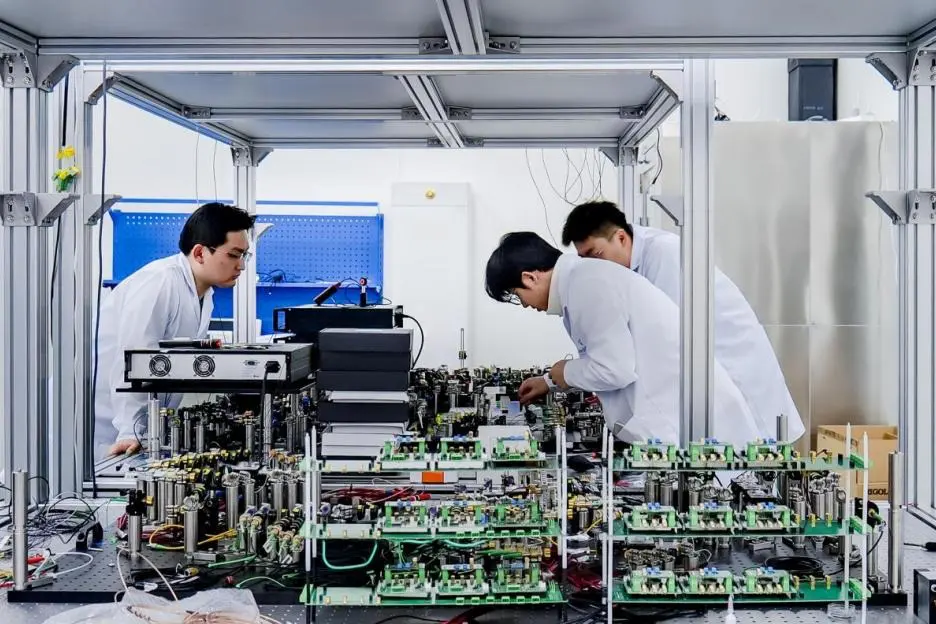
China Telecom has activated the Tianyan-P2000, a new photonic quantum computer capable of controlling 2,682 photons and now accessible via its cloud platform to researchers globally. The system recently completed a complex computation in 29 microseconds, a calculation estimated to require 16 billion years for even the most powerful classical supercomputers. This achievement marks China’s first online quantum advantage service utilizing photonic technology, offering a potential alternative to superconducting systems that demand extreme cooling. “With Tianyan-P2000 online, our platform has become the world’s first cloud platform capable of providing quantum advantage services through both photonic and superconducting technologies,” said Huang Wenya, a senior product manager of the Tianyan quantum cloud platform. According to China Telecom Quantum Group, the room-temperature operation and longer coherence times of this photonic approach offer advantages in cost and scalability.
Tianyan-P2000: Photonic Quantum Computing and Cloud Access
The Tianyan-P2000 photonic quantum computer, now operational and linked to China Telecom’s cloud platform, demonstrates a significant advance in qubit control with its ability to manage 2,682 photons, a figure indicative of its computational power. This achievement builds upon the core architecture of Jiuzhang 4.0, a prototype previously highlighted in Nature for surpassing classical computers in a specialized task, and represents a move toward wider accessibility for quantum computing resources. This speed is enabled by the fundamental principles of quantum computation, where, as explained by China Science Communication, quantum computers explore multiple possibilities simultaneously, unlike their classical counterparts which process information sequentially. Currently, Tianyan-P2000 is serving research institutions, universities, and businesses, with applications already launched in areas such as graph data analysis, drug discovery, and machine vision; the platform has already logged over 50 million visits and processed more than 4 million experimental tasks for users spanning 60 countries and regions. The system’s ability to maintain qubit coherence for extended periods further enhances its potential for complex calculations and reliable results.
With Tianyan-P2000 online, our platform has become the world’s first cloud platform capable of providing quantum advantage services through both photonic and superconducting technologies.
Jiuzhang 4.0 Architecture Enables Quantum Advantage Benchmarks
The pursuit of practical quantum computation recently saw a significant stride forward with the activation of the Tianyan-P2000 photonic quantum computer built upon the foundations laid by the Jiuzhang 4.0 prototype. This system is not simply an incremental improvement, but a deployment of an architecture previously validated for surpassing the capabilities of classical computers. Developers confirmed Tianyan-P2000 leverages the same core architecture as Jiuzhang 4.0, a prototype highlighted in Nature for achieving a quantum advantage in a specific computational task, signaling a transition to accessible online service. China Telecom Quantum Group reports the new system can control 2,682 photons, representing a substantial increase in qubit control for a photonic quantum computer and directly impacting its potential for complex calculations.
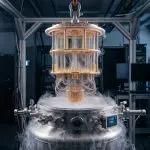
According to Liu Chunwang, a quantum control engineer at China Telecom Quantum Group, the choice of photonic qubits offers distinct advantages. He stated that “photonic quantum computing can operate at room temperature,” contrasting this with the extreme cryogenic requirements of superconducting systems, potentially lowering operational costs and broadening accessibility. Beyond eliminating the need for supercooling, the Tianyan-P2000’s photonic approach also boasts extended qubit coherence times and reduced noise, critical factors for maintaining accuracy in quantum calculations.



See today’s quantum computing news on Quantum Zeitgeist for the latest breakthroughs in qubits, hardware, algorithms, and industry deals.