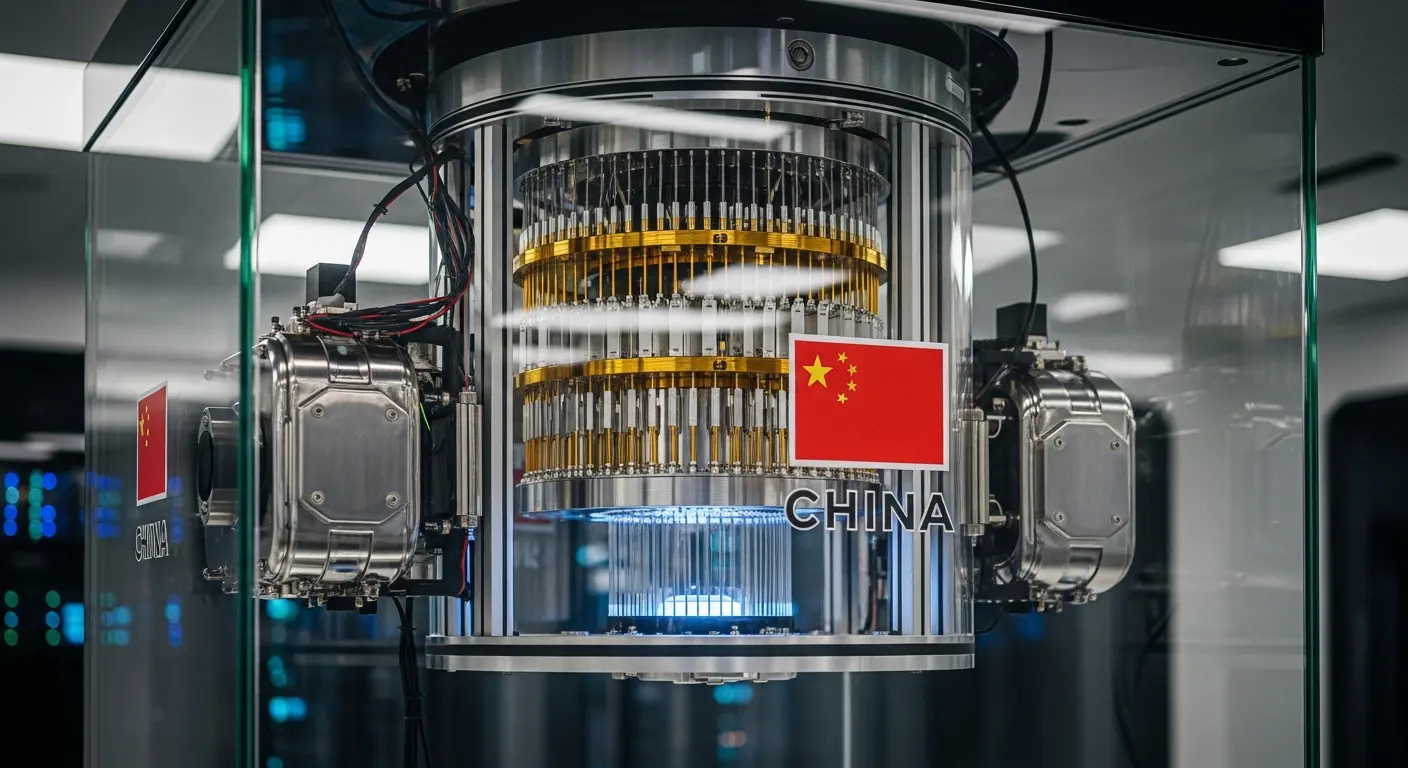
The leading china quantum computing companies in 2026 sit inside the most state-directed quantum ecosystem in the world, anchored by the University of Science and Technology of China in Hefei and funded through a national programme whose scale is widely quoted at around fifteen billion dollars, a figure that traces to a single 2022 McKinsey estimate and that credible analyses dispute. China ranks among the top two nations on quantum-advantage benchmarks, yet its commercial layer is younger and thinner than the United States, and two of its largest technology firms have stepped away from the field. This guide profiles the ten anchor organisations that lead the china quantum computing companies, from USTC spinouts to listed instrument makers, and explains how the state-led model actually works.
1. China’s quantum effort is state-led and academia-anchored. The centre of gravity is USTC in Hefei, which built the Jiuzhang photonic and Zuchongzhi superconducting processors. Almost every commercial player is a USTC spinout or a state institute rather than a venture-funded startup.
2. Origin Quantum is the commercial flagship. The Hefei full-stack firm runs the Wukong machine on a public cloud and shipped the 180-qubit Wukong-180 in 2026. It is the closest Chinese counterpart to IBM or Rigetti.
3. QuantumCTek and CIQTEK are the most mature businesses. Listed QuantumCTek leads quantum communication and is now controlled by China Telecom, while CIQTEK sells the instruments the sector runs on and cleared its own IPO in December 2025.
4. Photonics and education round out the field. TuringQ builds photonic quantum chips in Shanghai, and Shenzhen’s SpinQ exports desktop teaching machines while building superconducting systems for industry.
5. Big tech has pulled back. Alibaba closed its quantum lab in 2023 and Baidu donated its lab to a Beijing state institute in 2024, both redirecting effort to artificial intelligence.
6. Funding is national, the constraints are structural. A large state programme concentrates work in Hefei and Beijing, but export controls and a thinner private-venture layer than the United States are the main limits on the china quantum computing companies.
Why China punches at the quantum frontier
China sits at the leading edge of experimental quantum computing despite a commercial sector that is younger than its American rivals, and the reason is concentration of state resources rather than a broad startup market. The country treats quantum technology as a strategic priority, channelling sustained public funding into a small number of academic centres and their spinouts. That focus has produced two of the most cited quantum-advantage demonstrations in the field, the Jiuzhang photonic experiments and the Zuchongzhi superconducting processors, both from USTC.
The structure looks very different from the Dutch or German ecosystems, where independent startups compete across modalities. In China the research base and the commercial layer are tightly linked, with USTC acting as the source of talent, intellectual property and the founding teams behind Origin Quantum, QuantumCTek and CIQTEK. The result is a system that can move fast on national priorities, even though it carries fewer independent companies than its overall scale might suggest.
The state-led model and national programme
China’s quantum push is coordinated from the top, with central and provincial governments funding laboratories, talent programmes and the Hefei National Laboratory, the quantum-focused institute on the USTC campus. The often-quoted fifteen-billion-dollar commitment comes from one 2022 McKinsey estimate rather than any audited disclosure, and published estimates run from about four billion dollars upward. USTC’s own Chao-Yang Lu has said the real figure may be roughly a quarter of the number in circulation, so the honest position is that the true scale is unknown and much of the spending is infrastructure rather than direct company investment. The money concentrates activity in two hubs, Hefei in Anhui province and Beijing.
The policy backdrop tightened further in 2026. China’s fifteenth Five-Year Plan, adopted by the National People’s Congress in March 2026, names quantum technology first among the future industries it singles out for support, ahead of biomanufacturing, hydrogen and fusion energy, brain-computer interfaces, embodied intelligence and sixth-generation mobile communication. Sector funding rebounded sharply, with roughly 3.2 billion yuan of disclosed private rounds in the first quarter of 2026 alone, more than the whole of 2025. Shanghai reactivated the STAR Market’s fifth listing standard in June 2026 and widened it to cover quantum technology, clearing a public-capital path for pre-profit firms such as Origin Quantum.
The model deliberately blends research and commercialisation. State institutes such as the Beijing Academy of Quantum Information Sciences absorb hardware that private firms step away from, while listed companies like QuantumCTek operate national quantum-communication networks under state control. After China Telecom took control of QuantumCTek in 2025, the line between the commercial china quantum computing companies and the state became thinner still, which is a defining feature of the ecosystem.
The top china quantum computing companies
Ten anchor organisations lead the china quantum computing companies covered in this guide. One is the research anchor that produced most of the others (USTC), five are commercial vendors spanning superconducting, photonic, communication and instrument lines (Origin Quantum, QuantumCTek, CIQTEK, SpinQ and TuringQ), one is the state institute that consolidates donated hardware (BAQIS), and three illustrate the big-technology retreat and the software-only path (Baidu, Alibaba and Huawei). For the global picture, see our worldwide quantum computing companies guide. Independent directories of the China quantum computing companies reach a similar shortlist of names.









What the lineup shows
The Chinese lineup is unusually top-heavy on research and instruments. Origin Quantum is the only full-stack superconducting maker at scale, QuantumCTek dominates the communication layer, and CIQTEK supplies the hardware everyone else needs, which means the supply chain is concentrated in a handful of Hefei names. Photonics, through TuringQ, and education hardware, through SpinQ, add breadth, but the absence of many independent processor startups is the clearest contrast with the United States.
The wider Chinese quantum field
Beyond the ten anchor organisations, a deeper bench of firms and state institutes fills out the sector. QBoson, a Beijing maker of coherent optical Ising machines, raised about 145 million dollars in early 2026 to expand chip production, while the Hefei software house MiQro Era and the Shenzhen drug-discovery specialist XtalPi build out the algorithm and quantum-chemistry layers. Tencent keeps an active quantum laboratory focused on software and research rather than hardware, echoing the cloud-and-software route that Huawei took.
State-owned carriers add the communication layer, with China Telecom, China Mobile and China Unicom all running quantum-key-distribution links across the national backbone. For the full roster and how these names map across modalities, our Quantum Navigator tracks around fifty Chinese organisations in total.
Jiuzhang, Zuchongzhi and the advantage record
China’s strongest claim to the quantum frontier rests on two USTC processor families. Jiuzhang is a photonic line that performed Gaussian boson sampling from 2020 onward, and the 105-qubit Zuchongzhi 3.0, published as a Physical Review Letters cover in 2025, ran an 83-qubit random-circuit-sampling task its authors estimate around ten to the fifteenth power times faster than the leading classical supercomputer. USTC extended the superconducting line in December 2025 with the 107-qubit Zuchongzhi 3.2, which ran a distance-7 surface-code logical qubit below the fault-tolerance threshold, a move from raw sampling toward error correction. Both lines keep China in direct competition with the United States, though every such benchmark is contested and carries no direct commercial use on its own.
The photonic line advanced again in May 2026, when the USTC teams of Pan Jianwei and Lu Chaoyang reported Jiuzhang 4.0 in the journal Nature. The processor feeds 1,024 squeezed-state inputs through an 8,176-mode circuit and recorded up to 3,050 photon detections, which its authors describe as the largest Gaussian boson sampling experiment to date and a result they estimate lies far beyond any classical supercomputer on that specific task. As with the earlier machines the claim measures sampling capability rather than a general speed-up, and independent groups continue to test how wide the real gap is, so we treat it as a debated frontier result. Our coverage of Jiuzhang 4.0 and its 1,024 squeezed states walks through the detail.
These demonstrations matter less as products than as proof of capability, because the sampling tasks have no commercial use on their own. What they show is that China’s hardware can operate in the regime where classical simulation becomes infeasible, which underwrites the credibility of the whole sector. Our explainer on what quantum supremacy means covers how these benchmarks work and why they are contested.
Why Alibaba and Baidu pulled back
The most striking recent shift among the china quantum computing companies is the retreat of the platform giants. Alibaba’s DAMO Academy closed its quantum laboratory in November 2023 and donated the equipment to Zhejiang University, and Baidu followed in January 2024 by handing its laboratory and its Qianshi processor to the Beijing Academy of Quantum Information Sciences. Both companies redirected resources toward artificial intelligence during a period of cost discipline.
The exits do not signal a national retreat, because the hardware was absorbed by state institutes rather than scrapped. They do show that China’s quantum strength sits with academia and the state rather than with its consumer-internet champions, which is the opposite of the pattern in the United States, where Google and IBM lead. The commercial baton in China has passed to focused specialists like Origin Quantum and QuantumCTek.
Constraints: export controls and funding
The biggest external constraint on the china quantum computing companies is access to advanced components and tools, since United States and allied export controls limit Chinese firms’ access to some cryogenics, control electronics and fabrication equipment. That pressure has pushed companies like Origin Quantum to develop fully domestic stacks, which builds resilience but slows progress in areas where imported parts were faster.
The funding model is the second constraint. State money is abundant for infrastructure and academic work, but the private venture layer is thinner than in the United States, which leaves fewer independent startups and concentrates risk in a small number of names. Recent rounds, including SpinQ’s near CNY 1 billion Series C and TuringQ’s raise toward a CNY 7 billion valuation, suggest private capital is returning, though the sector remains far more state-shaped than its Western peers.
When China matters for your quantum strategy
Tracking the hardware frontier
If you follow the global race for quantum advantage, the Chinese programme is unavoidable, because USTC’s Jiuzhang and Zuchongzhi lines set part of the benchmark that everyone else is measured against. Watching Origin Quantum’s Wukong roadmap and the next Zuchongzhi generation is the clearest way to gauge how fast the gap with the United States is opening or closing.
Quantum communication and instruments
For quantum-secure communication and laboratory instruments, the Chinese names are genuinely world-class. QuantumCTek operates the largest quantum-communication networks anywhere, and CIQTEK exports the spectrometers, magnetometers and refrigerators that quantum labs worldwide rely on, so procurement and standards teams should track both regardless of geography.
Track the quantum race
Get the Quantum Zeitgeist newsletter
China’s quantum programme moves fast, from new Origin Quantum machines to fresh Jiuzhang and Zuchongzhi results. Join the Quantum Zeitgeist newsletter to follow the stories shaping the field as they happen.
Free to join, and you can unsubscribe at any time. Emails are handled by Substack; see our privacy policy.
Frequently asked questions
Who are the leading china quantum computing companies in 2026?
The Chinese ecosystem is anchored by USTC in Hefei, which built the Jiuzhang and Zuchongzhi processors and seeded most commercial spinouts. The leading commercial china quantum computing companies are Origin Quantum, a full-stack superconducting maker behind the Wukong machines; QuantumCTek, the listed quantum-communication leader now controlled by China Telecom; CIQTEK, a quantum-instruments and sensing firm; SpinQ, which builds superconducting systems and exports desktop teaching machines; and TuringQ, China’s first photonic quantum-computing company. The Beijing Academy of Quantum Information Sciences is the main state research institute, while Baidu and Alibaba have exited hardware.
What is Origin Quantum and why does it matter?
Origin Quantum is China’s leading commercial quantum-computer maker, founded in 2017 as a USTC spinout in Hefei. It builds a full stack of chips, control electronics and software, and it operates the Wukong superconducting machine on a public cloud that has logged more than 50 million remote accesses from over 160 countries and more than 900,000 jobs. The company launched the 180-qubit Wukong-180 in 2026 and completed China’s first export of domestic quantum computing power in 2025, which makes it the closest Chinese analogue to IBM or Rigetti.
Does China lead the United States in quantum computing?
China leads on some experimental benchmarks but not across the board. USTC’s Jiuzhang and Zuchongzhi processors rank among the strongest quantum-advantage demonstrations, and Zuchongzhi 3.0 in 2025 posted a result competitive with Google’s Willow. However, the United States has a deeper commercial layer, more independent companies and stronger access to advanced components, so the picture is a close race rather than a clear lead for either side. China is ahead on quantum communication networks, while the United States has more diverse hardware companies.
Why did Alibaba and Baidu close their quantum labs?
Both companies stepped back from quantum hardware during a period of cost discipline and a strategic pivot to artificial intelligence. Alibaba’s DAMO Academy closed its quantum laboratory in November 2023 and donated the equipment to Zhejiang University, and Baidu donated its laboratory and its Qianshi processor to the Beijing Academy of Quantum Information Sciences in January 2024. The hardware was absorbed by state institutes rather than scrapped, so China’s overall capacity was preserved even as the platform giants exited.
What is QuantumCTek?
QuantumCTek is China’s quantum-communication and quantum-key-distribution leader, based in Hefei and listed on the STAR Market under code 688027. It was the first Chinese quantum company to go public, in 2020, and China Telecom became its controlling shareholder in January 2025, anchoring it to the state. The company runs the Tianyan quantum cloud platform, which has drawn over 37 million visits from more than 60 countries, and it reported 2025 revenue near RMB 310 million.
How is China’s quantum sector funded?
China funds quantum technology mainly through the state, with central and provincial governments backing laboratories, talent programmes and a national laboratory in Hefei. Western estimates put the cumulative public commitment in the tens of billions of dollars, larger than any single Western programme, although the figures are uncertain and much of the spending is infrastructure. Private venture capital is thinner than in the United States, but recent rounds for SpinQ and TuringQ suggest commercial investment in the china quantum computing companies is recovering.
What modalities do Chinese quantum companies focus on?
China spans several hardware modalities. USTC and Origin Quantum lead on superconducting qubits, the technology behind Zuchongzhi and the Wukong machines, while USTC’s Jiuzhang and the startup TuringQ pursue photonic quantum computing. SpinQ adds nuclear-magnetic-resonance systems for education alongside its superconducting line, and CIQTEK works on nitrogen-vacancy diamond and sensing technologies. Quantum communication, led by QuantumCTek, is a particular national strength that sits alongside the computing work.
What is Jiuzhang 4.0 and why does it matter?
Jiuzhang 4.0 is the 2026 generation of USTC’s photonic quantum processor, reported in the journal Nature by the teams of Pan Jianwei and Lu Chaoyang. It feeds 1,024 squeezed-state inputs through an 8,176-mode circuit and recorded up to 3,050 photon detections, which its authors call the largest Gaussian boson sampling experiment so far. The result measures sampling capability rather than a general-purpose speed-up, and like all quantum-advantage claims it remains debated, but it keeps China’s photonic line at the experimental frontier alongside the Zuchongzhi superconducting processors.
How do export controls affect China’s quantum companies?
United States and allied export controls limit Chinese access to some advanced cryogenics, control electronics and fabrication tools, which raises the cost and slows parts of the roadmap for the china quantum computing companies. The response has been a push for fully domestic stacks, and Origin Quantum in particular emphasises self-developed chips, measurement and control systems and software. The controls build long-term resilience by forcing local capability, but they remove the speed advantage that imported components once provided.


See today’s quantum computing news on Quantum Zeitgeist for the latest breakthroughs in qubits, hardware, algorithms, and industry deals.