

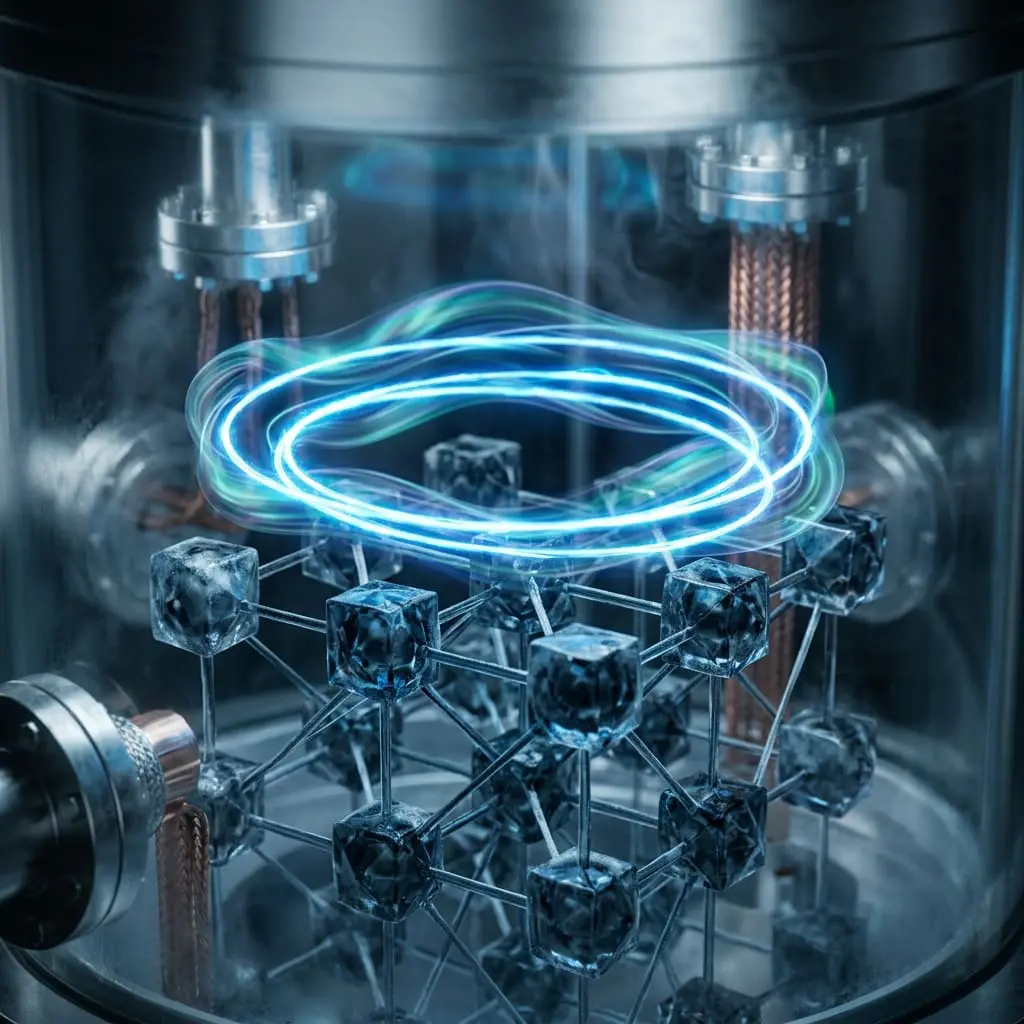
Georgia Institute of Technology and University of Michigan researchers have demonstrated a fundamental limitation to applying quantum computers to power grid optimization, proving that inherent network topology obstructs any potential speedup for direct current power flow calculations. The work establishes that grids that split into two large regions, a common characteristic of large transmission networks, force a quadratic growth in the pseudo condition number of the DC susceptance matrix as network size increases. This means that as the grid expands, the computational challenge escalates predictably, negating the promise of quantum algorithms. Combined with query and tomography lower bounds, the researchers found this precludes end-to-end quantum advantage, and have formally verified their proofs with accompanying Lean 4 source code, signaling a high degree of rigor and reproducibility.
QLS Complexity & Quantum Advantage Obstructions
The pursuit of quantum advantage in solving complex power grid calculations faces fundamental limitations imposed by the very structure of realistic transmission networks, according to new research from Georgia Institute of Technology and the University of Michigan. The work proves realistic grid properties limit the applicability of quantum computers for power flow. Grids that split into two large regions meeting at only a few buses, common in transmission networks, force the pseudo condition number of the DC susceptance matrix to grow polynomially in the network size, and long chains of lines bridging such regions force quadratic growth, making recent empirical observations rigorous. These bounds also hold with overwhelming probability for arbitrary bounded random line susceptances. Combined with query and tomography lower bounds, this precludes end-to-end quantum advantage for DC power flow at every readout level, and these obstructions persist through AC power flow, DC optimal power flow, and unit commitment.
All proofs are formally verified with accompanying Lean 4 source code. Researchers Cameron Khanpour and Samuel Talkington prove that grids characterized by distinct regions connected by limited tie lines, a common configuration in large-scale transmission systems, exhibit a pseudo condition number that grows polynomially with network size. Specifically, long chains of lines bridging such regions force quadratic growth, a precise limitation that moves beyond earlier empirical observations. This ill-conditioning isn’t simply a matter of poorly chosen test cases; the team’s analysis reveals that it’s a structural consequence of how power grids are designed and operated. The implications for quantum computing are stark. The team combines these topological limitations with established lower bounds on quantum query complexity and state readout to demonstrate that end-to-end quantum advantage for DC power flow is precluded, at every readout level.
Even assuming access to a hypothetical quantum random access memory (QRAM), recovering a classical approximation of the solution requires a number of quantum linear system (QLS) solves that exceeds classical methods, effectively negating any potential speedup. The researchers note this highlights the inherent overhead in translating quantum results into a usable classical form. The obstruction to quantum advantage isn’t limited to DC power flow; the researchers extend their analysis to AC power flow, DC optimal power flow, and even the computationally intractable layers of AC-OPF and unit commitment, suggesting a broad challenge for applying quantum algorithms to power systems optimization. The team concludes that nearly-linear time Laplacian solvers, randomized numerical linear algebra, and quantum-inspired algorithms may ultimately prove more effective in achieving the desired speedups, potentially augmented by algorithms running on conventional hardware.
Their analysis, rigorously verified with formal proofs in the Lean 4 programming language, shows that the ill-conditioning of power flow problems isn’t merely a quirk of specific test cases, but a structural property of realistic transmission networks. The core of their findings centers on how network separation impacts the pseudo condition number, a measure of how difficult a system is to solve. The researchers demonstrate that grids that split into two large regions force a polynomial, and in some cases quadratic, growth in this condition number as the grid expands. Transmission networks supply such cuts for both combinatorial properties of network decomposition and the physical phenomenon of inter-area electrical oscillations. Specifically, the presence of corridors, long lines acting as bottlenecks between regions, exacerbates this ill-conditioning. Theorem 1 highlights the disproportionate impact of these critical connections. The implications extend beyond DCPF.
Extension to AC/DC Power Flow & Optimization Layers
The assumption that quantum computers will effortlessly solve complex power grid calculations is facing increasingly rigorous scrutiny. Their findings, formally verified with accompanying Lean 4 source code, suggest that the very structure of modern transmission networks imposes computational bottlenecks that classical algorithms are already well-equipped to handle. Specifically, the team proved that grids that split into two large regions, connected by limited tie lines, force the condition number to grow polynomially with network size. The implications extend beyond the initial DC power flow (DCPF) calculations. The researchers rigorously show that these obstructions persist through increasingly complex layers of power system optimization. Every numbered result is machine-checked in Lean 4, highlighting the level of formal verification applied to these proofs. This level of rigor is unusual in the field, signaling a high degree of confidence in the findings.
The team’s analysis reveals that even retrieving a classical approximation of the solution requires applications of its preparation unitary and loading a dense classical vector, effectively negating any potential speedup. The authors conclude that nearly-linear time Laplacian solvers, randomized numerical linear algebra, and quantum-inspired algorithms may, in software, offer the most realistic path toward achieving the performance gains initially envisioned for quantum hardware.
The promise of quantum computers revolutionizing power grid optimization faces a sobering reality: the very structure of electricity transmission networks imposes limitations on potential speedups. These bounds aren’t limited to idealized scenarios. This structural limitation has profound implications for quantum computing. The work builds upon established quantum linear system (QLS) solver complexities, noting that QLS solving has query complexity dependent on the condition number.
👉 More information
🗞 The Limits of Quantum Computers for Power Flow
✍️ Cameron Khanpour and Samuel Talkington
🧠 ArXiv: https://arxiv.org/abs/2607.19263

See today’s quantum computing news on Quantum Zeitgeist for the latest breakthroughs in qubits, hardware, algorithms, and industry deals.



