Bertrand Russell found a hole in the foundations of mathematics in 1901, and the repair he built for it is still running inside the tools people use to program quantum computers. That is a strange sentence, and this page explains how it came to be true.
Russell was a British philosopher and logician who lived from 1872 to 1970, won the Nobel Prize in Literature, was sacked by two universities and was jailed twice. He is remembered by the public for almost none of the work that mattered most.
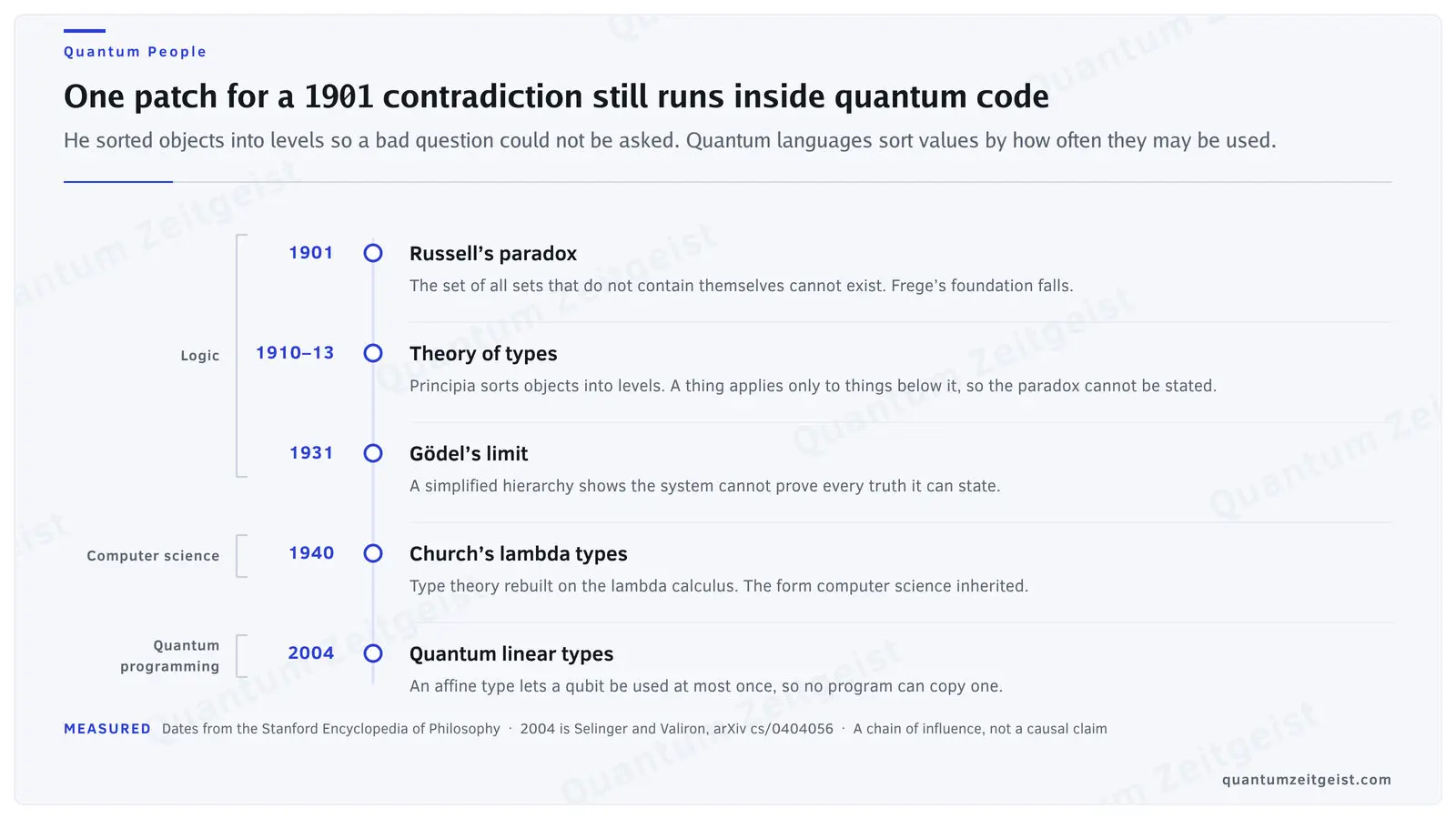
The through line is a single idea. Russell showed that a system of rules can quietly contain a contradiction, and he invented a way of sorting things into levels so the contradiction cannot be stated. Those levels are what programmers now call types.
1. One letter ended another mathematician’s life work. In 1901 Russell found a contradiction at the heart of the way collections were then defined. He wrote to Gottlob Frege, whose Grundgesetze der Arithmetik rested on exactly that definition. Frege replied with dismay and admiration, and never recovered from it.
2. The paradox is easy to state and hard to escape. Consider the collection of all collections that do not contain themselves. Ask whether it contains itself. Either answer gives you the opposite answer, so the definition cannot stand as it was written.
3. His repair was to forbid the question. Russell’s theory of types sorts objects into levels and rules that a thing may only be applied to things below it. The question that produces the paradox is then not false but meaningless, because it cannot be written down in the first place.
4. Ten years of work, and it still did not close the gap. Principia Mathematica, written with Alfred North Whitehead, came out in three volumes in 1910, 1912 and 1913. In 1931 Kurt Gödel used a simplified version of its own type system to show that no such system can prove every truth it can express.
5. Types outlived the project they were invented to save. Alonzo Church rebuilt Russell’s levels in 1940 on the lambda calculus. That is the ancestor of the type systems in ordinary programming languages, and of the affine linear types that quantum languages use to stop a program copying a qubit.
- Who Bertrand Russell was
- The letter that broke a life’s work
- What the paradox actually says
- Principia Mathematica and what it cost
- The theory of types, Russell’s repair
- How Gödel turned the system against itself
- From types to programming languages
- Why quantum programming needs Russell’s idea
- The public life, briefly
- What survived and what did not
- Bertrand Russell by the numbers
- Bertrand Russell FAQ
Who Bertrand Russell was
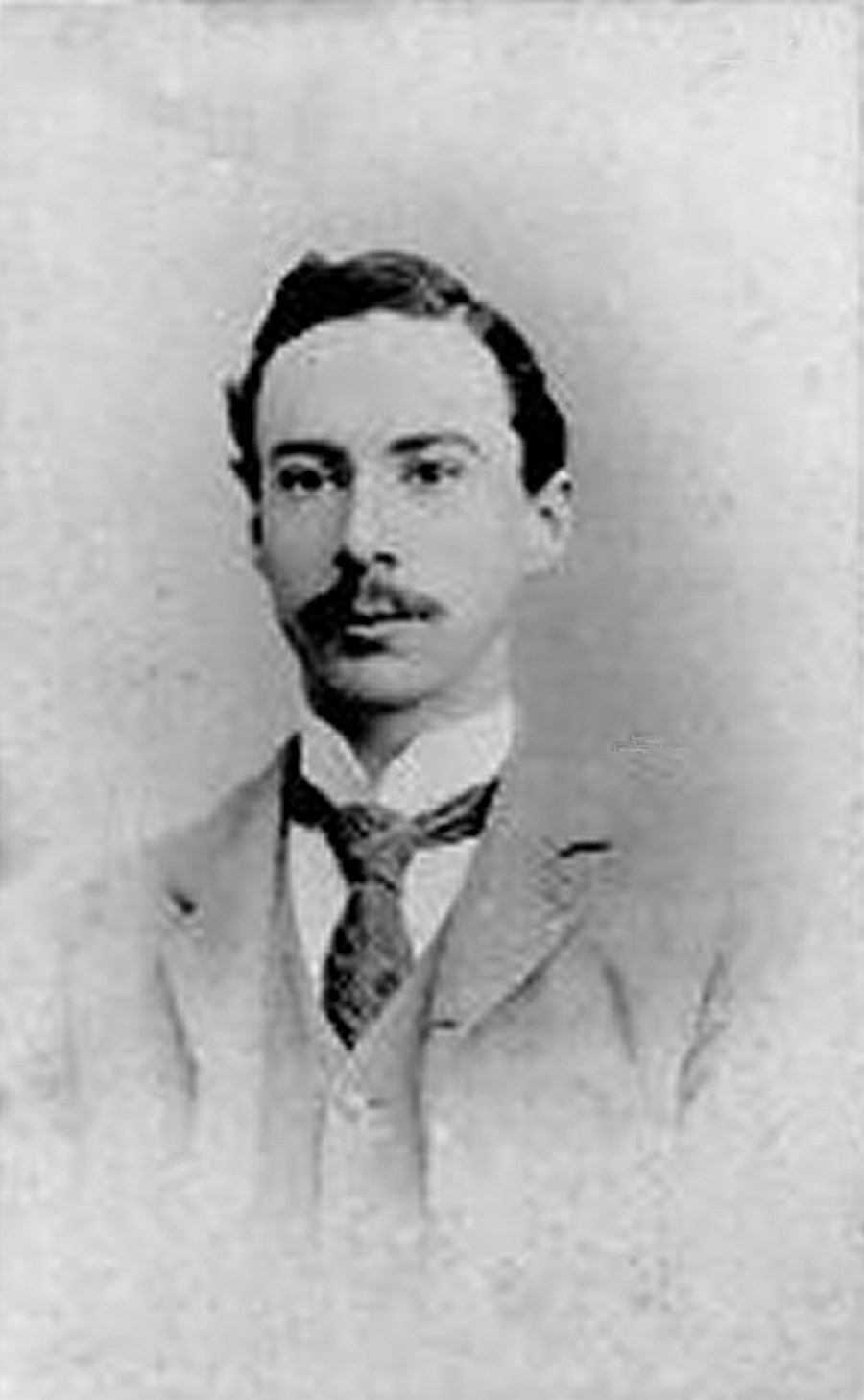
Bertrand Russell was born on 18 May 1872 at Ravenscroft in Trelleck, Monmouthshire, and both his parents were dead before he was four. His grandfather was Lord John Russell, a former prime minister, and the family won custody of the boy through the courts.
Bertrand Russell went to Trinity College, Cambridge, and spent most of his working life in and around it. The Stanford Encyclopedia entry on Bertrand Russell describes him as a philosopher, logician, essayist and social critic, best known for mathematical logic and analytic philosophy. With G. E. Moore he is counted as a founder of the analytic tradition.
The technical reputation rests on three things. He championed logicism, the view that mathematics reduces in some important sense to logic, and he refined Frege’s predicate calculus, which still underlies most modern logic. The third is the paradox and the theory of types that are the subject of this page.
He died on 2 February 1970 at Penrhyndeudraeth in Wales, aged 97. The span is worth holding in mind, because he was born four years before the telephone was patented and died the year before the first commercial microprocessor shipped.
The letter that broke a life’s work
Bertrand Russell came across the contradiction while working on his Principles of Mathematics, published in 1903. He is inconsistent about when, and the encyclopedia entry on the paradox sets out the discrepancy. He wrote in 1944 that it was June 1901, in 1959 that it was the spring of that year, and in 1969 that it was May.
He was not alone in finding trouble. Cesare Burali-Forti had noticed a related problem in 1897 involving the set of all ordinals. Several such antinomies surfaced in the same few years, which is usually the sign that a discipline has built on something it did not fully understand.
What made Russell’s version matter was where he sent it. Gottlob Frege had spent decades deriving arithmetic from logic, and the second volume of his Grundgesetze der Arithmetik was at the printer when Russell’s letter arrived. The letter set out the problem exactly as it applied to that work.
Frege added an appendix acknowledging the contradiction. He never found a repair that satisfied him and the project did not recover. It remains one of the more unusual episodes in the history of mathematics, a life’s work undone by a single page of correspondence.
What the paradox actually says
Start with an ordinary idea, which is that some collections contain themselves and some do not. The collection of all teacups is not itself a teacup, so it does not contain itself, while the collection of all non-teacups is not a teacup either and so does contain itself. Russell had a lasting fondness for this sort of crockery, and later invented an orbiting teapot to make a different point about who carries the burden of proof.
Now build the collection of every collection that does not contain itself. Ask the obvious question. Does it contain itself?
If it does contain itself then by its own definition it must not, and if it does not contain itself then it meets the entry condition and must. Both answers are wrong, which means the definition that allowed the collection to be built was itself wrong.
The damage is not to one collection. It is to the rule that said any property whatsoever picks out a collection of the things having it. That rule felt obvious and was doing a great deal of load bearing work, which is why removing it required a decade.
Principia Mathematica and what it cost
Principia Mathematica was written with Alfred North Whitehead and published in three volumes in 1910, 1912 and 1913, with a second edition following in 1925 and 1927. Its aim was to derive mathematics from logic alone, with every step made explicit and no appeal to intuition.
The explicitness is the famous part. The work is remembered for taking hundreds of pages to reach the proposition that one plus one equals two. That sounds absurd until you notice it is the point, since the whole exercise was to assume nothing that had not been written down.
The cost was real. Russell described the effort as having permanently damaged his appetite for that kind of work, and he never again attempted anything on the scale. The book sold poorly and was read closely by a small number of people, several of whom changed the twentieth century.
The theory of types, Russell’s repair
Bertrand Russell’s solution was to stop treating everything as the same kind of thing. Objects sit at the bottom, properties of objects sit one level up, properties of properties sit above that, and so on upward without limit.
The rule is then simple, since a property may only be applied to things strictly below it in the hierarchy, which means a collection cannot be a member of itself. Membership only ever runs upward through the levels.
This does not prove the paradox false. It makes the paradox unsayable. The sentence that generated the contradiction is not a false statement in the new system, it is not a statement at all, because the grammar of the system will not let you form it.
That move is the one worth remembering. Faced with a contradiction, Russell did not argue about the answer. He changed what counted as a well formed question, and a great deal of computer science has been doing the same thing ever since.
How Gödel turned the system against itself
In 1931 Kurt Gödel published his incompleteness results in a paper titled, in translation, On Formally Undecidable Propositions of Principia Mathematica and Related Systems. Russell and Whitehead’s book is named in that title because it was the most complete attempt of its kind.
Gödel did not use Russell’s full ramified hierarchy, but a simpler version of type theory, the one that keeps only classes, classes of classes and so on. That simplification was enough to carry the whole argument.
The result is that any consistent system rich enough to describe arithmetic contains true statements it cannot prove. The gap Russell spent a decade trying to close turned out not to be closable at all. Quantum Zeitgeist covers this in more depth in a separate piece on the incompleteness theorems.
It is worth being precise about what was lost. Principia was not shown to be wrong. It was shown to be incomplete, along with every other system of its kind, which is a limit on the ambition rather than a fault in the execution.
From types to programming languages
Bertrand Russell’s logicist programme did not survive. The machinery built for it did, and it travelled by a route nobody planned.
Alonzo Church gave a much cleaner formulation of simple type theory in 1940, built on the lambda calculus, treating functions as primitive objects rather than derived ones. The Stanford Encyclopedia notes that this formulation matters specifically because of its importance in computer science.
Every typed programming language is downstream of that, so when a compiler refuses to add a number to a piece of text it is applying Russell’s principle directly. Some combinations are not wrong answers, they are not questions the language will let you ask.
Alan Turing, working on a different question from the same Cambridge tradition, gave the other half of the foundation in 1936. Quantum Zeitgeist has a full account of the machine that defined computability.
Why quantum programming needs Russell’s idea
Quantum computing has a rule with no classical equivalent, and Bertrand Russell supplies the tool for it. An unknown quantum state cannot be copied, a result usually called the no-cloning theorem, so a program that duplicates a qubit is not merely inefficient but is describing something physics does not permit.
Catching that at the moment the program runs would be far too late. The natural place to catch it is the type system, which is exactly the tool Russell built for exactly this shape of problem.
Peter Selinger and Benoit Valiron set out a lambda calculus for quantum computation with classical control, giving it a type system based on affine intuitionistic linear logic. In a linear system a value must be used once. In an affine one it may be used at most once. Neither allows a value to be duplicated freely.
That constraint is the point. The physical rule that a qubit cannot be copied becomes a rule about which programs can be written at all, enforced before anything runs. Quantum Zeitgeist covers the wider field in quantum lambda calculus and the foundations of QPL and in a survey of quantum programming languages.
The lineage is direct rather than poetic. Russell sorted things into levels to make a bad question unaskable. A quantum type system sorts values by how many times they may be used, to make a physically impossible program unwritable. Same instinct, ninety years apart.
The public life, briefly

Bertrand Russell was dismissed from Trinity College, Cambridge, and later from City College, New York. He was imprisoned for opposing the First World War and again in his late eighties over anti-nuclear protest, and he campaigned against the war in Vietnam into his nineties.
He received the Order of Merit in 1949 and the Nobel Prize in Literature in 1950. The Nobel citation was awarded in recognition of his varied and significant writings in which he champions humanitarian ideals and freedom of thought.
It is a literature prize given largely for essays and popular books rather than for the logic, which is the ordinary shape of Russell’s public reputation. The work the public rewarded is not the work that still runs inside a compiler.
What survived and what did not
Bertrand Russell’s headline ambition failed. Mathematics was not reduced to logic, Gödel showed the programme could not be completed, and Principia is now read by historians rather than by mathematicians.
The tools outlived the ambition completely. Type theory became a working field of computer science, and the refined predicate calculus is still the basis of modern logic. The habit of asking whether a question is even well formed is now standard practice in language design.
There is a lesson in that for anyone building foundations today. Russell was wrong about what he was building and right about how to build it, and the second thing turned out to matter far more. His machinery is now in daily use by people who have never read a word of him.
- 1872Born on 18 May at Ravenscroft, Trelleck, Monmouthshire.
- 1901Finds the paradox and writes to Gottlob Frege about it.
- 1903Publishes The Principles of Mathematics.
- 1910First volume of Principia Mathematica appears, with volumes two and three in 1912 and 1913.
- 1931Gödel names Principia in the title of his incompleteness paper.
- 1940Church reformulates simple type theory on the lambda calculus.
- 1949Awarded the Order of Merit, and the Nobel Prize in Literature the following year.
- 1970Dies on 2 February at Penrhyndeudraeth, aged 97.
- 2004Selinger and Valiron publish a quantum lambda calculus typed with affine linear logic.
Bertrand Russell by the numbers
| Fact | Value | Detail |
|---|---|---|
| Born | 18 May 1872 | Ravenscroft, Trelleck, Monmouthshire |
| Died | 2 February 1970 | Penrhyndeudraeth, Wales, aged 97 |
| Paradox found | 1901 | He gave June, spring and May in three different accounts |
| Principia volumes | 3 | Published 1910, 1912 and 1913, second edition 1925 and 1927 |
| Co-author | Alfred North Whitehead | His former tutor at Cambridge |
| Gödel’s paper | 1931 | Names Principia Mathematica in its title |
| Church’s reformulation | 1940 | Simple type theory on the lambda calculus |
| Order of Merit | 1949 | Awarded the year before the Nobel |
| Nobel Prize | Literature, 1950 | For writings championing humanitarian ideals and freedom of thought |
| Universities that sacked him | 2 | Trinity College Cambridge, and City College New York |
The dates come from the Stanford Encyclopedia of Philosophy and the Nobel Foundation. Where Russell contradicted himself, as he did about the month he found the paradox, the table says so rather than picking one and presenting it as settled.
Bertrand Russell FAQ
What is Bertrand Russell’s paradox?
It concerns the collection of all collections that do not contain themselves. If that collection contains itself then by its own definition it must not, and if it does not then it must. Both answers contradict themselves, so the rule that allowed the collection to be defined has to go.
Why does Bertrand Russell matter to computing?
His theory of types sorts objects into levels so that certain expressions cannot be written at all. Alonzo Church rebuilt that idea on the lambda calculus in 1940, and it became the basis of type systems in programming languages, including the ones used for quantum computers.
What is the theory of types?
It is a hierarchy. Objects sit at the bottom, properties of objects one level up, properties of those above that. A property may only apply to things below it, which makes self-membership impossible to express and so removes the paradox.
What is Principia Mathematica?
A three-volume work by Bertrand Russell and Alfred North Whitehead, published in 1910, 1912 and 1913, that tried to derive mathematics from logic with every step written out explicitly. It is famous for taking hundreds of pages to establish that one plus one equals two.
Did Gödel disprove Russell?
Not exactly. Gödel’s 1931 paper, which names Principia Mathematica in its title, showed that any consistent system able to describe arithmetic contains true statements it cannot prove. Principia was shown to be incomplete rather than wrong.
What did Bertrand Russell win the Nobel Prize for?
The Nobel Prize in Literature in 1950, in recognition of his varied and significant writings in which he champions humanitarian ideals and freedom of thought. It was awarded for his essays and popular writing rather than for his work in logic.
How do types relate to quantum computing?
An unknown quantum state cannot be copied, which is the no-cloning theorem. Quantum programming languages use affine or linear type systems, in which a value may be used at most once, so a program that would duplicate a qubit cannot be written rather than merely failing when run.
When was Bertrand Russell born and when did he die?
Bertrand Russell was born on 18 May 1872 at Ravenscroft in Trelleck, Monmouthshire. He died on 2 February 1970 at Penrhyndeudraeth in Wales, aged 97. Both his parents were dead before he turned four.
Was Bertrand Russell imprisoned?
Yes, twice. He was jailed for his opposition to the First World War, and again in his late eighties in connection with anti-nuclear protest. He was also dismissed from Trinity College Cambridge and from City College New York.
What is logicism?
The view that mathematics is in some significant sense reducible to logic. It was the thesis Principia Mathematica set out to defend, and Gödel’s incompleteness results are generally taken to have ended the programme in its original form.



See today’s quantum computing news on Quantum Zeitgeist for the latest breakthroughs in qubits, hardware, algorithms, and industry deals.