IQM and AMD have demonstrated a chemistry simulation workflow that divides calculations between a quantum computer and graphics processing units, establishing a reproducible method for combining the two technologies, the company says. The collaboration tackles a core challenge in molecular modeling: an exponentially growing matrix that quickly becomes unsolvable for even the most powerful classical systems.
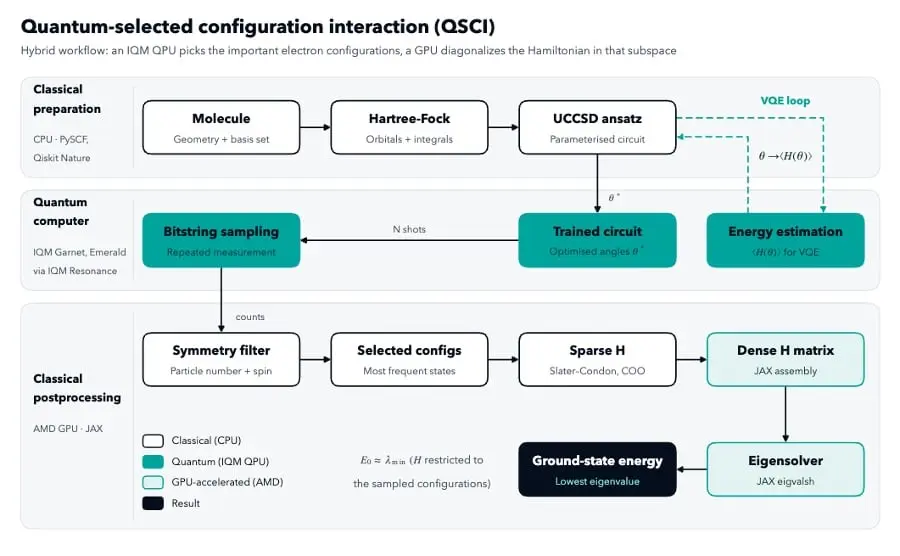
The method, called Quantum-Selected Configuration Interaction (QSCI), uses an IQM quantum computer to identify key electron arrangements before an AMD GPU completes the remaining calculations, a process the companies say “demonstrates that the pipeline works end to end.” This work represents the first in a series of posts detailing the joint effort to connect quantum and high-performance computing.
Quantum-Selected Configuration Interaction for Chemistry Simulations
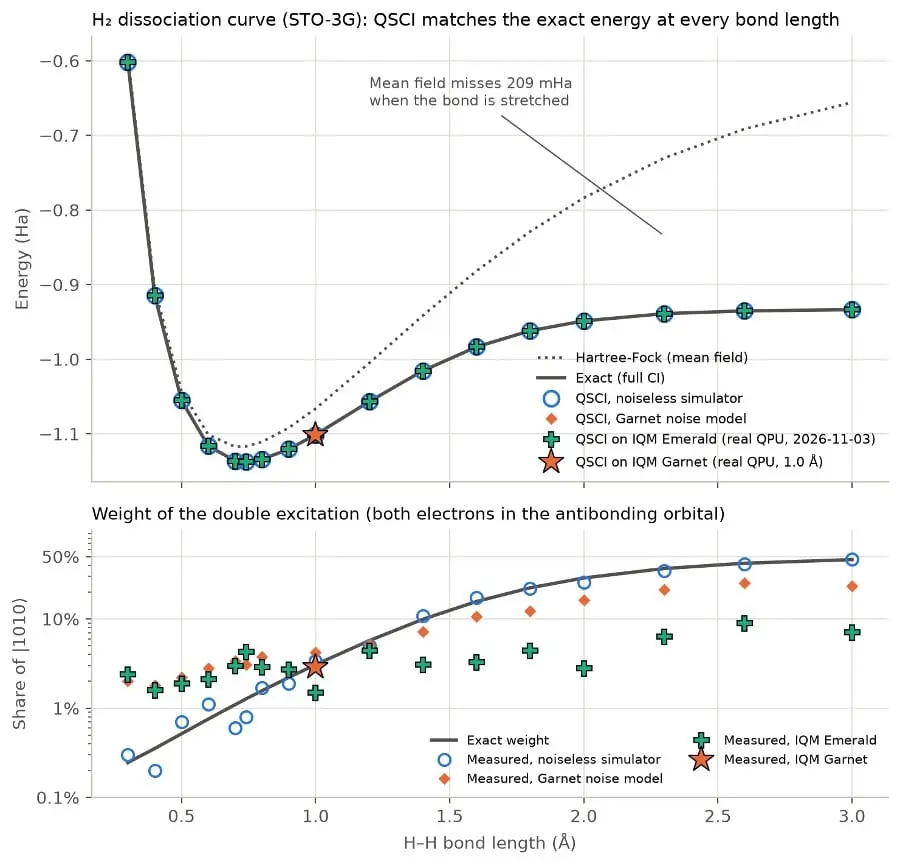
The hydrogen molecule, a deceptively simple system, served as the initial test case for a newly demonstrated hybrid computational workflow combining an IQM quantum computer and AMD GPUs. This initial run, using a STO-3G basis, deliberately avoided a demonstration of quantum advantage; instead, the focus was on establishing a functional pipeline capable of running on real hardware and delivering reproducible results. Researchers successfully calculated the dissociation curve of H₂ across 17 bond lengths using this integrated approach, validating the end-to-end functionality of the system.
Central to this workflow is a method called Quantum-Selected Configuration Interaction (QSCI), designed to address the exponential scaling problem inherent in calculating molecular ground states. The core challenge lies in the rapidly expanding matrix representing all possible electron arrangements. Beyond relatively small molecules, this matrix becomes computationally intractable even for the most powerful classical computers.
QSCI circumvents this limitation by using the quantum computer to intelligently identify a limited subset of electron configurations that significantly contribute to the final result. Each qubit within the IQM Garnet quantum computer represents an orbital. A trained circuit prepares a state approximating the molecule’s ground state, with frequently measured configurations indicating the most relevant arrangements, according to the company. This selective approach dramatically reduces the computational burden, allowing the remaining calculations to be efficiently handled by the AMD GPU.
After the quantum computer narrows the search, the AMD GPU filters unphysical samples, constructs the Hamiltonian matrix based on the selected configurations, and then diagonalizes it using JAX on AMD ROCm. This process yields both the energy and the precise weighting of each configuration within the reduced set. “The quantum computer chooses where to look, and the GPU solves the problem there,” explains the team, highlighting the division within the hybrid system.
The initial demonstration used IQM Resonance, IQM’s cloud platform, to access the quantum computer and the AMD Developer Cloud for GPU resources, with a Jupyter notebook providing a fully open and reproducible tutorial for others to replicate the workflow. While the current implementation relies on cloud-based access, AMD and IQM are actively pursuing tighter integration between quantum processors and GPU nodes.
This next phase of development aims to establish a more direct connection, potentially unlocking further performance gains and reducing latency. Researchers are also planning to extend the method to larger molecules, identifying the limits of QSCI on both the quantum and classical sides.
The classical computation, despite being streamlined by the quantum selection process, still presents a significant challenge. The cost of diagonalization scales cubically with the size of the selected subspace, meaning that even a modest increase in the number of relevant configurations can substantially increase computational demands. This is where the power of AMD Instinct GPUs and the ROCm platform becomes critical, providing the necessary acceleration to handle the remaining classical workload.
Software engineering played an important role in achieving this demonstration. The team had to carefully manage software versions and implement a couple of fixes within the ROCm environment to ensure smooth integration between the IQM quantum computers and AMD infrastructure.
This work, they state, is integral to building a robust and accessible software path for others to use the hybrid workflow. Jeremiah Coleman of IQM Quantum Computers notes that the goal is to “help define an open, scalable architecture where quantum, HPC and AI can operate together as parts of one scientific computing environment.” The full workflow is available at IQM Academy, allowing researchers to explore the method using either a simulator or real hardware, with developer credits available from AMD to facilitate access to the necessary resources.
Hybrid Workflow: IQM Quantum Computer and AMD GPU Division
The team is already planning tighter integration between the quantum and classical components, moving beyond the current cloud-based connection to directly link GPU nodes and quantum processors. “We ran the full QSCI pipeline on hydrogen (H₂, STO-3G basis),” the team reports, indicating a clear methodology for future expansion. The researchers are also exploring applications beyond chemistry, with error correction identified as another promising candidate for this hybrid approach. The team emphasizes that this is not a final architecture, but a functional demonstration of a system that runs.