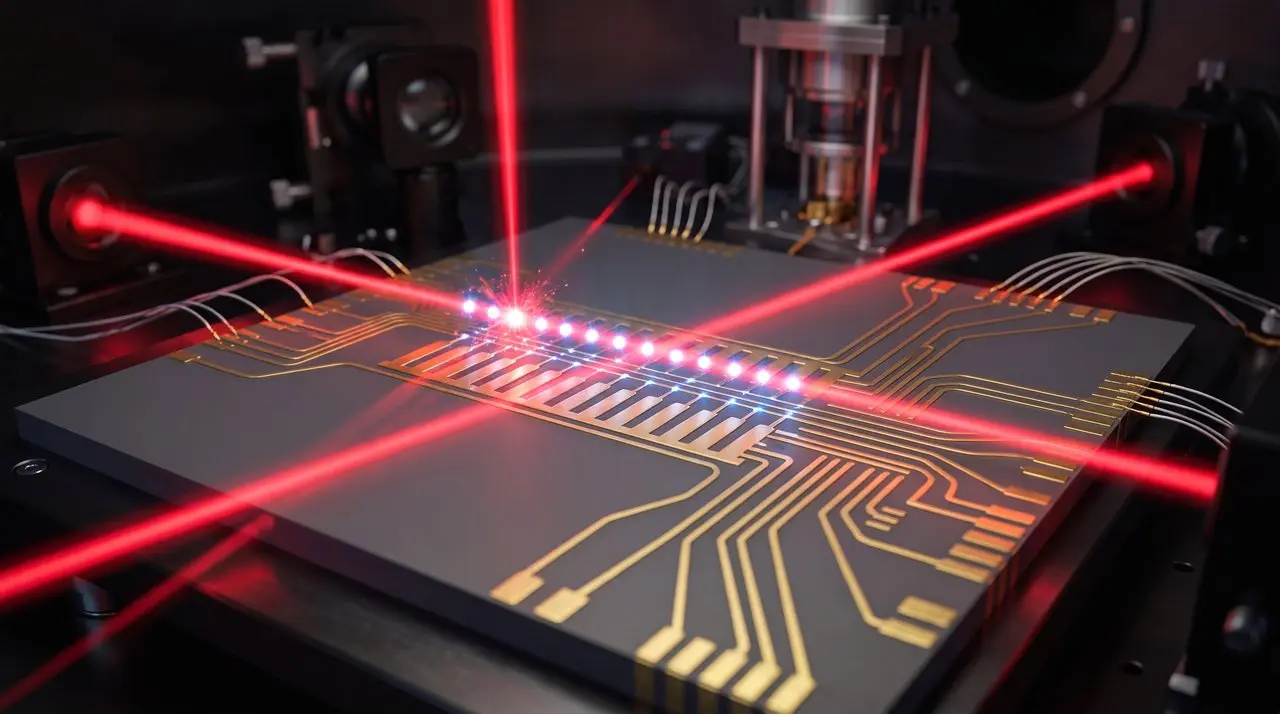
Researchers have demonstrated two-qubit operations in 125-135 ns using a new framework for quantum control. Qi Ding and colleagues designed gates with both frequency and amplitude modulation of microwave drives, enabling systematic analysis and design without requiring qubit frequency tunability. Using Floquet theory to analyze and design these drives, numerical simulations using typical transmon qubit parameters achieved a universal gate set, including X, Hadamard, phase and CZ gates, with control error well below 0.1% and gate times of 25-40 ns for single-qubit operations and 125-135 ns for two-qubit operations.
They show an always-on CZ gate tailored for driven qubits, which has gate times of 80-90 ns. This approach offers a path to fast, high-fidelity gates in superconducting quantum processors while preserving reduced flux-noise sensitivity, and can help alleviate frequency-crowding constraints.
Frequency- and Amplitude-Modulation Enables Universal Quantum Control
1%, demonstrating high fidelity essential for complex quantum computations. This approach bypasses the need for tunable qubit frequencies by shifting the modulation to the microwave drives themselves, a design choice validated through the use of Floquet theory to analyze and design the drives.
The team’s framework accommodates both adiabatic and nonadiabatic gates, broadening its applicability to diverse gate types and control strategies. This contrasts with methods relying solely on quantum optimal control or machine learning for pulse design. While frequency modulation for CZ gates in superconducting qubits appeared in prior work, this research generalizes the concept to create a complete, high-fidelity universal gate set and establishes a unified design framework.
The resulting gate durations are 25-40 nanoseconds for single-qubit operations, significantly faster than many existing implementations. The always-on CZ gate, a critical operation for entanglement, demonstrated gate times of 80-90 nanoseconds, a substantial reduction from typical speeds. This framework allows for systematic analysis and design of frequency modulation, complementing conventional amplitude modulation, and operates on fixed-frequency qubits. The work published on September 24, 2026, details how this approach enables optimal fidelity within defined parameters.
Floquet Theory Underpins Adiabatic and Nonadiabatic Gate Design
Floquet theory was used to analyze and design these drives for optimal fidelity within specified criteria, according to work detailed by Qi Ding and colleagues. This theoretical approach moves beyond reliance on tunable qubit frequencies, instead focusing modulation directly on the microwave signals used to manipulate quantum states. The framework systematically analyzes and designs these frequency modulations alongside conventional amplitude modulation, broadening the scope of both adiabatic and nonadiabatic gate designs.
This level of fidelity is important for complex quantum computations, and the simulations used parameters typical of transmon qubits, suggesting practical applicability. Single-qubit operations achieved durations of 25-40 nanoseconds, while the always-on CZ gate, essential for entanglement, operated between 80-90 nanoseconds. These speeds represent a reduction from typical gate durations and demonstrate the effectiveness of the frequency and amplitude modulation framework.
Beyond speed, the framework’s versatility extends to both adiabatic and nonadiabatic gates, offering a unified approach to quantum control. The selection of control parameters, including amplitude and frequency, allows for tuning the gate fidelity landscape, with outer-loop control serving as a key element. While adiabatic amplitude modulation remains relevant in certain stages, the framework’s ability to operate in the nonadiabatic regime opens possibilities for even faster two-qubit operations, exceeding the capabilities of purely adiabatic methods.
Further research will focus on addressing the computational cost of calculating Floquet modes in larger systems and incorporating robustness against noise and parameter variations. “We anticipate that frequency- and amplitude-modulated control will provide valuable perspectives for quantum gate design and control in the pursuit of scalable, high-fidelity quantum processors,” the researchers state.
Fixed-Frequency Transmon Qubits Mitigate Flux Noise & Crowding
1%, a level of precision essential for building practical quantum computers. The framework addresses a key challenge in superconducting qubits: frequency crowding, which can be a challenge as system size increases. While flux control offers faster, more tunable gates, it introduces calibration complexity and heightened sensitivity to noise; this new approach brings tunability to fixed-frequency qubits without direct frequency adjustments. By treating microwave drive frequency as a control parameter, the design alleviates crowding while maintaining the reduced flux-noise sensitivity and coherence advantages inherent in fixed-frequency devices.
This is particularly important as efforts continue to improve gate fidelities, directly impacting the depth of executable circuits and reducing overhead for error correction. The proposed gate schemes rely exclusively on all-microwave drives, eliminating the need for baseband, fast-flux pulses and the challenges they present. “High-fidelity quantum gates are essential for running quantum algorithms and building error-corrected quantum computers,” the paper states, emphasizing the importance of these advancements for future quantum computation.
Simulated Universal Gate Set Achieves 0.1% Control Error
1%, a key threshold for reliable quantum computation. This framework allows for the construction of gates within a single control paradigm, streamlining the design process and potentially simplifying hardware requirements.
While the resulting protocols are more detailed than traditional Rabi-drive gates, the simulations demonstrate the feasibility of harnessing nonadiabatic transitions within this framework, opening avenues for fast, nonadiabatic control where speed is paramount. Researchers used this framework to demonstrate a universal gate set, achieving control errors well below 0.1%.
90ns “Always-On” CZ Gate Reduces Operation Time
An “always-on” version of the controlled-Z (CZ) gate achieved a gate time of 80-90 nanoseconds in simulations, a substantial reduction compared to standard CZ gate implementations. This speed increase stems from eliminating the time needed to ramp the drive amplitude up and down, as the control signal remains active during qubit idling. The simulations demonstrate a pathway to faster quantum computations with superconducting qubits.
This accelerated gate speed relies on separating the roles of amplitude and frequency modulation; amplitude modulation ensures adiabatic transitions between qubit states, while frequency modulation activates the necessary interactions for gate operation. Researchers identified key instantaneous eigenstates, termed Floquet modes, relevant to the intended gate operation and then applied a multi-level FAQUAD protocol to this subspace. The staged control strategy detailed in the work allows for precise manipulation of qubit states, using both amplitude and frequency to achieve desired outcomes.
The team also implemented a standard CZ gate, turning the drive on and off, alongside this always-on approach, and successfully demonstrated a Hadamard gate using similar nonadiabatic principles. The framework’s ability to function with fixed-frequency qubits suggests potential advantages in coherence times compared to architectures requiring tunable frequencies.
Microwave Control Bridges Fixed-Frequency & Tunable Qubit Approaches
1%, a level of precision vital for scaling quantum processors. These simulations, performed using parameters typical for transmon qubits, also demonstrated single-qubit operations completing in 25-40 nanoseconds, establishing a benchmark for speed within this architecture. The approach converts the requirement for qubit frequency tunability into drive frequency modulation, effectively bringing tunability to fixed-frequency qubits without directly altering their inherent frequencies.
By using microwave control with both amplitude and frequency modulation, the system alleviates these constraints while preserving the benefits of fixed-frequency qubits, such as reduced flux-noise sensitivity and improved coherence. Implementing the control pulses requires bandwidth and sampling rates achievable with existing single-sideband (SSB) modulation techniques, suggesting practical compatibility with current experimental setups.
Numerical Simulations Validate High-Fidelity Gate Performance
Numerical simulations confirm control errors well below 0. These results, achieved with parameters mirroring those of transmon qubits, validate a new framework combining frequency and amplitude modulation for microwave control. The framework’s utility extends to both adiabatic and nonadiabatic gate designs, offering flexibility in pulse shaping and execution. The simulations reveal single-qubit operations completed in 25-40 nanoseconds, while two-qubit operations, including a continuously active CZ gate tailored for driven qubits, require 125-135 nanoseconds.
This always-on CZ gate represents a particular advantage, achieving its speed by removing the need to ramp drive amplitude up and down, a common source of delay in traditional gate implementations. Floquet theory was used to analyze and design these drives, providing a systematic approach to analyzing and constructing both frequency and amplitude modulation strategies.
Amplitude & Frequency Modulation: A General Control Methodology
The framework detailed in this work extends beyond specific gate implementations, establishing frequency modulation as a broadly applicable technique for quantum control rather than a solution limited to individual gate types. While the simulations operated under restrictions, specifically limiting simultaneous amplitude and frequency control to simplify potential experimental implementation, the underlying framework allows for expansion to incorporate full generality across all stages of gate operation.
The work focused on a specific process of turning the drive on and off, mapping between qubit states, but future studies may broaden this to encompass complete control over both frequency and amplitude throughout the entire gate sequence. Device and control parameters were established using realistic transmon parameters, with the exact avoided crossing between qubit levels found to be a critical factor in maintaining adiabaticity during frequency modulation; the ac Stark shift remained weak during amplitude modulation, but increased significantly with frequency modulation.
👉 More information
🗞 Frequency- and Amplitude-Modulated Gates for Universal Quantum Control
✍️ Qi Ding, Shoumik D. Chowdhury, Agustin Di Paolo, Réouven Assouly, Alan V. Oppenheim, Jeffrey A. Grover and William D. Oliver
🧠 DOI: http://link.aps.org/doi/10.1103/zhk6-vxnn



See today’s quantum computing news on Quantum Zeitgeist for the latest breakthroughs in qubits, hardware, algorithms, and industry deals.