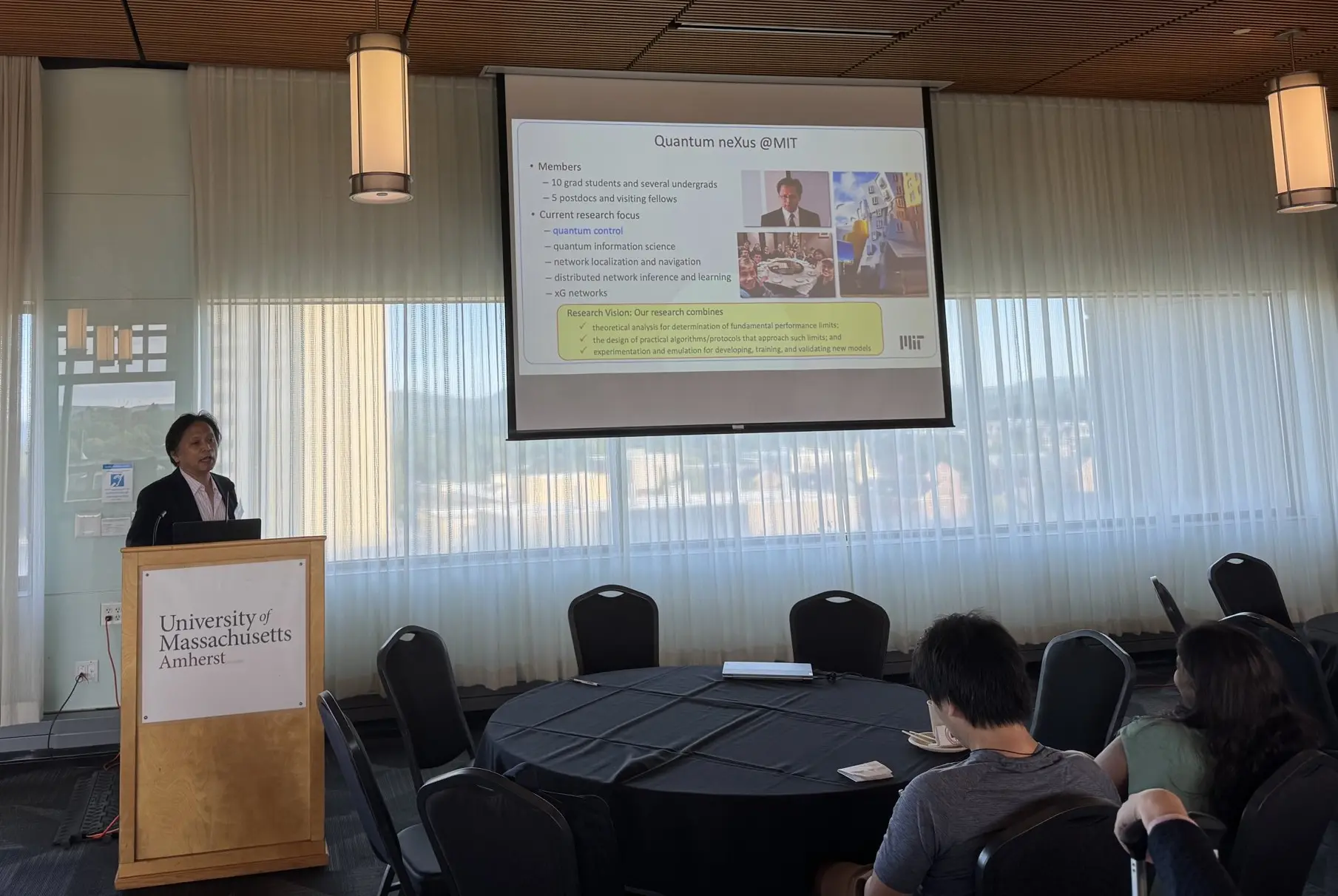
Approximately 50 researchers convened at UMass Amherst in September to address critical challenges in building future quantum networks, focusing on quantum networking, quantum information science, quantum security and classical networking. The event, NeSQom 2026 (NSF Workshop on Quantum Communication and Networked Systems), aimed to directly inform the National Science Foundation’s quantum computing research agenda.
“The workshop’s central theme was how to build the systems architecture for future quantum networks,” said Taqi Raza, assistant professor of electrical and computer engineering, noting the need to integrate insights from both classical and quantum fields, as qubits can be 1, 0, or a combination of the two, a fundamental difference from traditional computers.
NeSQom 2026 Workshop Focuses on Hybrid Classical-Quantum Networks
Development and deployment of a quantum internet represents a key challenge demanding collaboration across multiple disciplines, a point emphasised by the NeSQom 2026 workshop held in September. The event specifically addressed the need to integrate classical and quantum networking expertise, recognizing that quantum advancements alone are insufficient for building functional, large-scale networks.
Raza, an organizer of the workshop, explained that “building a quantum internet is not only a quantum-physics problem,” but also requires innovation in established fields like computer systems and security. The workshop’s focus on a hybrid approach stems from the unique demands of quantum communication; entanglement, described by Don Towsley as “the critical resource required by most networked quantum applications including quantum key establishment, distributed quantum computing and distributed quantum sensing,” necessitates a re-evaluation of traditional networking paradigms.
Qubits, unlike the binary bits of classical computers, can exist as 1, 0, or a combination of both, a characteristic that fundamentally alters how information is transmitted and secured. This complexity requires new networking ideas and computer system designs to fully realize the potential of quantum technologies.
Currently, National Science Foundation funding for quantum networking is divided between programs focused on physics and classical networking, creating a siloed approach to research. Quantum networking is still at an early stage, which makes this an important time for different research communities to jointly define the architecture and research questions rather than developing individual components in isolation, Raza stated.
Towsley believes the event “has taken a large step towards removal of barriers between these communities and fostered a consensus for the need of an NSF research program focused on hybrid classical-quantum networks,” suggesting a potential shift in funding priorities toward more integrated research initiatives. The resulting networks, according to Raza, “can help enable larger and more reliable hybrid classical-quantum networks that connect quantum computers, sensors and communication systems,” ultimately moving toward a fully realized quantum internet.
Quantum computing uses quantum mechanics to process information in fundamentally different ways from today’s computers.
Taqi Raza, assistant professor of electrical and computer engineering in UMass’s Riccio College of Engineering
Entanglement as Critical Resource for Future Quantum Applications
This quantum relationship between qubits, capable of persisting over distance, presents unique challenges and opportunities distinct from classical communication methods, demanding a re-evaluation of existing networking paradigms. The recent workshop at UMass Amherst highlighted the necessity of interdisciplinary collaboration to overcome hurdles in harnessing entanglement for networked systems. Participants deliberately brought together expertise from classical networking, quantum communications, computing and sensing, focusing on problems that cannot be solved within one community alone, Raza explained.
This collaborative approach acknowledges that building a functional quantum internet extends beyond the realm of quantum physics, requiring advancements in computer systems, security protocols, and engineering practices. He added that new ideas are needed in networking, computer systems, security, and engineering fields, which is why bringing these communities together is so important. Workshop discussions centered on the creation of hybrid classical-quantum networks, designed to use the strengths of both technologies.
The event’s output included specific, open-problem statements intended to guide the National Science Foundation’s future research agenda, ensuring funding aligns with the most pressing needs of the field. Towsley believes these discussions “can help NSF to understand where new research is needed.” Ultimately, the workshop’s goal is to accelerate the transition from theoretical quantum networking to tangible, real-world infrastructure, and this workshop will contribute to the development of the quantum internet.
One of the main goals of the workshop was to bring the classical and quantum networking communities together and identify open problems and research directions that can help shape a future NSF research agenda.
Taqi Raza, assistant professor of electrical and computer engineering in UMass’s Riccio College of Engineering



See today’s quantum computing news on Quantum Zeitgeist for the latest breakthroughs in qubits, hardware, algorithms, and industry deals.