Lumen Technologies is actively reshaping its fiber network to address the escalating energy demands of artificial intelligence, investing in research at The Ohio State University to explore the potential of quantum connectivity over long distances, the company says. The company and Emerald AI are evaluating a system where AI workloads automatically shift locations based on power availability and cost, a response to predictions that data center power limits will constrain AI expansion.
“The network must do more than just connect,” said Kate Johnson, CEO of Lumen. Lumen is also positioning its Secure Access Service Edge solution, based on Fortinet, to introduce quantum-resistant security capabilities.
Emerald AI and Lumen Address AI Workload Energy Demands
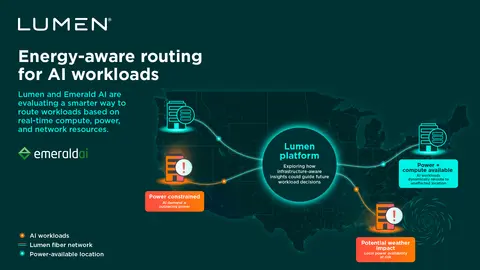
Emerald AI and Lumen are actively developing energy-aware AI workload routing, a system designed to alleviate power constraints hindering the expansion of artificial intelligence infrastructure. The collaboration integrates Emerald AI’s Emerald Conductor platform with Lumen’s programmable fiber network, enabling the automatic shifting of AI computing tasks to locations with available power while maintaining low latency and high performance, according to the company. This approach aims to unlock up to 100 gigawatts of capacity on the existing U.S. grid, offering a solution to potential power bottlenecks and promoting grid stability as AI demand increases.
“Our collaboration with Lumen brings that opportunity to AI inference,” said Dr. Varun Sivaram, founder and CEO of Emerald AI, emphasizing the potential for flexible data centers to support AI growth. Gartner predicts that by 2030, 75% of IT infrastructure and operations leaders will mandate energy-aware AI workload placement, highlighting the growing importance of this capability.
Lumen and Emerald AI are exploring a pilot using Lumen’s edge and network infrastructure to test the approach. Jim Fowler, Lumen’s chief technology and product officer, explained that the company is moving beyond traditional network connectivity, exploring how to make the network an active component in determining where and how computing occurs, the firm reports. This effort represents a significant departure from conventional data center operations, where computing resources are fixed in location regardless of energy costs or availability. “The network has traditionally connected computing resources wherever they happen to be,” Fowler stated.
This proactive approach not only addresses immediate energy concerns but also positions Lumen to support future advancements in AI and other computationally intensive fields. Kate Johnson, CEO of Lumen, summarized the broader vision, stating, “We’re innovating our network to help AI computing adapt to available energy, lay the foundation for a connected quantum future, and prepare enterprises for continuous and emerging security threats.”
Power is a critical bottleneck to AI growth, and flexible AI data centers could unlock up to 100 gigawatts of capacity on the existing U.S. grid while being good grid citizens-helping keep electricity affordable and the power system reliable.
Dr. Varun Sivaram, founder and CEO, Emerald AI
Ohio State Research Explores Lumen Fiber for Quantum Networking
Lumen is directing research funding toward a key challenge in scaling quantum computing: maintaining signal integrity over distance. The company is investing in The Ohio State University to investigate how its existing fiber optic infrastructure can support the transmission of quantum information, a task complicated by the fragility of quantum states and the limitations of traditional networking equipment. Unlike conventional data, quantum information cannot be simply copied or amplified, necessitating novel optical technologies for distribution.
This research focuses on two primary areas within quantum networking. The first explores long-range networking, specifically the optical technologies needed to reliably link geographically separated quantum systems. The second area of study centers on distributed sensing, examining the potential of quantum technologies to enhance geophysical monitoring and improve the assessment of conditions impacting network performance.
Lumen’s support supplements existing federal and state funding directed toward advancing quantum information science and engineering at Ohio State by using the university’s deployed optical fiber resources. The effort acknowledges a fundamental constraint in realizing a widespread quantum internet: the inability to simply replicate quantum data for error correction or signal boosting.
This move aims to safeguard sensitive enterprise data against potential decryption by future quantum computers. Lumen’s many-sided approach positions the company to support both the immediate needs of AI and the long-term development of quantum technologies, anticipating a future where networks are not merely conduits for data, but active participants in solving complex computational and security challenges.
The network has traditionally connected computing resources wherever they happen to be. We’re exploring how to turn that equation around, making the network an active part of how and where computing happens.
Jim Fowler, chief technology and product officer at Lumen




See today’s quantum computing news on Quantum Zeitgeist for the latest breakthroughs in qubits, hardware, algorithms, and industry deals.