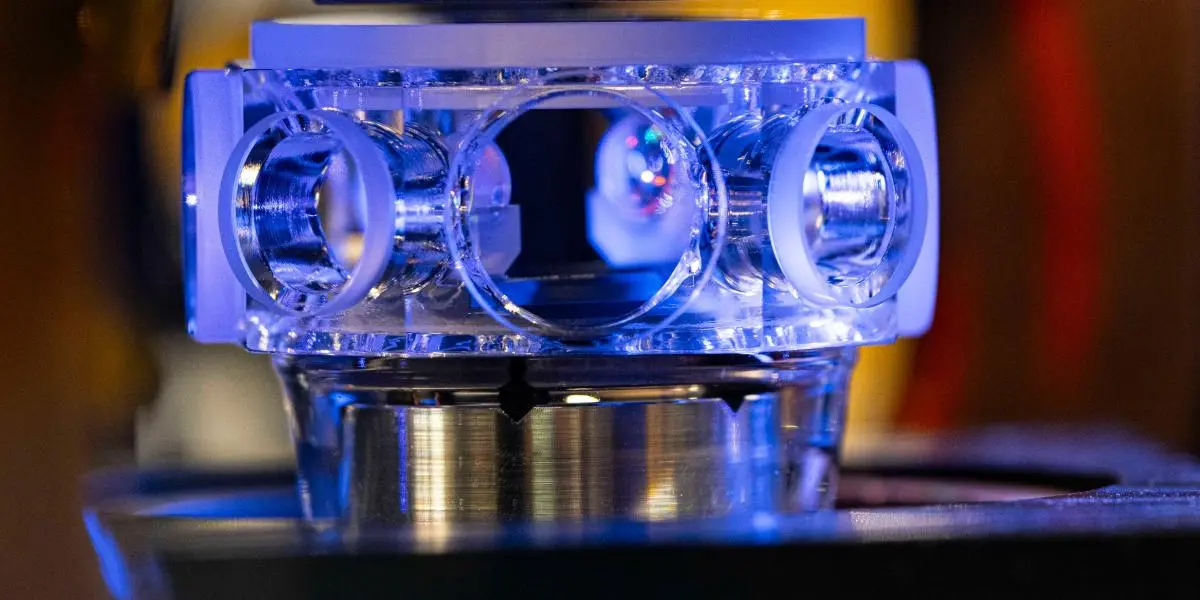
Researchers at LMU Munich have demonstrated a key advance for linking quantum computers through light, achieving strong interactions between rubidium atoms separated by several micrometers, distances thousands of times larger than the atoms themselves, the company says. The team, led by Johannes Zeiher, Professor at LMU Munich, combined optical tweezers, an optical cavity with two highly reflective mirrors, and Rydberg atom excitation within a single device, overcoming challenges posed by stray electric fields.
“It was great to see how well the electric field shielding for our high-cooperativity cavity worked in our experiment,” said doctoral researcher Jacopo De Santis. This setup enables both the coupling of atoms to light and the collective behavior necessary for quantum gates, representing a stepping stone toward networked quantum processors, according to Zeiher.
Rydberg Atom Array Enables Micrometer-Scale Interactions
This range stems from exciting the atoms to Rydberg states, where their strong interactions with neighbors become possible despite the physical separation. The team’s setup represents a novel combination of technologies, previously difficult to achieve due to the sensitivity of Rydberg atoms to stray electric fields, according to LMU Munich.
The experimental platform uses two highly reflective mirrors forming an optical cavity, causing a photon to bounce back and forth approximately thousands of times. This prolonged interaction significantly strengthens the coupling between a single atom and the light. This amplified interaction is a key step toward linking quantum computers through photons, allowing for the exchange of quantum information between processing nodes.
Johannes Zeiher, Professor at LMU Munich, explains, “Optical tweezers, optical cavities and Rydberg atoms have each driven remarkable progress in quantum science over the past decade. Bringing them together in a single platform lets us control the interface between light and matter at an entirely new level.” Measurements confirm the presence of two essential interactions within the same atomic array.
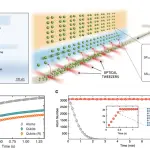
Atoms measurably shift the resonance of the optical cavity, demonstrating strong coupling to light, while groups of up to four atoms exhibit Rydberg blockade, a collective behavior where excitation of one atom inhibits excitation of its neighbors, the company says. “We see this as a stepping stone toward quantum processors that talk to each other through light, and toward new ways of creating and shaping entangled states of light and matter,” Zeiher adds. The team is currently focused on deterministically entangling atoms in specific configurations and reading their states using the cavity, an important step toward implementing quantum error correction protocols needed for scaling up quantum computers.
We see this as a stepping stone toward quantum processors that talk to each other through light, and toward new ways of creating and shaping entangled states of light and matter.
Johannes Zeiher, Professor a der LMU Building block for quantum networks
Cavity-Atom Coupling Demonstrates Quantum Network Building Blocks
This blockade transforms the group into a “super-atom” whose response accelerates with increasing atom count, a clear indicator of entanglement. The observed acceleration demonstrates a speed-up in response time, a characteristic fingerprint of entanglement between atoms, and a key element for scalable quantum computation. This capability extends beyond computation, offering a platform for generating entangled states of light, a significant resource for quantum communication and sensing. Researchers are now positioned to explore quantum materials where particles interact over extended distances, potentially revealing new understanding of complex physical phenomena.
We see this as a stepping stone toward quantum processors that talk to each other through light, and toward new ways of creating and shaping entangled states of light and matter.
Johannes Zeiher, Professor a der LMU Building block for quantum networks

See today’s quantum computing news on Quantum Zeitgeist for the latest breakthroughs in qubits, hardware, algorithms, and industry deals.