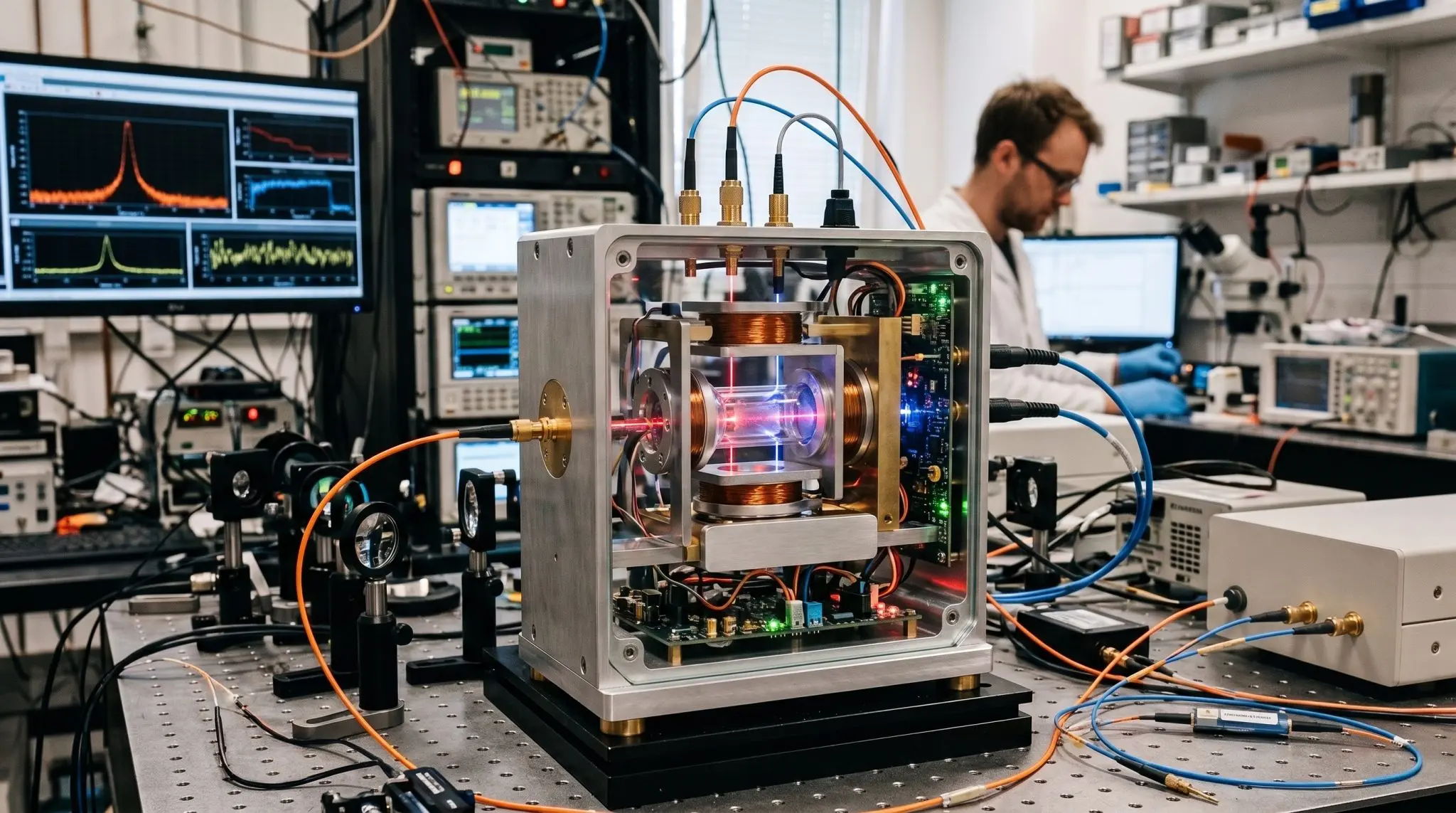
The U.S. National Science Foundation has announced Project Triad, an initiative to integrate quantum sensing, networking, and computing into a single operational system by July 7, 2026. This project aims to move quantum technology beyond laboratory research and into practical applications ranging from healthcare to national security. By uniting these three capabilities, Project Triad will establish a foundation for scaling and commercializing quantum systems through U.S. industry, bolstering economic competitiveness. “NSF Project Triad will unite the research enterprise to advance the administration’s vision, ensuring public investments translate into strategic advantages in quantum technology for all Americans,” said Brian Stone, performing the duties of the NSF director. The project directly aligns with the executive order “Ushering in the Next Frontier of Quantum Innovation.”
This initiative, slated to deliver a proof-of-concept system for experimentation by December 2026, distinguishes itself by focusing on the synergistic potential of these fields rather than individual advancements. The July 7, 2026 target date underscores a concrete timeline for realizing this integration, signaling a commitment to measurable progress. According to NSF Chief Science Officer Simon Malcomber, “Achieving Project Triad will require exceptional fundamental scientific work alongside translational research to utilize quantum data effectively.” This integrated approach promises to unlock applications ranging from enhanced navigation for first responders, independent of satellite access, to more efficient detection of underground resources and personalized medicine through precise medical imaging. The project’s structure, encompassing NSF National Quantum Virtual Laboratory, NSF X-Labs, and NSF Quantum+X, is designed to foster collaboration between government, universities, and private industry. NSF is actively seeking partnerships to launch initial funding tracks for NSF Quantum+X, with a focus on sectors including energy, finance, biotechnology, and pharmaceuticals. This direct engagement with industry is intended to identify and accelerate promising use cases for the integrated quantum technology.
NSF Project Triad will unite the research enterprise to advance the administration’s vision, ensuring public investments translate into strategic advantages in quantum technology for all Americans.
Brian Stone, performing the duties of the NSF director
The convergence of quantum sensing, networking, and computing is rapidly shifting from theoretical possibility to demonstrable reality, but a significant hurdle remains: integrating these distinct technologies into a cohesive, functioning system. Currently, advancements in each area largely occur in isolation, hindering the realization of truly transformative applications. The National Science Foundation’s Project Triad directly addresses this challenge, with the NSF National Quantum Virtual Laboratory positioned as the central engine for building a proof-of-concept integrated quantum system. NSF plans to accelerate several NQVL projects from the design phase to implementation by December 2026, contingent upon securing necessary funding. This acceleration isn’t simply about speed; it’s about establishing a platform for rigorous experimentation and testing, crucial for refining and scaling these complex systems. A key component of this integration lies in developing robust quantum interconnects and photonics, technologies essential for transferring quantum information between devices. This systematic approach, prioritizing scalable breakthroughs and fostering collaboration, aims to position the U.S. as a leader in the rapidly evolving quantum landscape.
Achieving Project Triad will require exceptional fundamental scientific work alongside translational research to utilize quantum data to its utmost.
Simon Malcomber, NSF Chief Science Officer
Advancements in quantum sensing, networking, and computing are expected to converge through a new initiative focused on practical application. At the heart of this effort is NSF Quantum+X, a program designed to directly engage with industry and accelerate the translation of quantum research into tangible benefits across multiple sectors. The program’s approach isn’t simply about funding research; it’s about identifying specific use cases and potential applications for integrated quantum technology, with initial funding tracks anticipated to span energy, finance, biotechnology, and pharmaceuticals. This direct industry engagement is critical, according to NSF, as it seeks to refine, scale, and commercialize these complex systems. The initiative builds upon NSF’s existing quantum research portfolio, including specialized institutes and engineering centers, providing a robust foundation for real-world testing within an integrated quantum system.


See today’s quantum computing news on Quantum Zeitgeist for the latest breakthroughs in qubits, hardware, algorithms, and industry deals.