Matias Miguel Castillo Valle and colleagues at the École polytechnique fédérale de Lausanne have demonstrated a way to encode any quantum state using only 2N narrowband signals, a potentially simpler approach to mimicking quantum processes. Their work introduces “wavebits”, classical wave analogs of qubits, and shows that complex, nonseparable states can be built from locally separable signals, recovering correlations through time-averaged demodulation.
The researchers prove that any two-qubit gate “unravels” into simpler, localized wave manipulations and that circuit complexity scales linearly with the number of entangling gates, independent of the total qubit count. This architecture, validated for up to six qubits and achieving over 0.99 fidelity in emulated quantum operations, is directly implementable in acoustic, photonic and mixed-signal platforms.
Wavebits Encode Qubits with Time-Averaged Oscillatory Signals
Any nonseparable N-qubit state, regardless of its complexity, can be encoded using only 2N narrowband signals, a finding that dramatically reduces the hardware demands of simulating quantum systems with classical waves. This encoding method maintains local separability within each signal at all times.
The complex, nonseparable correlations essential to quantum behavior are only revealed through time-averaged demodulation using auxiliary carrier frequencies, termed the “nonseparability channels”. This approach contrasts sharply with other analog emulation techniques, such as that of La Cour and Ott, which require a single composite signal with a bandwidth that expands exponentially with the number of qubits.
This “unraveling” of two-qubit gates simplifies the physical manipulations needed to emulate quantum circuits, moving away from the need for globally complex operations. This decoupling of cost from qubit number addresses a major limitation in scaling quantum computation, as traditional methods often see exponential increases in resource requirements.
The potential for increased efficiency, however, is not without limits; the exponential cost inherent in representing a -dimensional quantum state reappears during the readout process and in the necessary averaging time for circuits with many two-qubit gates. Researchers quantified this limitation with an analytic error bound that also functions as a practical design rule for hardware implementation.
Nonseparability Channels Recover Correlations in Wavebit States
This encoding distributes the information across these channels, ensuring that the physical system remains locally separable at all times, with the essential nonseparable correlations recovered only during readout. This linear scaling holds true for a fixed number of gates, meaning adding more qubits does not inherently increase the computational burden.
Two-Qubit Gate Unraveling via Time-Varying Operators
Any two-qubit gate can be constructed from the time-averaged product of two locally operating time-varying operators, a finding that simplifies the physical requirements for emulating quantum circuits with classical wave analogs known as wavebits. This “unraveling” process, as the researchers term it, allows for the decomposition of complex quantum operations into simpler, localized manipulations of these wave-based qubits.
The core principle relies on constructing a time-varying operator, U(t), equivalent to the tensor product of two local operators, and , each acting independently on a wavebit system. This approach circumvents the need for a base frequency or oscillating signal for single-qubit gates, implementing them instead with static gains, a significant simplification in hardware design.
Linear Scaling of Base Frequencies with Entangling Gates
The work demonstrates this principle by successfully emulating circuits with up to six qubits, requiring a base-frequency count that grows proportionally to the number of entangling gates used. Single-qubit gates within these emulated circuits are implemented as static matrices, requiring no oscillating signals, further simplifying the hardware requirements. The resulting unitary operation is expressed as a product of entangling layers, each driven by a base frequency proportional to the square root of a parameter, p_ℓ and a reference frequency, .
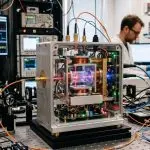
These tests reveal a trade-off between circuit complexity and the averaging time required to achieve accurate results. A mixed-signal prototype emulates Bell state generation, controlled-NOT gates, phase kickback and Bloch-sphere rotations at fidelities above 0.99. Numerical benchmarks against exact statevectors validate the scheme for up to six qubits. The constant oracle, containing no entangling gates, achieved exact results regardless of the averaging window, highlighting the efficiency of the static components.
Exponential Cost Shifts to Readout in Analog Emulation
The exponential demands of simulating quantum systems traditionally manifest during circuit execution, but a new approach shifts that burden to the final readout stage. This relocation simplifies the analog mapping and overall circuit architecture by deferring the computational cost of representing a -dimensional state until the very end of the process. The framework centers on “wavebits,” a classical wave representation of qubits where amplitudes are carried by physical oscillatory signals rather than static complex numbers.
This physical wavebit system encodes any nonseparable N-qubit state in 2N narrowband signals that remain locally separable at every instant; the nonseparable correlations are recovered at readout by time-averaged demodulation over auxiliary carrier frequencies. This convergence cost, alongside the readout stage, is where the inherent difficulty of classical emulation reappears, though the architecture’s design makes these costs explicit and manageable.
The researchers note that the resulting growth of the required window time is intrinsic, but allows for analog parallelism and narrowband channels that are relatively inexpensive. This strategy concentrates the exponential cost at readout and in the averaging time, rather than during the circuit’s operation. Any two-qubit gate unravels into the time-averaged tensor product of two local time-varying operators, and that arbitrary circuits are emulated with a base-frequency count scaling linearly in the number of entangling two-qubit gates, independent of qubit number for a fixed gate count.
The framework’s encoding eliminates exponential bandwidth, projection, and pairwise-hardware bottlenecks seen in single-signal approaches, again relocating the exponential cost to readout and integration time. This is not to suggest a quantum or quantum-inspired computational advantage; the team acknowledges that the costs grow superpolynomially for general circuits, consistent with the known limitations of classical simulation.
Instead, the value lies in a clear cost structure and a framework rooted in multi-frequency phase coherence that dynamically parameterizes nonseparable state structure. A CMOS implementation of the system ran a six-qubit Grover search approximately 400 times faster than a desktop CPU, while consuming six times less power than a comparable FPGA emulator at ten qubits.
“At fixed register size, analog signal-based emulators have been shown to outperform digital hardware,” the researchers state, highlighting the potential for efficiency gains. This approach offers a distinct path for exploring quantum algorithms using classical analog systems, with the most significant challenges now focused on optimizing the readout and integration processes.
Dynamical Parameterization of Nonseparable States
This encoding maintains local separability at every moment in time, recovering the nonseparable correlations only through time-averaged demodulation during readout, a departure from traditional methods requiring projection operators. The framework’s approach provides a dynamical parameterization of nonseparable states, framing them within coherent multi-frequency classical dynamics and complementing existing entanglement resource theories. This dynamic parameterization isn’t merely conceptual. It provides a constructive method for emulating quantum circuits using classical wave hardware, as detailed in Section VII of the research.
The normalization condition ||^2 + ||^2 = 1 applies to the time-averaged state, but at any given instant t, ||^2 + ||^2 need not equal unity, demonstrating a flexibility in signal manipulation not found in static representations. The physical measurement statistics, however, are recovered from this time-averaged state, ensuring accurate results despite the dynamic fluctuations.
For a static two-qubit system, a nonseparable state cannot be created from a product of single-qubit states, but with dynamic amplitudes, the composite state |Ψ(t)⟩ is separable at every instant, while its time average can be nonseparable, a process the researchers term “unraveling.” The framework’s architecture avoids exponential frequency overhead by using active gates, building nonseparable states by applying gates to an initial product state, mirroring the process in a quantum circuit. Resources needed to emulate an N-qubit circuit with δ two-qubit gates are explicitly defined.
The exponential costs are localized at readout and integration time, rather than during circuit execution itself. Numerical benchmarks against exact statevectors validate the scheme for up to six qubits.
👉 More information
🗞 Classical analog emulation of quantum circuits via time-averaged dynamic states
✍️ Matias Miguel Castillo Valle, Tim Tuuva, Benjamin Apffel, Hervé Lissek, Romain Fleury and Mathieu Padlewski
🧠 DOI: http://link.aps.org/doi/10.1103/1d5g-5s8g




See today’s quantum computing news on Quantum Zeitgeist for the latest breakthroughs in qubits, hardware, algorithms, and industry deals.