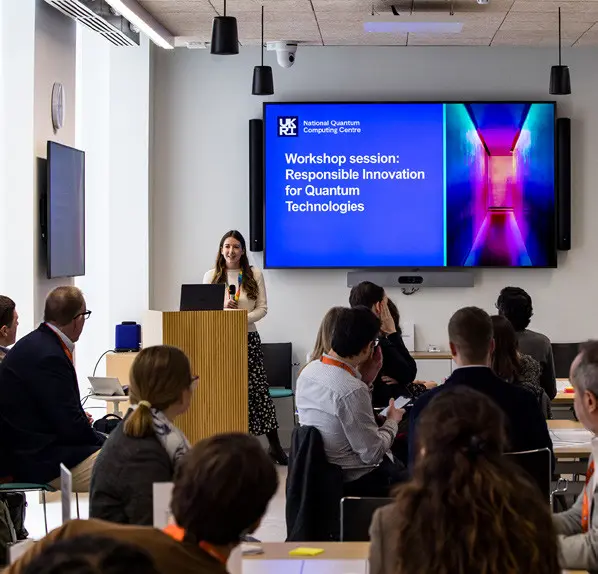
A shift in international public policy is prioritizing the application and adoption of quantum technologies, mirroring a move by industry from supplying components to meeting user demand. This change in focus comes as the National Quantum Computing Centre’s SparQ user engagement programme expands, attracting new participants from a growing number of UK institutions and forging new partnerships with industry.
“Industry is similarly pivoting from supply to demand in quantum technologies,” notes the NQCC’s annual report, reflecting a clear increase in commercial and research interest in the potential of quantum computing. Building on the first decade of the National Quantum Technologies Programme and the UK Industrial Strategy, 2026 has become a year of renewed energy for both the national programme and the NQCC itself.
Superconducting, Trapped-Ion, and Neutral Atom Quantum Computing
The National Quantum Computing Centre is actively developing open-architecture quantum computing systems using three distinct modalities: trapped-ion, superconducting and neutral atom technologies. This many-sided approach allows for comparative analysis and uses the unique advantages of each platform as the centre progresses toward building a robust national capability. NQCC researchers are demonstrating atom trapping and site refilling in their neutral atom work, a key step toward realizing single and two-qubit global gates.
The ProQure programme follows on from NQCC’s three-year quantum computing testbed initiative, which established a unique UK capability, hosting seven commercial quantum computers across five qubit modalities. UK and are both contributing neutral atom systems, while Ionics, a company, is deploying a trapped-ion platform. The NQCC’s work extends beyond simply hosting these testbeds. The centre is focused on strengthening the UK’s quantum computing capability through strategic partnerships and skills development.
This includes advancing in-house research and development across the three core modalities, ensuring a connected national capability for quantum computing. “Building the UK quantum computing ecosystem” is the central aim, and the NQCC’s efforts are designed to support the transition from foundational research to practical applications and user adoption.
Quantum Computing Testbed Initiative & HPC Integration
The Quantum Computing Testbed Initiative (QCTI) moved beyond development and deployment in 2026, entering a phase focused on performance evaluation and use led by the National Quantum Computing Centre (NQCC) in partnership with the Quantum Software Lab. The NQCC’s approach integrates expertise across the entire quantum computing stack, advancing the field through both research and collaborative efforts. NQCC’s work with the QCTI has established the centre as a global leader in quantum technology evaluation, attracting both national and international attention.
This coordinated effort has positioned the NQCC to not only host these testbeds but also to strengthen the UK’s quantum ecosystem, as described in the NQCC’s recently published report highlighting achievements and near-term outcomes. “It is a legacy of which he should be extraordinarily proud,” noted Dr Michael Cuthbert, Director of the NQCC, speaking to the overall progress of the initiative.
QM1 Mission: £2 Billion Investment & Action Plan
The National Quantum Computing Centre hosted the then Chancellor of the Exchequer and Secretary of State in March, marking the formal announcement of the £2 billion government investment underpinning the Quantum Computing Mission 1 (QM1). This plan builds on the Quantum STATES principles, strengthening accountability and offering guidance on operationalising responsible quantum computing practices. NQCC’s work in this area has also influenced national and international policy discussions, including the OECD’s Recommendation of the Council on Quantum Technologies.
The NQCC’s ProQure initiative represents a significant escalation of its efforts in assurance, benchmarking and verification. Following a decade of global leadership in quantum sensing, imaging, timing, networking and computing, the UK now boasts a thriving commercial landscape.
ProQure Program Drives Research, Scaling, and Adoption
This expansion emphasises a broader shift towards application-led values, central to the UK Quantum Missions and a new model for governmental support of quantum technology development. The ProQure programme is establishing a framework to drive research, scale up capabilities and accelerate user adoption, complemented by funding calls from UK Research and Innovation focused on applications, algorithm development and supply chain engagement. Alongside direct research funding, the government is using Innovate UK contracts to stimulate revenue within the sector while simultaneously building the technical assurance necessary for large-scale procurement over the next decade.
This finding aligns with the NQCC’s observations across the quantum ecosystem, informing the direction of the ProQure programme as it transitions from design and assessment into the delivery of prototypes for evaluation beginning in 2027. The intention is to make the most promising technologies accessible to scientists, researchers, the public sector and businesses, establishing the UK as a hub for advanced quantum technology and transforming the national computing infrastructure.
NQCC’s SparQ Program Expands User Engagement
This momentum builds on observations that industry is pivoting from solely supplying quantum components to demanding solutions, a trend the NQCC has long anticipated through its focus on use cases and applications. As error rates decrease and hybrid classical-quantum workflows mature, commercial and research interest in quantum computing’s potential is demonstrably increasing. NQCC’s SparQ program’s growth is evidenced by community events like the one hosted at the University of Kent, demonstrating research supported through the SparQ Access initiative.
This expansion aligns with the UK Quantum Missions, which prioritize user adoption and application-led values as central pillars for long-term growth. The NQCC is actively driving industry sector engagement through access to quantum computing cloud resources and the sharing of best practices in quantum readiness.
The NQCC’s SparQ user engagement programme continues to go from strength to strength, with new users from an expanding range of UK institutions and new channels opened for industry partners. “Looking across international programmes, I have seen a shift in public policy over the past 12 months, with growing emphasis on applications and user adoption,” notes an NQCC representative. The NQCC’s ambition remains to establish the UK as a quantum-ready economy, fully equipped to benefit from quantum computing, and is also addressing the ongoing challenge of skills and workforce development alongside these efforts.
NQCC Infrastructure Benchmarking & Future Roadmaps
NQCC researchers, working alongside colleagues Quantum Software Lab, have spent 2026 rigorously testing quantum platforms at device, system and application levels, directly informing future scaling decisions and roadmap development. This testing extends beyond simple performance metrics to encompass user experience and access models, establishing a blueprint for future on-premises hardware that addresses operational requirements, cybersecurity and user access protocols. The work is designed to verify machine performance against pre-defined target specifications, ensuring alignment with evolving user needs.
By encouraging collaboration and technology transfer, the NQCC aims to broaden participation and accelerate progress across the quantum ecosystem. The NQCC will collaborate closely to provide Innovate UK with technical assurance as ProQure moves into deployment next year. The future quantum workforce, the NQCC asserts, extends beyond PhD physicists, requiring a broader range of skills and expertise to fully realize the potential of this emerging field.
UK Quantum Ecosystem: Skills, Outreach, and PhD Programs
The National Quantum Computing Centre expanded its reach in 2026, forging new partnerships to bolster the UK’s quantum readiness through focused skills development and outreach initiatives. Chris McDonald, Minister of State, visited NQCC in September 2026. The NQCC’s work in 2026 also saw renewed government commitment to £2 billion of investment in quantum technologies playing a central role in the design and delivery of the program.
NQCC Impact: Collaboration, Publications, and Funding
The National Quantum Computing Centre’s collaborative efforts have demonstrably spurred further investment, with over £23.8 million in additional funding secured by projects initially supported by the NQCC, according to their annual report. This financial boost follows initial NQCC support for 11 separate initiatives, indicating a strong multiplier effect from early-stage backing of quantum ventures.
Beyond direct funding, the NQCC’s network has facilitated collaboration with over 144 organisations, solidifying its role as a central hub within the UK quantum landscape. NQCC’s impact extends to intellectual property generation, with 96+ patents, licenses and copyrights originating from projects associated.
Industrial Strategy Collaboration Across Eight Sectors
Collaboration across all eight sectors of the UK’s Industrial Strategy has been a central focus for the National Quantum Computing Centre, with the organisation supporting 116+ scientific publications and attributing ideas through 116+ letters of support. This activity highlights a commitment to translating research into economic benefit, strengthening the UK’s position in the emerging quantum landscape. Average Technology Readiness Level across recorded projects increased by two levels, indicating a tangible shift towards more mature and deployable technologies.




See today’s quantum computing news on Quantum Zeitgeist for the latest breakthroughs in qubits, hardware, algorithms, and industry deals.