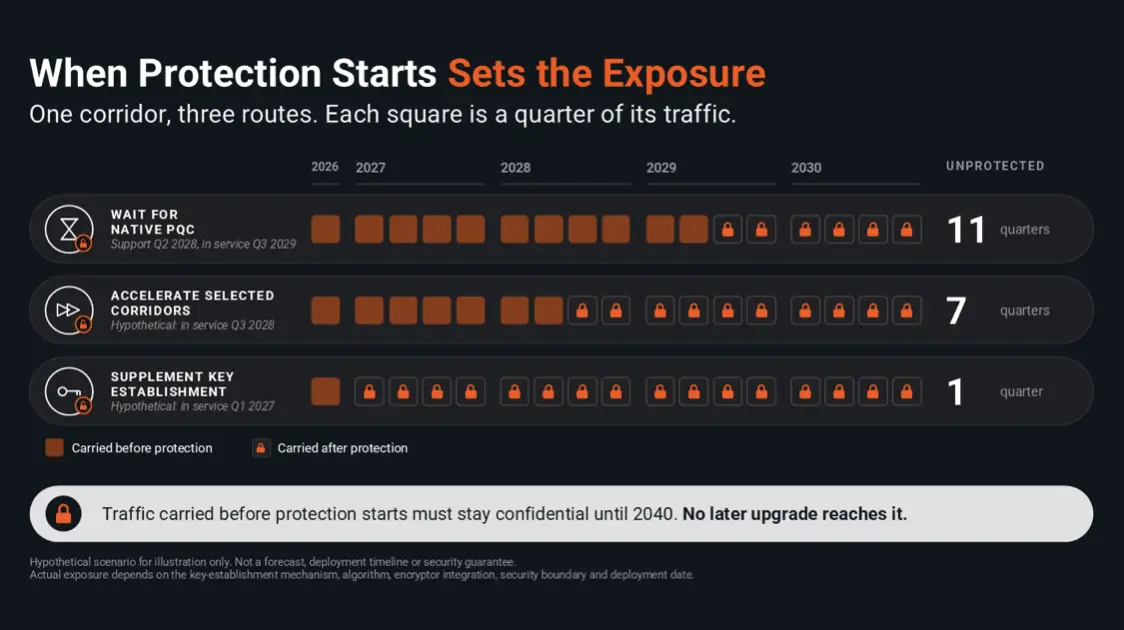
Chief Information Security Officers are bringing quantum security concerns to their boards earlier than expected, not due to immediate endpoint vulnerabilities, but because of long-lived network interconnects with undated upgrade paths. This exposure is particularly acute given the threat of (HNDL) collection, where captured data remains compromised even after planned upgrades; “an upgrade planned for 2029 does nothing for traffic collected in 2027.” Security leaders are now prioritizing the data flow itself, focusing on protecting key network corridors with solutions like quantum key distribution where fiber and data lifetime justify it, while broader cryptographic migrations continue.
CISOs Prioritize Long-Lived Data in Quantum Migration
Conversations with security leaders at large enterprises reveal that exposure related to these long-lived connections is reaching board agendas earlier than anticipated, particularly when feasible mitigation options exist. This proactive approach focuses on reducing confidentiality exposure on specific data paths while broader quantum migration projects proceed. The urgency stems from a fundamental principle: waiting for complete network-wide upgrades is not a neutral position. Data with a confidentiality lifetime extending beyond the timeline of planned cryptographic changes remains vulnerable, creating a critical risk window.
The calculation determining this exposure requires no prediction of when a cryptographically relevant quantum computer will arrive; it simply counts the volume of unprotected data transmitted before protection is implemented. This prioritization shifts the focus from individual assets to the data flow itself. Instead of solely concentrating on securing endpoints, organizations are now evaluating which network corridors carry data with the longest confidentiality requirements.
Supplementing existing encryptors with external key establishment, and potentially quantum key distribution (QKD) where appropriate, allows selected corridors to move forward with enhanced protection while the wider estate continues its migration, IonQ says. This approach addresses the challenge of heterogeneous environments and lengthy procurement cycles that often delay full PQC implementation. The benefit extends beyond immediate risk reduction. Establishing an external key path creates a more agile cryptographic infrastructure.
“Once the external key path and policy layer exist, the next algorithm or standards rollover has another route into production without automatically triggering another infrastructure refresh,” the source explains. This transforms future cryptographic changes from multi-year, disruptive overhauls into more manageable policy updates. The ability to decouple the network-wide quantum safety date from the timeline for protecting the most valuable traffic is a key advantage.
Identifying the share of longest-lived traffic still dependent on a single class of cryptographic assumption is a key review question for organizations. This allows organizations to protect their most sensitive data now, rather than waiting for full network-wide PQC deployment, according to IonQ. The goal is to shrink the period of exposure, ensuring data confidentiality extends beyond the reach of future quantum computers.
Harvest-Now-Decrypt-Later Threat Drives Early Mitigation
Boards at large enterprises are increasingly focused on the exposure created by network interconnects with extended service lives and undefined upgrade timelines, a shift observed in recent conversations with Chief Information Security Officers. “Nobody has watched an archive get smaller,” highlighting the permanence of data breaches in a post-quantum world.
The fundamental challenge lies in the fact that a scheduled upgrade in 2029 offers no protection against data intercepted in 2027, a point emphasized by security leaders prioritizing immediate mitigation strategies. This approach acknowledges that the slowest dependency in a migration should not dictate the risk timeline for all data.
One emerging solution involves establishing an external key path and policy layer to deliver quantum-safe key material to existing encryptors, a strategy that avoids the need for immediate hardware replacement or application rewrites. Clarion KX, a key-management and policy layer from IonQ, combines external keys from both post-quantum cryptography (PQC) and quantum key distribution (QKD) sources, offering a flexible approach to early mitigation. The Solteris appliance hosts the Clarion KX platform, underpinned by a NIST Entropy Source Validation (ESV) certified quantum random number generator (QRNG) entropy source, providing a secure foundation for key generation.
The economics of this approach are compelling. The mitigation focuses on a single layer, offering a significant reduction in exposure relative to the cost of a full migration program. The value of this strategy diminishes as native PQC support becomes widespread across applications, TLS stacks and network platforms, which is precisely the intended outcome.
However, even after full migration, the combination of different PQC families or QKD-derived material provides assurance diversity for the longest-lived data, ensuring that key compromise does not rely on a single set of assumptions. Interoperability with existing vendor equipment is a key architectural consideration, with organizations urged to verify compatibility against their current infrastructure. The ability to address this interoperability now creates a more agile cryptographic infrastructure, and the early risk-reduction benefit is hard to ignore.
Accelerating Corridor Protection with External Key Sources
Boards are increasingly focused on reducing exposure to quantum decryption before native cryptographic upgrades are available, a shift driven by the longevity of network interconnects and undefined upgrade timelines. The concern isn’t the encryption algorithms themselves, but the establishment of fresh keys, prompting a re-evaluation of key management strategies. Rather than replacing existing encryptors, the focus is shifting to altering the source of cryptographic keys.
An existing encryptor can remain in place while a separate, quantum-safe key source contributes to session keying through a supported external interface. “Key material is supplied through a supported external interface and contributes to the session keying, while the native protocol stays in place,” according to IonQ documentation. This configuration delivers two distinct benefits: accelerated mitigation for critical data flows and enhanced cryptographic agility.
Field Quantum Security Officer at IonQ notes that “Your board may well agree” with this approach, given the potential to reduce quantifiable risk. The system’s cryptographic agility is a key advantage, allowing for smooth transitions to new algorithms or standards without requiring a complete infrastructure overhaul. Clarion KX pre-builds and buffers keys locally in a secure enclave, and supports backup delivery paths, addressing concerns about service interruption should the external key feed be lost.
This policy decision is made on a per-path basis, allowing organizations to tailor security measures to the specific needs of each network corridor. Support for external key interfaces varies by product family and software release, necessitating careful evaluation against existing equipment. However, the potential to accelerate quantum security and maintain cryptographic flexibility is proving compelling for organizations facing the long-term threat of quantum decryption. The calculation, according to IonQ, needs no date for a cryptographically relevant quantum computer; it counts only what was carried before protection began.
Quantum Key Distribution Supplements PQC for Agility
Selecting specific network corridors for early quantum security deployment offers a tangible benefit beyond simply awaiting full post-quantum cryptographic (PQC) implementation, shrinking the window of vulnerability for long-lived data. An unprotected data flow existing between now and a planned 2029 upgrade remains exposed for its entire lifespan, but initiating protection immediately reduces that risk to the time required to establish the key path, the company says.
This agility is particularly valuable as the migration to native PQC gains momentum, reducing the early risk-reduction benefit but maintaining assurance diversity for the most sensitive, longest-lived data. Should the external key feed be interrupted, the system can be configured to either fail open, maintaining service with native key establishment, or fail closed, raising an alert to indicate a potential compromise. This approach allows organizations to prioritize data flows, rather than individual assets, as the primary unit for quantum security planning.
However, the combination of PQC- and quantum key distribution (QKD)-derived material provides assurance diversity, reducing reliance on any single cryptographic assumption for the most valuable data. The early risk-reduction benefit diminishes as applications and network platforms gain native PQC protection, but this is viewed as a sign of success.
The continued value lies in the system’s cryptographic agility and the assurance diversity it provides for data with extended confidentiality requirements. The selection of corridors for early deployment allows organizations to move forward while vendor and execution timelines continue for the rest of the network, offering a phased approach to quantum security.




See today’s quantum computing news on Quantum Zeitgeist for the latest breakthroughs in qubits, hardware, algorithms, and industry deals.