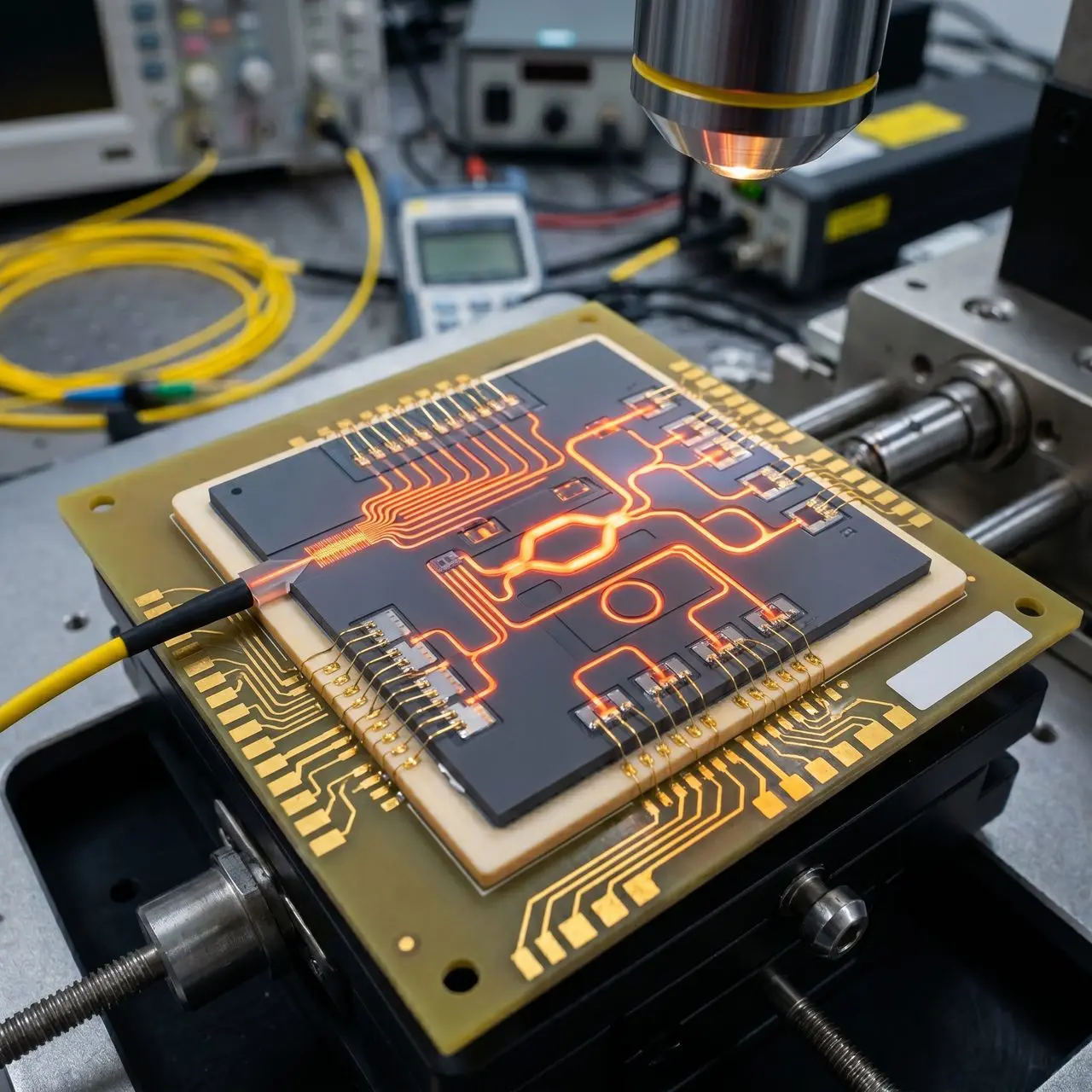
Q.ANT has released the first open-source software development kit for photonic computing, giving developers a new way to build applications accelerated by light instead of electricity, the company says. The kit includes an API for common programming languages and a CPU-based simulation backend, allowing developers to begin building and validating applications without immediate access to Q.ANT’s photonic hardware.
“Markets and ecosystems are created by applications,” said Michael Förtsch, Founder and CEO of Q.ANT, “and that is why Q.ANT is working every day to put photonic computing into developers’ hands as fast as possible.” This release provides an opportunity to program core operations on a photonic processor, with examples demonstrating how advanced neural networks can achieve better results using significantly fewer parameters.
Open SDK Enables Photonic Application Development
Q.ANT’s newly released software development kit includes an example neural network that achieves superior results using significantly fewer parameters than conventional designs. This demonstration highlights a core advantage of the company’s photonic approach: enhanced efficiency stemming from reduced data movement, not simply faster processing speeds, according to Q.ANT. The ability to build more expressive networks with fewer parameters directly addresses a key limitation of traditional AI architectures, where energy consumption is heavily tied to data transfer between memory and processor.
The fundamental shift enabled by Q.ANT’s technology lies in how computation is performed; its Native Processing Units (NPUs) allow calculations to occur in the optical domain. Unlike conventional processors that approximate non-linear functions with transistors, Q.ANT’s system executes these functions directly, using the properties of light itself.
This direct execution minimizes the need for complex approximations, further reducing energy demands and potentially unlocking new levels of performance for demanding applications like AI inference and scientific programming. Bob Sorensen, Senior Vice President of Research at Hyperion Research, notes that Q.ANT’s system, coupled with the new SDK and cloud access, “offers the advanced computing community an ideal way to explore the performance potential of Q.ANT’s systems.” Recognizing the importance of a robust developer ecosystem, Q.ANT has prioritized accessibility with this open-source SDK, lowering the barrier to entry and fostering broader adoption by allowing developers to build and validate applications without requiring immediate access to Q.ANT’s photonic hardware.
The company is collaborating with high-performance computing centers like the Leibniz Supercomputing Centre (LRZ) and Jülich Supercomputing Centre (JSC), as well as cloud provider IONOS, to expand access to its technology. “It emerges when the software layer is open and others can build on it.” Q.ANT’s strategy reflects a broader trend in the emerging photonic computing landscape, where software tools are seen as critical for driving adoption.
The company, a 2018 spinout from TRUMPF, secured €62 million in Series A funding in July 2025, and a further $80 million investment from Duquesne Family Office in November of the same year. This funding has enabled the development of its second-generation photonic processor, the NPU 2, a 19-inch rack-mountable unit with PCIe connectivity, with customer shipments scheduled for the first half of 2026, the company says.
Recent hires, including IBM veteran Joerg Behrend as VP Hardware, signal a commitment to scaling hardware development and delivering on the promise of photonic computing. Förtsch frames this moment as “the ‘Linux moment’ of photonic computing: the point at which a new possibility becomes a global platform.”
Markets and ecosystems are created by applications, and that is why Q.ANT is working every day to put photonic computing into developers’ hands as fast as possible.
Michael Förtsch, Founder and CEO of Q.ANT
Photonic Computing Benchmarks & Efficiency Gains
This benchmark, embedded within the SDK, allows developers to directly compare classical and photonic network architectures based on metrics like accuracy, functional approximation, and training loss, providing concrete evidence of the technology’s potential. The ability to achieve comparable or superior results with reduced complexity addresses a critical challenge in AI development, where model size and data movement often limit scalability and energy efficiency.
Q.ANT’s commitment to open-source development reflects a broader trend in the industry, where collaborative innovation is seen as essential for accelerating progress and driving down costs, the company states. The SDK’s availability marks the first time developers have openly programmable access to a photonic processor.
The ever increasing cost, complexity, and power needs of traditional advanced computing systems are opening the door to new and innovative methods for solving some of today’s most vexing computation problems.
Bob Sorensen, Senior Vice President of Research, and Chief Analyst for Quantum Computing at Hyperion Research
Source: https://qant.com/press-releases/q-ant-launches-world-first-open-source-sdk-for-photonic-computing/




See today’s quantum computing news on Quantum Zeitgeist for the latest breakthroughs in qubits, hardware, algorithms, and industry deals.