Wake Forest University has opened the Nano and Quantum Technologies Laboratory, NanoteQ, featuring its first ISO 5-certified cleanroom essential for fabricating silicon-based qubits. Led by physics professor and NanoteQ director David Carroll, the facility is designed to accelerate research into room-temperature quantum processors, a pursuit that bypasses the need for the extremely cold environments required by many existing quantum computers.
“Physics is becoming the physics of information,” Carroll said, envisioning NanoteQ as “the nexus, the hub of the people in computer science, physics, chemistry.” The new lab also supports commercial innovation, housing companies like Quoherent, which has the bulk of its operations in Winston-Salem and aims to create handheld quantum computing power.
NanoteQ Lab Enables Silicon-Based Qubit Research
The debut of Wake Forest University’s first ISO 5-certified cleanroom is central to advancing silicon-based qubit research at the new NanoteQ laboratory. This tightly controlled environment is essential for fabricating the quantum bits that underpin emerging quantum computing technologies, addressing a critical need for precision in materials science.
NanoteQ’s advanced spectroscopy facility complements this capability, allowing researchers to verify the composition and structure of these newly created qubits. “An ISO 5 cleanroom and advanced spectroscopy fix that together, one by controlling the environment and the other by proving what the team actually built,” explained David Carroll, physics professor and NanoteQ director.
Carroll envisions the laboratory as “the nexus, the hub of the people in computer science, physics, chemistry.” This collaborative model is intended to overcome a common obstacle to progress, as the team frequently encounters discoveries with data insufficient for industry partners to validate. A key focus for Carroll’s team is the development of room-temperature quantum processors, a potentially disruptive advancement over existing technologies that require extremely cold operating conditions.
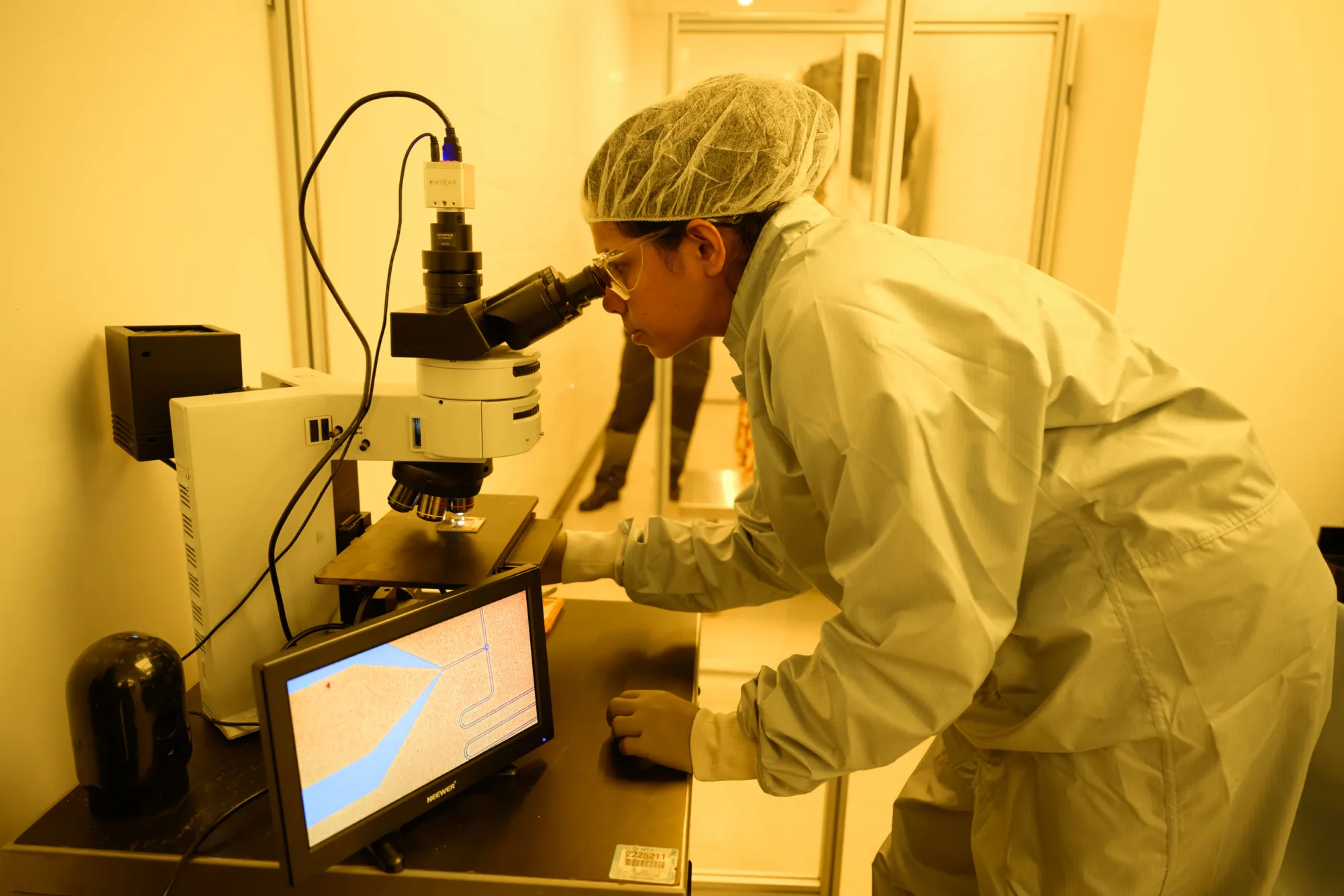
He predicts that this technology will eventually allow quantum computing capabilities to be integrated directly into everyday devices. “We’ll be able to drive this to the point where you’ll have a handful of quantum bits in your cell phone doing quantum AI, and you don’t need to go to the cloud. It’s very exciting stuff,” Carroll said. Mihirangi Medahinne studies quantum computing in the new NanoteQ lab. The team believes this research may even reveal connections to fundamental biological processes, as the observed effects are thought to be linked to the development of life.
I was designing and performing lithography to make these circuits and also did a lot of MFM imaging for the purpose of this calibration.
Alli Swyt, Recent Wake Forest graduate
Room-Temperature Quantum Processors Drive Quoherent Innovation
NanoteQ’s establishment directly supports the commercialization of quantum technologies, evidenced by the presence of Quoherent, a company with the bulk of its operations and actively utilizing its resources. Alton Reich, Quoherent co-founder and COO, anticipates a future where quantum processing power is readily accessible. This shift represents a departure from current models requiring remote cloud access for quantum processing.
Carroll’s team intends to investigate chiral-induced spin selectivity building upon current projects. “We have plans to work together to study an effect called chiral-induced spin selectivity, going even one step smaller,” Carroll noted, indicating a commitment to pushing the boundaries of nanoscale quantum phenomena. The facility’s advanced spectroscopy capabilities and ISO 5-certified cleanroom are essential for this work, enabling precise material characterization and fabrication at the atomic level.
Physics is becoming the physics of information, and this laboratory is going to play a deeper and deeper role.
David Carroll, Wake Forest physics professor and NanoteQ director
ISO 5 Cleanroom Advances Reproducible Quantum Research
The limited availability of ISO 5-certified cleanrooms has historically constrained progress in quantum research, but Wake Forest University’s new NanoteQ lab addresses this bottleneck with its first such facility. Fewer than 100 universities across the nation maintain these rigorously controlled environments, essential for fabricating the silicon-based qubits central to advancing quantum computing. Contamination, even at a microscopic level, can impede the reproducibility of experimental results, a critical hurdle in validating hypotheses and translating research into viable technologies.
NanoteQ’s design directly tackles this issue, providing a space where researchers can reliably generate and analyze quantum systems. Reproducibility is not merely a matter of scientific rigor; it is fundamental to attracting external partnerships and securing commercial investment. “A team has a real discovery but cannot produce data clean enough or consistent enough for a partner to trust.” The lab’s advanced spectroscopy capabilities, paired with the ISO 5 environment, provide the means to overcome this challenge, ensuring data integrity and fostering confidence in research outcomes.
We’ll be able to drive this to the point where you’ll have a handful of quantum bits in your cell phone doing quantum AI, and you don’t need to go to the cloud.
Nanotechnology Facility Supports Cross-Disciplinary Collaboration
NanoteQ fosters collaboration by design, integrating researchers from diverse fields within a single facility. The facility builds upon Carroll’s prior work directing the Center for Nanotechnology and Molecular Materials, a 25-year effort now evolving into a more expansive, interdisciplinary operation. NanoteQ’s advanced spectroscopy facility complements the cleanroom, enabling detailed analysis of materials for developing silicon-based qubits. This combination establishes a reliable environment for reproducible results, a factor increasingly important for attracting external funding and partnerships.
Carroll’s team is actively developing quantum processors designed to function at room temperature, a potential breakthrough that could dramatically reduce the cost and complexity of quantum computers. The laboratory’s design and instrumentation are intended to accelerate this work, positioning Wake Forest University as a leader in both fundamental research and commercial innovation in quantum technologies.
A team has a real discovery but cannot produce data clean enough or consistent enough for a partner to trust.
Trillitye Paulen, an NCInnovation regional entrepreneur-in-residence
Source: https://news.wfu.edu/2026/09/22/new-wake-forest-quantum-lab-takes-research-to-the-next-level/




See today’s quantum computing news on Quantum Zeitgeist for the latest breakthroughs in qubits, hardware, algorithms, and industry deals.