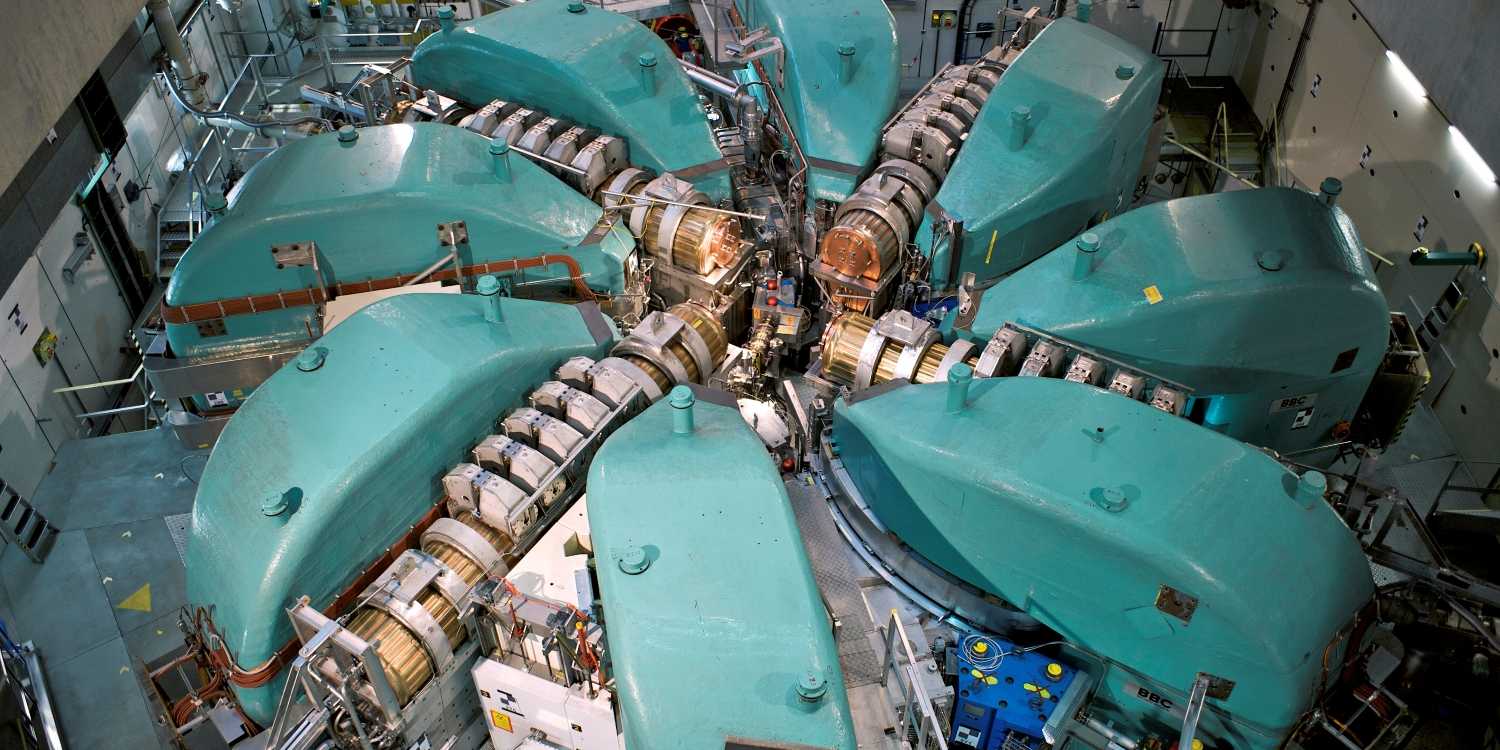
Researchers at ETH Zurich and the Paul Scherrer Institute are artificially producing an intense, cold beam of muonium, an exotic atom containing a second-generation antiparticle, in an attempt to rigorously test a cornerstone of Einstein’s theory of gravity. The team aims to measure whether Earth’s gravitational pull acts on muonium in the same way as it does on ordinary matter, a question that could reveal the existence of a fifth fundamental force.
“We have taken an important step towards carrying out an exciting experiment on this topic,” says Anna Soter, professor of physics at ETH Zurich; “We want to measure the gravitational interaction of the muon.” By investigating how this second-generation particle falls, the researchers hope to probe the enigmatic principle of equivalence with precision.
Muonium Atoms as Probes: Testing Gravity’s Universality
The creation of a superthermal muonium beam, achieved at the Paul Scherrer Institute, represents a critical advancement in the effort to test fundamental physics. Unlike previous attempts, this beam consists of muonium atoms propagating at similar speeds, a necessity for precise gravitational measurements. Researchers used a unique approach, utilizing superfluid helium cooled to near absolute zero, minus 273 degrees Celsius, to facilitate this controlled atomic propagation.
“Superfluid helium is what is known as a quantum fluid, in which the individual helium atoms lose their identity, and which does not tolerate any impurities within it,” explains a researcher, highlighting the specialized environment required for the experiment. This novel method builds on the institute’s existing infrastructure; PSI’s particle accelerator provides the world’s most intense, continuous muon beams, essential for generating a sufficient quantity of muonium atoms.
The team’s success in producing “cold” muonium, where atoms move almost parallel to one another, directly addresses a key limitation of earlier experiments. Prior sources yielded atoms traveling in various directions at differing speeds, rendering accurate gravity measurements impossible. The next phase involves constructing an interferometer, a device designed to measure the effect of gravity on the muonium beam by exploiting the wave-like properties of the atoms and generating an interference pattern.
This experiment isn’t simply about confirming existing theories; it’s about pushing the boundaries of our understanding of gravity itself. “I simply want to measure, for the first time, whether the equivalence between gravitational and inertial mass also applies to the second generation of particles – this alone is quite an inspiring piece of work,” states a researcher involved in the project.
The team anticipates initiating the gravity experiment within two to three years, contingent on successful apparatus development and beam stability. “We hope to be able to test the method for the first time with the atomic beam this year, and if all goes well, the actual gravity experiment should follow in two or three years’ time,” they predict, outlining the ambitious timeline for this research.
PSI Accelerator Produces Intense, Cold Muonium Beam
This approach, detailed in Nature Physics, represents an advancement in the ability to control and study these exotic atoms, essential for probing the fundamental laws of physics. Researchers achieved this “cold” state, where atoms move with similar velocities and in parallel, overcoming a key obstacle in gravity experimentation, as Anna Soter explains, “We have managed to produce the muonium atoms in a ‘cold’ state, which is what makes the gravity experiment possible in the first place.” PSI’s high-intensity muon beam is central to this achievement, enabling the production of a substantial quantity of muonium atoms. This isn’t simply about creating more particles, but about generating a beam with the necessary characteristics for sensitive measurements.
The team’s method relies on this intense source; according to Soter, “Thanks to this high-quality source, a great many muonium atoms can be produced.” This high flux is critical for overcoming the short lifespan of muonium, an unstable atom composed of an electron and an antimuon, demanding a constant replenishment for sustained experimentation. The next step involves constructing an interferometer to detect subtle shifts in the muonium beam’s interference pattern caused by Earth’s gravity.
“That would indeed be surprising,” notes Soter, “and, in addition to other theories, it could point to the existence of a fifth force.” The underlying question, however, extends beyond this specific measurement. “But we physicists do not yet understand why these additional generations exist at all in the first place,” she adds, highlighting the broader mysteries surrounding the fundamental building blocks of the universe and the forces that govern them.
Interferometry Measures Gravity’s Effect on Muon Waves
The creation of a measurable gravitational effect on muonium relies on a specific atomic state achieved through intense cooling. This extreme cooling isn’t simply about lowering temperature, but about controlling the atoms’ motion, as Soter clarifies: “In this case, ‘cold’ means that the atoms propagate at similar speeds, almost parallel to one another.” Maintaining this “cold” state is essential for generating a coherent beam suitable for interferometry, a technique demanding precise atomic velocities.
The choice of muonium as the experimental subject stems from a key physical property; “The exotic muonium is very well suited to this because it is a neutral atom,” Soter notes, highlighting its advantage over charged particles. Stray electromagnetic fields would otherwise obscure the subtle gravitational effects the team seeks to measure, making a neutral particle important for isolating gravity’s influence.
This neutrality, however, presents challenges given the muon’s inherent instability, decaying after only 2.2 microseconds, demanding a high-intensity beam to generate sufficient data. This device will not simply register a fall, but analyze the interference pattern created by the atoms, with gravity inducing a subtle alteration.



See today’s quantum computing news on Quantum Zeitgeist for the latest breakthroughs in qubits, hardware, algorithms, and industry deals.