Computation is now occurring on a scale previously unimaginable, as researchers at UCLA have built networks where physical connections are measured in billionths of a meter. Fifteen years of research has revealed within these self-organizing nanowire networks, offering a potential alternative to traditional silicon-based computing. This approach merges software and hardware, creating systems where the material itself is the neural network, and could benefit applications like satellites, robots, and distributed sensors needing on-site processing.
“Silicon-based electronics have shaped how we think about computing, but they’re not the only way to do it,” says UCLA research scientist Adam Stieg, explaining that in these systems, “the model evolves in the physical network itself. It adapts and changes.”
Nanowire Networks and Physical AI: A New Computing Paradigm
Connections within these networks measure on the scale of billionths of a meter, establishing the basis for computation far beyond the dimensions of traditional silicon circuitry. This approach offers a potential solution for on-site data processing in environments like satellites, robots, and distributed sensors, where minimizing power consumption and reliance on external connectivity are critical.
The potential for localized AI operation stems from the network’s ability to adapt its physical structure in response to incoming signals, effectively learning and computing within the material itself. “We’re asking what becomes possible when the hardware itself is adaptive — when the material reorganizes in response to information and becomes part of the learning process,” explained Stieg, highlighting a departure from conventional computing models.
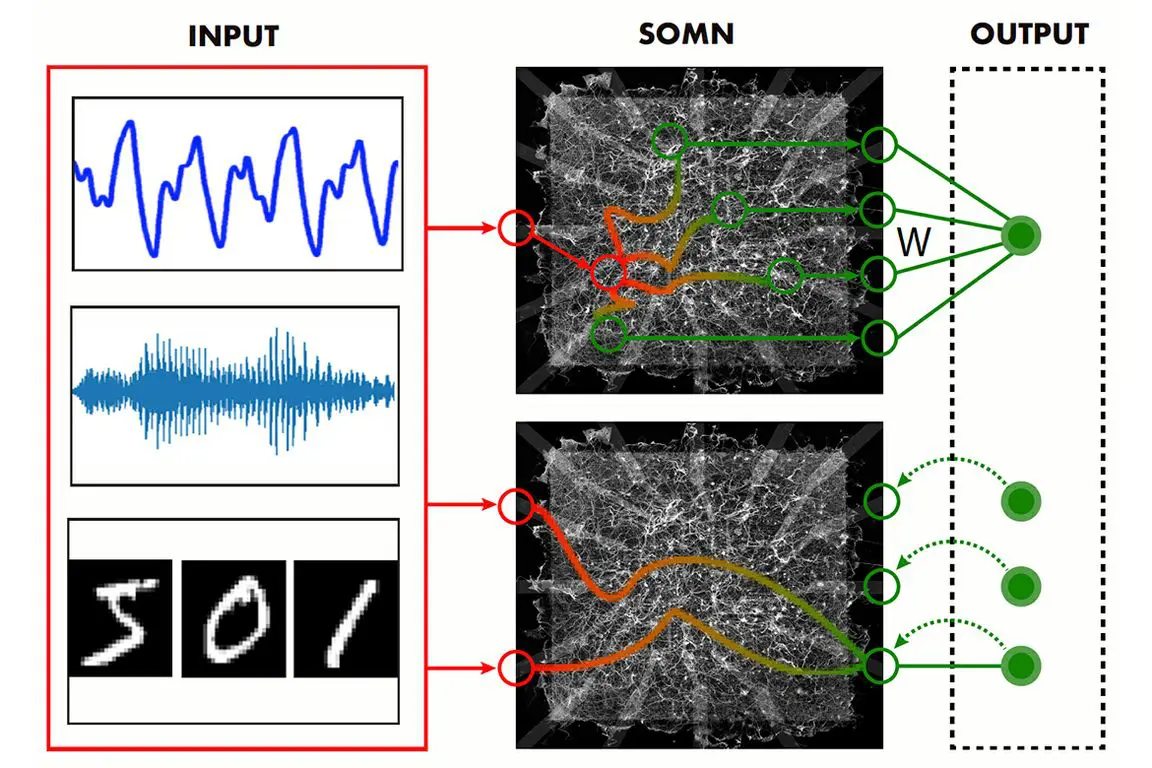
This adaptive quality allows the networks to perform machine learning benchmarks, including speech and image recognition, in real time by using the inherent physical properties of the network rather than relying on software-based neural networks. The review paper details how this technology could realize physical AI through edge computing, processing data directly at the source where sensors gather information from the real world.
Stieg clarified the team’s inspiration, stating, “The original inspiration was the brain, but we were never trying to build one,” emphasizing a focus on replicating effective properties rather than a complete biological simulation. Zdenka Kuncic, a physicist at the University of Sydney and review co-author, added, “Can it respond, adapt and process information in some of the ways biological systems do?
If so, there may be many different materials that can get us there.” Collaboration across disciplines is essential to fully harness this approach; as Stieg noted, “To really take advantage of this approach will require cooperation across multiple disciplines.”
Silicon-based electronics have shaped how we think about computing, but they’re not the only way to do it.
Adam Stieg, research scientist and associate director of the California NanoSystems Institute at UCLA
UCLA’s 2011 Nanowire Networks and 2013 Nanoparticle Systems
The distinct approaches to building adaptable computing systems at UCLA began with nanowire networks in 2011, followed by nanoparticle networks in 2013, each offering a unique physical substrate for computation. These systems move beyond traditional hardware roles, embodying a shift where the material itself actively participates in processing information, rather than simply supporting software execution.
“Most AI treats the hardware as a passive platform for running software,” explained Stieg, highlighting the fundamental difference in this design philosophy. This interdisciplinary approach is reflected in the authorship of the review paper, with each co-author contributing specialized expertise to the project.
Simon Brown, a physicist at the University of Canterbury in New Zealand, also contributed to the development of the nanoparticle networks initially unveiled in 2013. This focus on functionality over material composition underscores the team’s aim to replicate the adaptive qualities of biological systems. The networks are designed to respond and change, mirroring aspects of the human brain’s cortex, though the researchers acknowledge the limitations of fully replicating biological complexity.
“I don’t think of the brain as a computer, and I don’t think we can reproduce the full richness of a biological system,” Stieg said. “The goal is to understand which properties make biological systems so effective and see whether we can build those into engineered systems.”
Most AI treats the hardware as a passive platform for running software.
Adam Stieg, research scientist and associate director of the California NanoSystems Institute at UCLA
Self-Organizing Networks Mimic Brain Function for Low-Power Processing
The review paper details how these networks use the inherent behavior of their physical structure for computation, offering an energy-efficient alternative to traditional processing methods. This approach is particularly suited for edge computing, where data processing occurs directly at the source of information, such as within satellites, robots, or distributed sensor arrays.
We’re asking what becomes possible when the hardware itself is adaptive – when the material reorganizes in response to information and becomes part of the learning process. That points toward a very different kind of AI: one that is physical, energy-efficient and able to operate and adapt locally.
Edge Computing Potential: Adapting Hardware for Resource-Constrained Environments
This approach moves computation away from traditional models where software directs static hardware; instead, the physical network actively participates in processing data, adapting its structure to incoming signals. These networks offer a pathway to continuous, local AI operation in environments with limited power and connectivity, a capability important for applications beyond centralized cloud processing. The concept builds on decades of brain-inspired computing, but diverges significantly from current neural network software, which still relies on conventional hardware. This physical AI promises a new paradigm for resource-constrained environments, offering a fundamentally different approach to computation and intelligence.
The original inspiration was the brain, but we were never trying to build one.
Adam Stieg, research scientist and associate director of the California NanoSystems Institute at UCLA




See today’s quantum computing news on Quantum Zeitgeist for the latest breakthroughs in qubits, hardware, algorithms, and industry deals.