
Researchers have moved beyond traditional imaging detection in neural networks by demonstrating a system that processes signals using a single-pixel detector. Published in Light: Science & Applications, the work details a novel spatiotemporal all-optical neural network architecture integrating time and space for enhanced computation. This configuration shifts the focus from spatial light intensity to effectively overcoming speed bottlenecks caused by 2D array detectors. Experimental studies confirm the system accelerates processing of real-world spatiotemporal lidar signals, enabling real-time reconstruction of multi-target moving scenes.
Spatiotemporal Light Field Modulation for Neural Networks
Operating at gigahertz speeds and without relying on traditional 2D array detectors, the system achieves signal processing by utilizing a single-pixel detector to measure temporal intensity variations. This approach integrates the temporal dimension as a core computational resource into the network, changing all-optical neural networks from focusing on “imaging detection” to focusing on “temporal analysis” and effectively overcoming the speed bottleneck caused by the bandwidth limitations of traditional 2D array detectors.
By dispensing with the need to capture a full image, the architecture bypasses a major bottleneck in processing speed and allows for real-time data analysis. The single-pixel approach also simplifies the hardware requirements, potentially reducing the cost and complexity of future implementations. Unlike earlier all-optical neural networks limited to spatial light intensity, this new design integrates time as a core computational resource, enabling two-dimensional modulation across both space and time.
Previous attempts at spatiotemporal architectures, such as the work of researchers who cascaded multiple pulse shaping systems, passively projected spatial information into the time domain. This configuration actively manipulates light fields to create spatiotemporal structured light, converting incident light containing both spatial and temporal features into a modulated form. The system then uses diffraction layers to impart different phases to light fields of varying frequencies, achieving temporal chirp and enabling precise control over the output pulse characteristics.
The core of the system’s functionality lies in its ability to generate specific spatiotemporal structured output fields based on input spatial and temporal features. Light fields are first converted into structured light through spatiotemporal light field modulation, then filtered spatially using a mask. This process allows the system to encode information not just in the intensity of light, but also in how that intensity changes over time.
Following spatial filtering, the system employs diffraction layers constructed in the ω – ky domain, where ω represents frequency and ky represents spatial frequency. Cylindrical lenses and gratings then recollect dispersed frequencies and perform an inverse spatiotemporal Fourier transform, ultimately projecting the modulated signal onto the t-y plane. Theoretical and experimental results demonstrate the system’s capacity to generate these tailored spatiotemporal outputs, confirming the effectiveness of the modulation process.
The researchers detail how the temporal chirp of the output pulse is precisely designed by training the parameters of the diffraction layers, allowing for fine-tuned control over the signal. A detailed analysis of the system’s operational speed and energy efficiency is available in the published work.
All-Optical Neural Networks & Limitations of Spatial-Only Processing
Current all-optical neural networks typically map input spatial light intensity onto a predefined output distribution, then rely on electronic processing for final decision-making; this architecture functions as a space-to-space projection for data, a limitation the researchers addressed by expanding processing into the temporal dimension. This shift moves beyond simply detecting spatial patterns to utilizing the speed advantages inherent in manipulating light’s properties over time, a departure from designs focused solely on spatial light intensity.
The team’s work details a novel network architecture integrating both time and space, enabling learning beyond the spatial-only restrictions of previous systems. A key constraint of earlier optical neural networks stemmed from their reliance on electronic pattern recognition following the optical projection; this created a bottleneck that limited overall processing speed, even with the potential for light-speed computation within the optical layers themselves.
To overcome this, the researchers constructed a system that processes information encoded in both the spatial and temporal characteristics of light, effectively expanding the computational space available to the network. This advancement allows for the direct processing of spatiotemporal data, eliminating the need for a separate electronic interpretation step and unlocking faster performance. Detailed descriptions of the experimental setup and dataset characteristics are provided in Supplementary Notes 12-15.
The system’s capabilities were demonstrated using a specialized dataset simulating aircraft altitude and attitude variations during takeoff and landing, with motion detection tasks performed based on this data. Benefiting from the inherent light-speed processing capability of diffractive neural networks, the actual operational speed is ultimately limited by the performance of the signal input and detection. This approach contrasts with traditional methods that often rely on static spatial patterns, enabling the network to analyze dynamic, evolving scenes more efficiently.
The team’s work builds on prior investigations into activation functions for optical neural networks, as well as fundamentals and recent developments in free-space optical neural networks. Further research detailed in the paper references work on performing optical logic operations by a diffractive neural network and high-speed all-optical neural networks empowered by spatiotemporal mode multiplexing. The team cites “Space-time profiles of shaped ultrafast optical waveforms” and “Ultrafast optical pulse shaping: a tutorial review” as foundational to their approach, demonstrating a clear lineage of research into manipulating light in both space and time.
This builds on earlier work, such as “Terahertz pulse shaping using diffractive surfaces” and “Free-space propagation of spatiotemporal optical vortices,” which explored the fundamental principles of controlling light’s spatiotemporal properties. “Large-scale neuromorphic optoelectronic computing with a reconfigurable diffractive processing unit” also provided a basis for the current study.
Real-Time Reconstruction of Moving Scenes with Lidar Signals
The system achieved 5% and speed errors below 3.0%. This level of accuracy, achieved without traditional scanning mechanisms, represents a departure from conventional lidar systems which rely on components like micro-electromechanical systems to build 2D or 3D representations of environments. The researchers constructed a dataset simulating vehicles traveling at speeds ranging from 10 to 50 millimeters per second. experimental studies demonstrate that the system can accelerate the processing of real-world spatiotemporal lidar signals, facilitating the real-time reconstruction of multi-target moving scenes.
The core of this advancement lies in the system’s ability to project three-dimensional target positions onto a temporal pulse intensity waveform; analyzing changes in this waveform allows for real-time motion monitoring and scene reconstruction. This differs significantly from previous optical neural networks primarily focused on spatial light intensity for both inputs and outputs, offering enhanced flexibility and faster processing speeds. A single-pixel photodetector and a high-speed oscilloscope were used to capture the temporal output signals, demonstrating the system’s capacity for direct processing of spatiotemporal data without intermediate steps.
Supplementary Movie 1, provided with the published work, visually demonstrates the system’s high-speed signal processing and real-time recovery capabilities by synchronously displaying the lidar detection scene, output pulse waveform, and reconstructed results. The network’s performance extends beyond lidar applications, as training and testing with the MNIST dataset indicate good classification performance.
The phase distribution loaded onto the spatial light modulator during experimentation, detailed in the published work, is critical to the system’s function, as illustrated by the relationship between target positions and the resulting output waveform. Detailed digital processing and scene reconstruction procedures are further explained in Supplementary Note 10, providing a comprehensive overview of the methodology employed.
Space-to-Time Projection Methods in Prior Optical Networks
This approach, while functional, presented limitations in both modulation capability and operational speed, prompting exploration of alternative architectures. Researchers consistently sought methods to add degrees of freedom to improve network performance, a challenge highlighted in recent publications focusing on all-fiber systems and complex optoelectronic setups. One earlier attempt to overcome these limitations involved a single-pixel detection method utilizing multimode fiber dispersion, converting input images into temporally distinct patterns, enabling high-speed detection with a single photodiode.
However, computation in that 2015 system remained electronic, diminishing the inherent advantages of optical computing. Another approach combined digital micromirror devices, optical fibers, and active optoelectronic devices to process light fields’ spatial and temporal information, but resulted in a complex system with scalability concerns. Zhang et al. proposed a space-to-time information projection method based on output aperture-confined intensity detection, directly mapping 2D spatial information to 1D intensity values, representing a further refinement of temporal analysis.
These earlier methods, while innovative, often traded one complexity for another, or relied on hybrid electronic-optical processing. The current work diverges by achieving full optical processing through spatiotemporal light field manipulation, a key distinction from previous designs. “Adding degrees of freedom to improve the modulation capability of the network as well as enhancing the network’s operation speed remains a significant challenge,” as noted in prior research on optical neural networks.
The new system, however, directly addresses this by projecting spatiotemporal data onto a single pixel, bypassing the need for traditional 2D array detectors. This shift is not merely architectural; it fundamentally alters how data is processed, potentially unlocking significantly faster speeds. The ability to process real-world spatiotemporal lidar signals faster than previous systems demonstrates a practical application beyond theoretical speed improvements. This advancement builds on earlier work in diffractive neural networks, including studies published in Science and ACS Photonics, but moves beyond static spatial intensity mapping.
Electronic Training & Optimization of Light Field Parameters
Network parameters within this system are not set statically but are instead trained and optimized electronically, enabling precise manipulation of light fields according to their spatial and temporal characteristics. This electronic training process allows for the creation of customized light field structures tailored to specific recognition tasks, a departure from systems relying on fixed optical elements. The resulting all-optical framework facilitates accurate and efficient pattern recognition, positioning the system for use in real-time, high-speed applications demanding multi-dimensional light field control and signal processing.
This capability is underpinned by an optical forward propagation model constructed based on this modulation process, detailed further in Supplementary Notes 1 and 2. The system’s propagation, denoted as ‘c’ in the supporting materials, accepts chirp-free pulse light fields with differing spatial intensity distributions as input.
The physical realization of connections between gratings, lenses, and diffraction layers relies on free-space diffraction, a technique elaborated upon in Supplementary Note 2. Training of the system utilized Python version 3.6.5 and the TensorFlow framework version 2.4.0, executed on a server equipped with an NVIDIA GeForce RTX 3090 GPU and an Intel Xeon Silver 4210R CPU with 32 GB of RAM, running Windows 10. To balance computational accuracy with processing demands, the light field was discretized into a 200 × 200 × 200 matrix representing the x, y, and ω axes, respectively.
The phase distributions of the diffraction layers, represented as 200 × 200 matrices ranging from 0 to 2π, is the optimization target, defining the spatial characteristics of the manipulated light field. Loss function construction employed either the CE or MSE method, with the Adam optimizer driving the training process; further details are available in Supplementary Note 4.
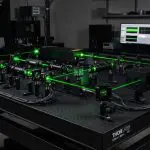
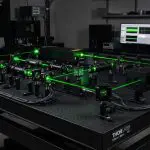
Experimental validation of the system utilized an ultrafast Ti: Sapphire laser (COHERENT Mira 900-D) operating at a wavelength of 800 nm with a bandwidth of approximately 6 nm, a pulse duration of ~200 fs (FWHM), a repetition rate of ~76 MHz, and an output power of ~1 W, all with linear polarization.
To expand the physical spatial size of the light field, the trained phase distribution, a 200 × 200 matrix, was loaded onto a spatial light modulator (SLM) by sampling adjacent 5 × 5 matrix elements, effectively creating a 1000 × 1000 matrix phase distribution. Time delays in a reference path were achieved using two mirrors mounted on a displacement stage (Thorlabs, LTS300C) offering a 300 mm travel range and 0.1 μm minimum incremental movement.
High-Speed GHz-Scale Operation in Spatiotemporal AONNs
Operating at gigahertz speeds with a single-pixel detector, a departure from array-based systems, the system moves beyond traditional optical neural network detection methods and achieves accelerated processing. This configuration allows for direct measurement of temporal intensity variations, effectively bypassing the time-consuming step of imaging the output and enabling faster signal analysis. Rather than reconstructing a full image, the network focuses on analyzing how light changes over time, a shift the researchers describe as moving from spatial-only to spatiotemporal modulation.
The resulting temporal variations in light passing through this mask become the system’s output, directly measurable with the high-speed detector. This process allows for the analysis of complex spatiotemporal signals, such as those encountered in lidar systems, with significantly reduced latency.
Demonstrated application of this system to lidar showcases its potential for real-time reconstruction of multi-target moving scenes, a capability previously limited by processing speeds. Lidar systems rely on emitting light and analyzing the reflected signal to determine the position and distance of objects; this new network accelerates the processing of the spatiotemporal signals generated by lidar, enabling faster and more accurate scene reconstruction. Experimental validation included aircraft takeoff and landing detection, confirming the system’s ability to handle dynamic scenarios.
Theoretical work also suggests potential applications beyond lidar, including orbital angular momentum (OAM) mode demultiplexing, with operation speeds reaching the GHz level, as detailed in Supplementary Note 11. The system’s speed is achieved, in part, by avoiding the spatiotemporal slicing and imaging detection required by interferometric all-optical neural networks. The use of a single-pixel detector, combined with the novel spatiotemporal modulation technique, enhances the performance of traditional approaches.
Researchers also point to related work in areas like direct retrieval of pupil functions using integrated diffractive deep neural networks and for high-speed applications, building upon existing advancements in optical signal processing. The development of all-fiber high-speed image detection enabled by deep learning and ultrafast dynamic machine vision with spatiotemporal photonic computing further contextualizes this work within a broader trend toward accelerated optical computing. The new system, however, directly addresses this by projecting spatiotemporal data onto a single pixel, bypassing the need for traditional 2D array detectors, and demonstrating a practical application beyond theoretical speed improvements.


See today’s quantum computing news on Quantum Zeitgeist for the latest breakthroughs in qubits, hardware, algorithms, and industry deals.