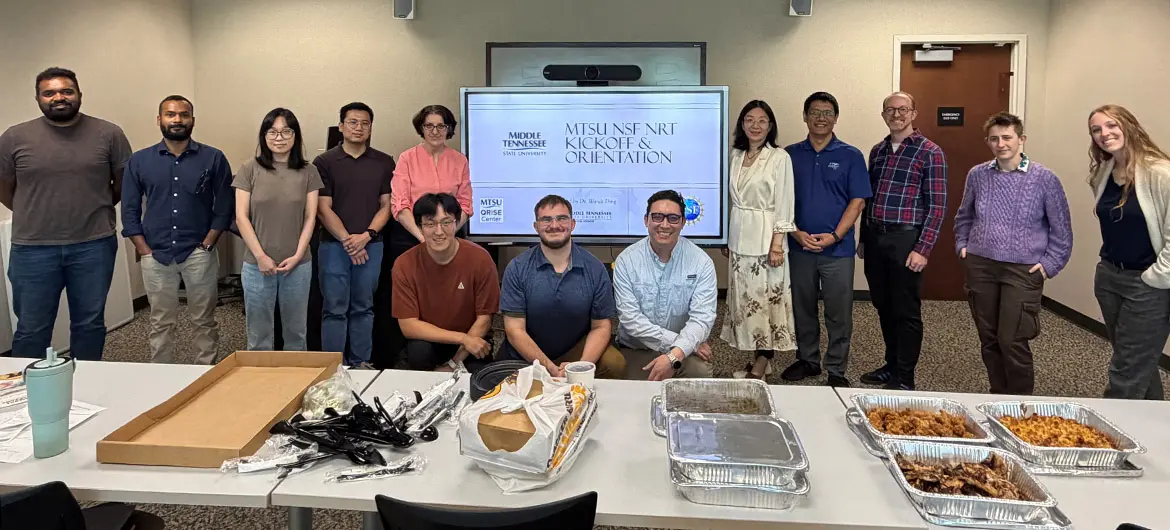
Middle Tennessee State University’s Quantum Research Interdisciplinary Science and Education Center, or QRISE, will begin with fundamental research at MTSU and extend to work at Oak Ridge National Research Laboratory. A $2 million National Science Foundation grant will fund tuition assistance of $16,000 and a $37,000 stipend for eligible students focused on quantum computing and artificial intelligence research. The program aims to create a workforce pipeline by combining fundamental research with practical industry experience.
QRISE Center Receives $2M NSF Grant for Quantum-AI Training
This National Research Traineeship grant prioritizes practical application, allowing trainees to transition from fundamental research at MTSU and spend time at Oak Ridge National Research Laboratory working on the forefront of quantum science. Aspen Malone, research project manager, emphasized the importance of mentorship within the program, explaining, “Another thing they get out of this program is a mentor, and so we pair them with a faculty member on our grant team.” Mentorship will be provided by a team including computer science professor Joshua Phillips, assistant computer science professor Kritagya Upadhyay, and assistant mathematics professor Donglin Forrest Wang, guiding the initial cohort of eight students through their research endeavors.
This support is particularly helpful for students like Laurel Koenig, who previously balanced academic pursuits with part-time employment. “Part of the reason it has taken so long is that I have been working part time for Thompson Machinery during that time period,” Koenig said. Koenig’s work exemplifies the program’s emphasis on practical applications of quantum machine learning, specifically in predictive maintenance for heavy machinery.
She and her mentor are applying these techniques to analyze data from large machines, aiming to anticipate failures and maximize equipment lifespan. “Preventive maintenance is scheduled,” Koenig explained, “Predictive maintenance is trying to catch when something is going to fail so that you can fix it, essentially right before it fails, to get as much useful life as you possibly can.” This approach demonstrates the potential for cost savings and increased efficiency.
Fellow trainee Tomy Chet’s research further illustrates this focus on applied quantum simulation, exploring material behavior to accelerate the development of new technologies. “It’s much cheaper to run the simulation of how the materials can behave rather than make it, because you can simulate it 10 times for the cost of making it once,” Chet stated.
The grant’s broader objective, as articulated by Terletska, is to establish a robust quantum ecosystem within Tennessee. This vision extends beyond technical training, encompassing a strategic focus on identifying real-world problems and fostering collaboration with industry partners. According to Terletska, the program seeks to answer critical questions: “What problem are we solving? Who is the customer?
Can this technology be deployed? That is the workforce pipeline we want to build.” Gavin Liles, another member of the inaugural cohort, frames the endeavor in terms of national competitiveness, stating, “In my head, quantum is really like the next space race,” and adding, “As someone who cares about my community, about this country, how can we best prepare our country for this next space race?” Wandi Ding, principal investigator for the grant and associate director of education for MTSU’s QRISE Center, expressed her elation at the NSF’s decision, stating, “We thought, ‘Our dream just came true.’ I’m very thankful.”
A student might begin with fundamental research at MTSU, spend time at Oak Ridge National Research Laboratory working at the frontier of quantum science, and then work with an industry partner where the questions become very different.
Hanna Terletska, physics professor and director of Quantum Research Interdisciplinary Science and Education Center (QRISE), Middle Tennessee State University



See today’s quantum computing news on Quantum Zeitgeist for the latest breakthroughs in qubits, hardware, algorithms, and industry deals.