A 13-node quantum network has demonstrated that the proposed hierarchical encoding scheme is feasible and achieves perfect fidelity, marking a practical step toward scaling quantum networks beyond small, isolated systems. Dick Maryopi, as first author, proposes a lossless source coding scheme for addressing in quantum networks that enables compact and coherently processable quantum address states. The work introduces an isometric hierarchical encoder and its adjoint decoder designed to uniquely identify nodes and manage resources within the network. This approach establishes a rigorous connection between source coding theory and quantum network design, offering a framework for scalable and coherent quantum addressing as networks evolve toward larger, globally interconnected architectures. The researchers detail how this scheme accommodates dynamic network conditions and heterogeneous cluster sizes, critical for future quantum internet development.
Hierarchical Network Model for Quantum Systems
Researchers are now addressing the challenge of identifying individual nodes and efficiently managing resources within increasingly interconnected quantum systems, moving beyond the limitations of isolated quantum processors. The team’s approach centers on an isometric hierarchical encoder and its adjoint decoder, a specific technical implementation designed to uniquely identify each node and manage network resources. This is not merely theoretical; the researchers demonstrate a practical framework for translating the principles of classical data compression, source coding theory, into the quantum realm. The design prioritizes networks with inherent hierarchical structures, accommodating varying cluster sizes and dynamically adjusting to changing network conditions. This adaptability is crucial, as real-world quantum networks will inevitably experience fluctuations in entanglement availability and topology.
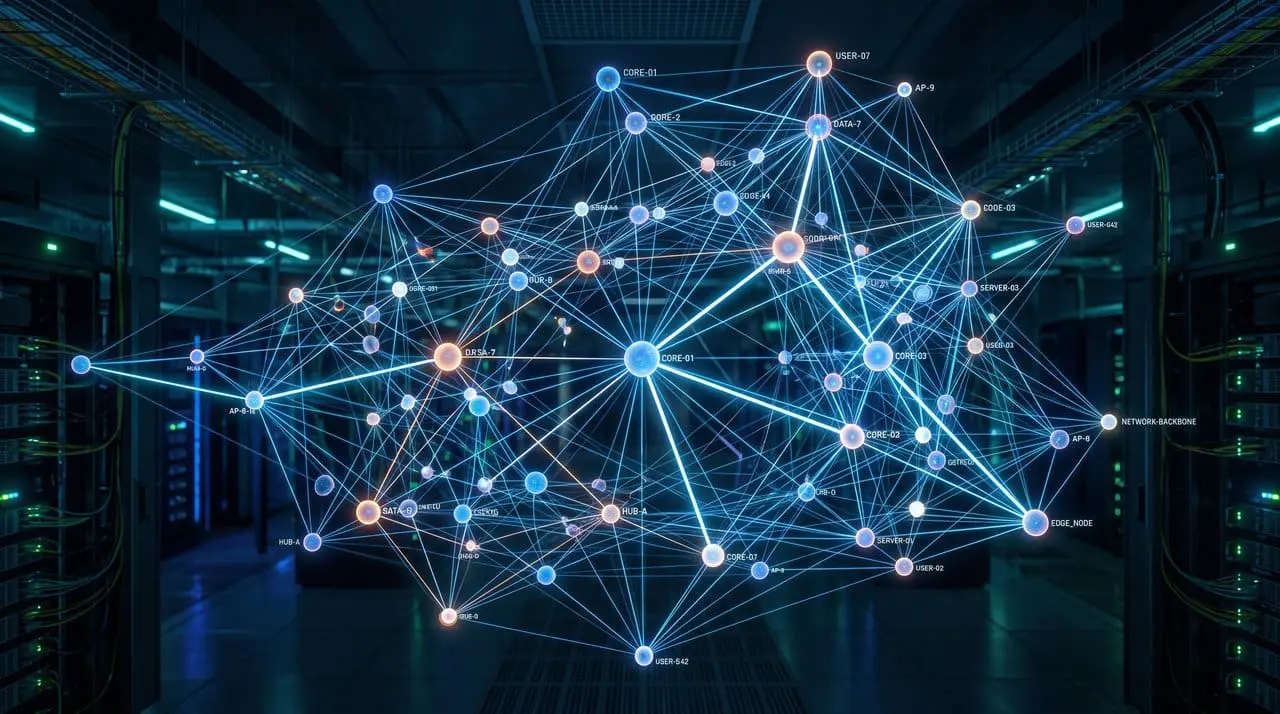
The core innovation lies in treating node identification as a lossless source coding problem, a perspective that allows the application of established information theory principles to quantum network design. “Naming or labeling a set of objects is essentially a natural instance of a source coding task,” the paper explains, framing the challenge as one of representing addresses as decodable quantum states. The researchers develop a concrete encoding procedure that uses spectral diagonalization and Huffman-based prefix/suffix codes, creating codewords suitable for dynamic addressing. This method ensures that the address remains meaningful even as the network evolves. A numerical example, conducted on a 13-node network, demonstrates that the proposed hierarchical encoding scheme is feasible and achieves perfect fidelity, demonstrating negligible recovery and isometry errors. This result confirms that the scheme can maintain data integrity and coherence, essential requirements for quantum information processing. The network in the numerical example was modeled with a two-tier architecture, where the tier-2 layer serves as an entanglement service provider and the tier-1 layer consists of user nodes organized into clusters that consume the distributed entanglement.
Lossless Coding Framework for Quantum Addressing
Unlike previous schemes relying on superposition or hybrid classical-quantum approaches, this work focuses on a purely quantum representation of addresses. This connection allows for the application of classical compression techniques to the unique constraints of quantum information processing, potentially unlocking new avenues for efficient and scalable quantum communication. Dick Maryopi, in conversation with the author, proposes a lossless source coding scheme for addressing in quantum networks that enables compact, hierarchical, and coherently processable quantum address states.
Dick Maryopi, as first author of a recent work, is developing a new approach to addressing nodes within increasingly complex quantum systems. The core innovation lies in a specifically designed isometric hierarchical encoder and its adjoint decoder intended to uniquely identify nodes and efficiently manage resources within a quantum network. A key element of the scheme is an isometric hierarchical encoder-decoder. This combination guarantees unique decodability, ensuring that each node can be reliably identified even as the network scales. Maryopi’s team further develops a concrete encoding procedure that uses a Huffman-based procedure to embed prefix-free, length-eigenstate codewords into the address space, further preserving the integrity of the quantum information.
Numerical Validation on a 13-Node Network
While theoretical frameworks for quantum addressing are rapidly developing, practical validation remains a significant hurdle. Dick Maryopi and his team addressed this need by implementing their lossless source coding scheme on a simulated 13-node quantum network, moving beyond purely conceptual designs to demonstrate feasibility. This network was described as a simple hierarchical quantum network model where nodes are partitioned into two functional layers: first, the tier-2 layer serves as an entanglement service provider (ESP), and second, the tier-1 layer consists of user nodes organized into clusters that consume the distributed entanglement. The researchers deliberately introduced heterogeneity, assigning varying numbers of nodes to each cluster within the network to reflect the complexities of real-world deployments. The core of the validation involved assessing the fidelity of the encoded and decoded quantum addresses.
This level of accuracy is paramount in quantum networks, where even minor disturbances can disrupt delicate quantum states and compromise information transfer. Importantly, the numerical example wasn’t merely about achieving high fidelity; it was about demonstrating the scalability of the approach. The design is allowing for efficient address assignment even as the network expands and its topology changes. The successful demonstration on the 13-node network provides a concrete foundation for extending these principles to larger, more complex quantum networks.
Quantum Network Addressing Challenges & Requirements
This work, focused on lossless address coding, proposes a system where each node receives a uniquely identifiable quantum “name” that can be processed without collapsing delicate quantum states. The core innovation lies in a hierarchical addressing scheme designed to accommodate the dynamic nature of quantum networks. Unlike classical networks that rely on fixed locations, quantum networks experience fluctuations in resource availability and entanglement, necessitating an adaptable addressing system. The team developed a concrete encoding procedure that uses spectral diagonalization and Huffman-based prefix/suffix codes, coupled with an isometric hierarchical encoder and its adjoint decoder, to guarantee unique decodability, even as the network topology shifts.
The design specifically targets networks with hierarchical structures, allowing for efficient address assignment even with varying cluster sizes. The work further details a Huffman-based procedure for embedding prefix-free codewords into the address space, preserving the crucial property of isometry. A numerical example on a 13-node network demonstrates that the proposed hierarchical encoding scheme is feasible and achieves perfect fidelity. This work establishes a rigorous connection between source coding theory and quantum network design, offering a practical framework toward scalable and coherent quantum addressing.
Source: https://arxiv.org/abs/2607.23510


See today’s quantum computing news on Quantum Zeitgeist for the latest breakthroughs in qubits, hardware, algorithms, and industry deals.