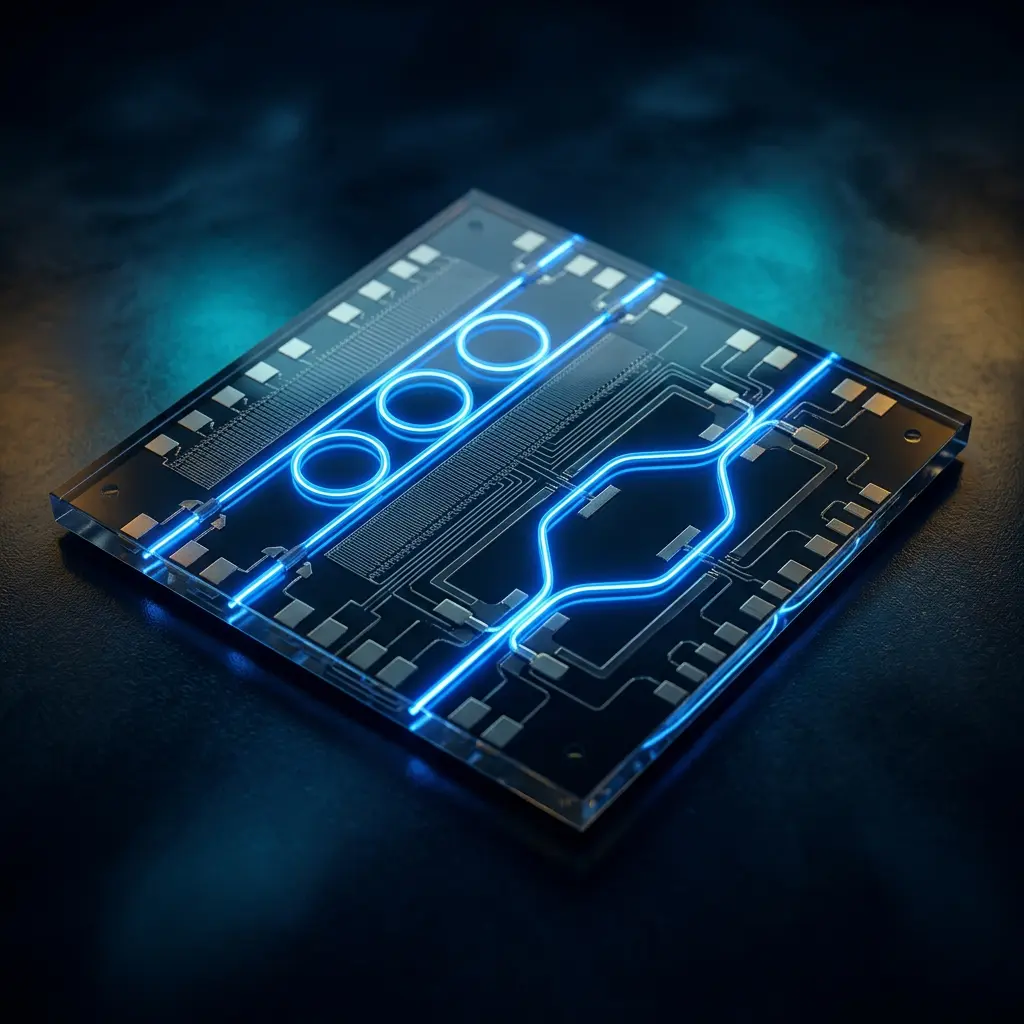
Researchers at the University of Wisconsin-Madison and Argonne/University of Chicago have achieved a full characterization of both intravalley and intervalley tunnel couplings within a silicon double quantum dot, revealing how complex phases directly control measurable parameters like the gaps at anticrossings between quantum states. This detailed measurement is significant because tunneling in silicon uniquely connects qubit states with valley minima on opposite sides of the Brillouin zone, impacting the behavior of these quantum dots. The team reports that these phases evolve with quantum dot gate voltages and depend on the underlying atomic structure of the quantum well, completing a crucial understanding of variations in valley couplings. According to the researchers, knowledge of these valley phases fills a key gap in understanding physical parameters such as spin-orbit coupling and Landé g-factors, enabling more stable and scalable silicon-based quantum computing. 1.7 percent germanium is incorporated into the Si quantum well to enhance the average valley splitting.
The team’s work demonstrates that tunneling in silicon depends on the complex phase differences between the conduction-band valley eigenstates in localized dots, a critical aspect for scaling up qubit operations. The researchers utilized a technique called delta-axis spectroscopy (DAXS) to map the double-dot energy dispersion, enabling the simultaneous fitting of six Hamiltonian parameters, including the complex valley coupling parameters, with unprecedented detail. 1.7 percent germanium is incorporated into the Si quantum well to enhance the average valley splitting. By obtaining enough detail to fit these parameters, including the anticrossing gaps, the team was able to extract both the magnitudes and phases of the tunnel couplings, revealing their dependence on the local atomic distribution of germanium within the quantum well. This detailed understanding is crucial for mitigating device variability, a significant challenge in building large-scale silicon quantum computers.
The team incorporated 1.7 percent germanium into the silicon quantum well to enhance the average valley splitting, a common practice to optimize performance. The complete measurement of these couplings, including their complex phases, completes our understanding of sample-wide variations of valley couplings and the physical parameters that depend on them. This advancement is particularly important for mitigating device variability, a persistent challenge in scaling silicon-based quantum computing architectures, and promises more reliable and predictable quantum systems.
The study highlights a critical connection between tunneling, essential for manipulating qubit states, and the valley minima present in silicon’s conduction band. They employed a device incorporating 1.7 percent germanium into the Si quantum well to enhance the average valley splitting.
The precise concentration of germanium within silicon quantum wells directly dictates the behavior of electron “valleys,” fundamentally altering quantum dot performance. The team’s work centers on silicon double quantum dots, structures increasingly vital for quantum computing due to their potential for scalability and high-fidelity operations. Crucially, the incorporation of germanium is not merely about enhancing valley splitting; it’s about precisely tuning it. The study found that 1.7 percent germanium is incorporated into the Si quantum well to enhance the average valley splitting. This level of germanium alters the underlying atomic structure, impacting the complex phases that govern electron tunneling. The team reports demonstrating a clear picture of how tunnel couplings and energy splittings emerge from the underlying microscopic physics of a Si double quantum dot.
The team’s approach leverages a device fabricated with 1.7 percent germanium incorporated into the Si quantum well to enhance the average valley splitting. The experimental setup, detailed in their recent publication, utilizes precisely tuned barrier and plunger gates to form and control the double quantum dot, operating near a specific charge-occupation triple point. By enhancing the resolution of DAXS measurements at energy-level anticrossings, the researchers were able to simultaneously fit six Hamiltonian parameters, including the complex phases governing tunnel couplings. The team reports that “knowledge of both the gap locations in detuning energy and the sizes of the gaps themselves is important and corresponds to six independent pieces of information,” highlighting the completeness of their measurement.
The approach leverages a Si/SiGe quantum dot device incorporating 1.7 percent germanium. The team’s work builds upon existing methods, notably delta-axis spectroscopy (DAXS), to extract all valley coupling magnitudes and phases. They incorporated 1.7 percent germanium.
Source: https://arxiv.org/abs/2607.09638




See today’s quantum computing news on Quantum Zeitgeist for the latest breakthroughs in qubits, hardware, algorithms, and industry deals.