A Nobel laureate who proved black holes are inevitable, then argued the human mind is something no ordinary computer can ever be.
Who Roger Penrose is
Roger Penrose is a British mathematical physicist whose career has reshaped how scientists picture both the cosmos and the mind. Born in Colchester, England, on 8 August 1931, he spent the bulk of his working life at the University of Oxford, where he is the emeritus Rouse Ball Professor of Mathematics and an emeritus fellow of Wadham College.
What sets Penrose apart is the unusual breadth of his contributions. He has produced rigorous results in general relativity, invented an entirely new geometric framework called twistor theory, discovered a famous family of aperiodic tilings, and written best-selling books that question whether human thought can ever be captured by a machine.
A mathematician among physicists
Penrose trained as a pure mathematician before turning to physics, and that background shapes everything he does. He tends to attack physical problems with geometry and topology rather than brute computation, which is partly why his proofs about black holes carried such weight.
This mathematical instinct also explains his recurring interest in foundations. Penrose is less satisfied than many colleagues with treating quantum mechanics as a recipe that simply works, and he keeps returning to the question of what the theory really says about reality.
It is worth stressing how rare this range is. Roger Penrose has made first-rank contributions to relativity, to pure geometry, and to the philosophy of mind, and few living scientists span so many fields with comparable depth. That versatility is part of why his name recurs across so many different debates in modern science.
Black holes and the 2020 Nobel Prize
Penrose was awarded a half-share of the 2020 Nobel Prize in Physics for showing that black hole formation is a robust prediction of Einstein’s general theory of relativity. The other half went jointly to Reinhard Genzel and Andrea Ghez for their observations of the compact object at the centre of our galaxy.
The work the prize honoured dates back to 1965, when Penrose proved his singularity theorem. He showed that once matter collapses past a certain point, the formation of a singularity is unavoidable under general relativity, rather than being an artifact of perfect symmetry that real stars would not share.
The singularity theorems with Hawking
Penrose then worked with Stephen Hawking to extend these ideas, producing the Penrose-Hawking singularity theorems. Together these results argued that singularities are a generic feature of gravitational collapse and of the early universe, not a mathematical accident.
The partnership earned the two men the 1988 Wolf Prize in Physics. Their theorems remain foundational to modern cosmology, and they are a large part of why the existence of black holes shifted from speculation to mainstream expectation.
The 2020 award was also notable for its timing. It arrived more than half a century after the original proof, a gap that reflects how long it took for observation to catch up with Penrose’s mathematics. By the time the prize was announced, telescopes and gravitational-wave detectors had supplied overwhelming evidence that the objects he described really populate the universe.
The recognition also marked a shift in how the physics community treats theoretical work on gravity. For decades black holes were viewed by some as exotic and possibly unphysical solutions, yet Penrose showed they follow inevitably from Einstein’s equations. That conceptual clarity, more than any single observation, is what the committee chose to honour.
To make these arguments watertight, Roger Penrose invented a new way of drawing spacetime. His conformal diagrams shrink an entire infinite universe onto a finite page while keeping every light ray at a tidy forty-five degrees, so the causal structure that a proof depends on stays visible at a glance. The picture below follows a star collapsing into a black hole, with the singularity drawn as a jagged line across the top.
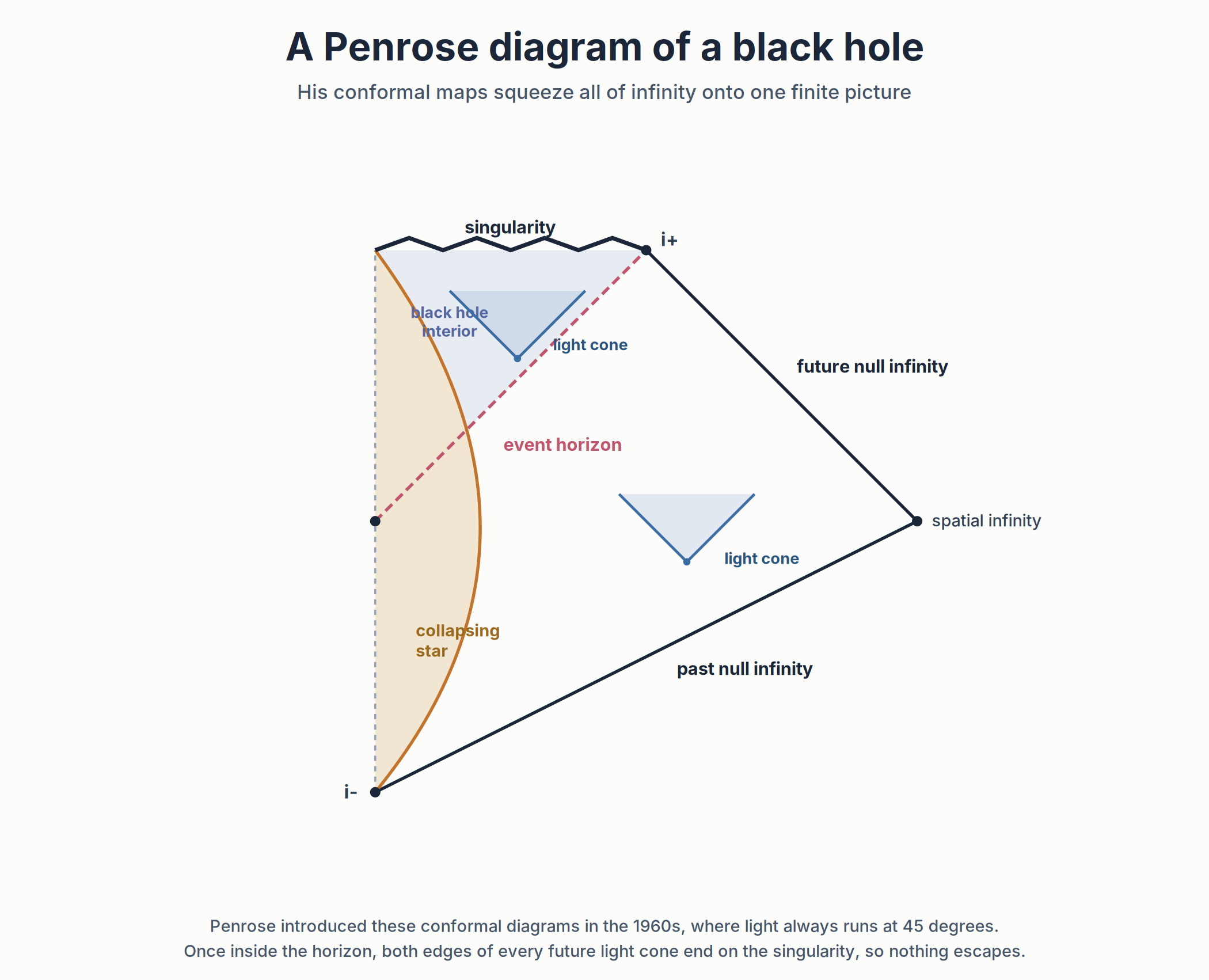
These diagrams did far more than illustrate. They turned vague questions about gravitational collapse into problems that could be reasoned about with rigour, and they are still a working tool wherever gravity meets the quantum world. The black hole information paradox, one of the sharpest open problems joining quantum theory to gravity, is argued out to this day on the conformal diagrams that Penrose introduced.
Twistor theory and Penrose tilings
Beyond gravity, Penrose is known for two strikingly original pieces of mathematics. In 1967 he introduced twistor theory, a framework that recasts spacetime points as derived objects built from more fundamental geometric entities called twistors. The aim was to find a deeper language in which gravity and quantum theory might fit together more naturally.
Twistor methods have not replaced standard physics, yet they have proven genuinely useful. In recent decades twistor techniques have become important tools for calculating the scattering amplitudes that particle physicists measure, which is a striking afterlife for an idea first floated as pure speculation.
The persistence of twistor theory says something about how Penrose works. He is willing to pursue a deep mathematical idea for years even when its physical payoff is uncertain, trusting that elegant structure tends to find an application. That patience has been vindicated more than once across his long career.
Tilings that should not exist
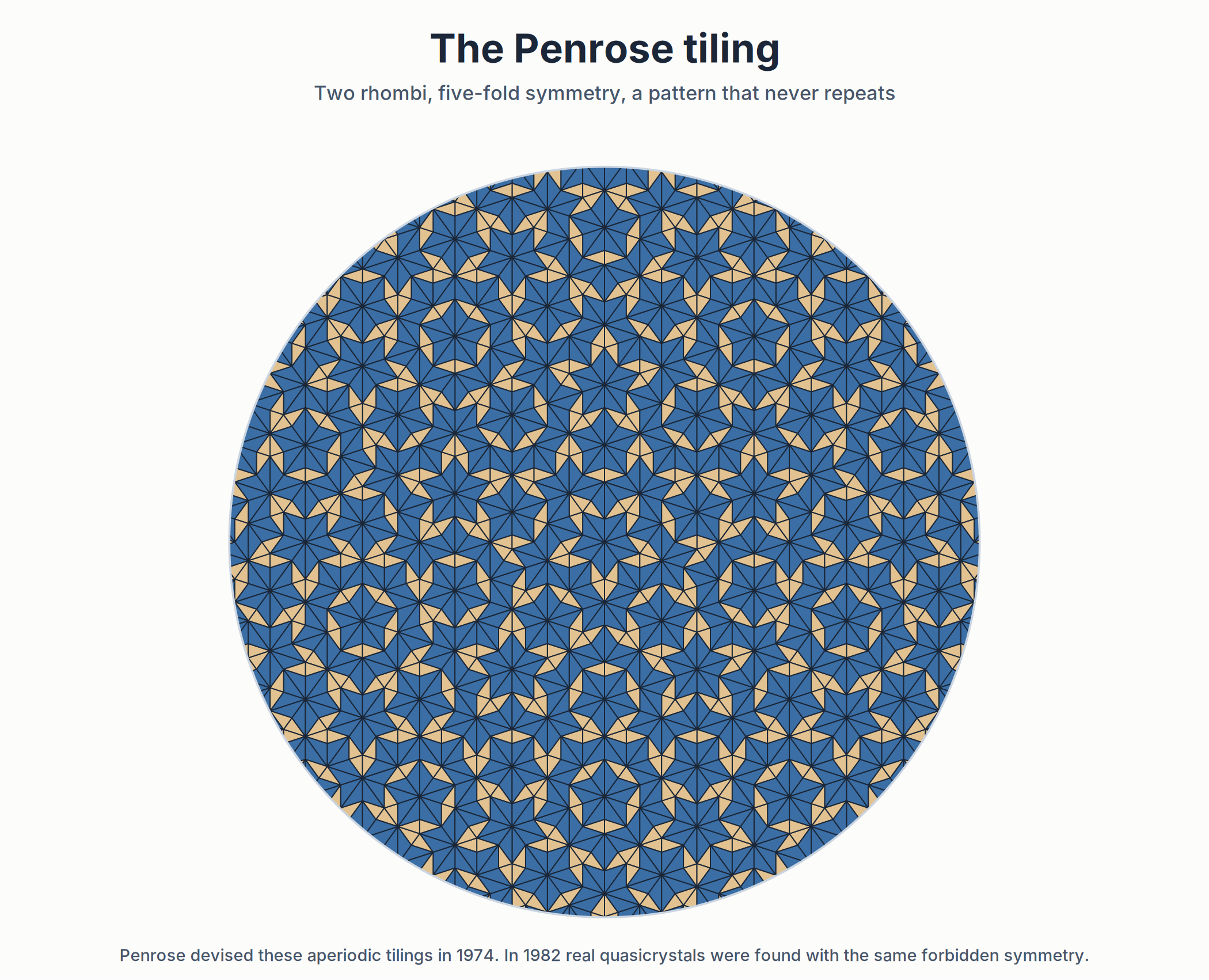
Penrose also discovered aperiodic tilings, now called Penrose tilings, that cover a plane with a few simple shapes while never repeating in a regular pattern. The patterns were a beautiful curiosity until nature appeared to imitate them. Physical quasicrystals, materials with ordered but non-repeating atomic structure, were later observed and echo the same forbidden symmetries.
This is a recurring theme in his career. An object invented for its mathematical elegance turns out to describe something real, which reinforces his conviction that mathematics and the physical world are linked more tightly than coincidence would allow.
Roger Penrose has a second, more playful claim on visual culture. In 1958, working with his father Lionel, he published a short paper on impossible objects that included the triangle shown below, a bar which looks solid at every corner yet cannot exist in three dimensions. The Swedish artist Oscar Reutersvard had drawn a version of the same figure independently in 1934, though it was the Penrose paper in the British Journal of Psychology that carried it to a scientific audience. The two had been struck by the prints of the Dutch artist M.C. Escher, and Escher repaid the debt, building his lithograph Waterfall around the Penrose triangle and his endless staircase on a related Penrose figure.

The tilings had an afterlife in the courtroom too. When Kimberly-Clark embossed a Penrose tiling on quilted Kleenex toilet paper, Penrose and Pentaplex, the company that licenses his work, brought a copyright claim against the manufacturer in April 1997. The episode is usually told as a joke, but it captures something real about him, a refusal to treat hard-won ideas as ordinary property to be borrowed without a thought.
The Emperor’s New Mind and the limits of computation
In 1989 Penrose published The Emperor’s New Mind, the book that made him a household name far beyond physics. Its central claim is provocative. Penrose argued that human understanding is non-algorithmic, meaning it cannot be reproduced by any ordinary computer following fixed rules, however powerful that computer becomes.
His reasoning leaned heavily on mathematical logic, especially Gödel’s incompleteness results. Penrose suggested that mathematicians can grasp truths that no fixed formal system can prove, and he took this as evidence that conscious insight involves something beyond standard computation.
A skeptic of the brain as computer
This makes Penrose one of the most prominent skeptics of the strong claim that the mind is simply a classical information processor. Many computer scientists and philosophers reject his argument, and the debate over whether his use of Gödel’s theorem holds up has run for decades without resolution.
Whatever one concludes, the book reframed an old question in sharp terms. It forced a serious public discussion about what computation can and cannot do, a discussion that still echoes through debates about artificial intelligence and the foundations of quantum computing. It set Penrose against thinkers like Seth Lloyd, who see the universe itself as a giant quantum computation.
The Orch-OR theory of consciousness
Roger Penrose did not stop at arguing that consciousness is non-computable. With the anaesthesiologist Stuart Hameroff he developed a specific proposal called Orchestrated Objective Reduction, usually shortened to Orch-OR. The idea is that quantum processes inside tiny protein structures called microtubules, found within neurons, play a role in generating conscious experience.
In this picture, the collapse of quantum states inside microtubules is tied to Penrose’s own ideas about how gravity might trigger the reduction of the quantum wavefunction. Hameroff supplied the biological candidate, microtubules, after reading The Emperor’s New Mind, and the two combined their views into a single hypothesis.
Why most scientists remain unconvinced
It is important to be clear about the status of Orch-OR. It is a controversial, minority hypothesis, not established science, and most neuroscientists and physicists regard it as unproven at best. A common objection is that the warm, wet brain should destroy delicate quantum states far too quickly for them to matter.
Penrose and Hameroff have continued to defend and refine the theory, and a handful of experiments have probed quantum effects in biological molecules. Even so, no result has confirmed Orch-OR, and readers should treat it as a bold conjecture about consciousness rather than a settled account of how the brain works.
The fairest way to describe the situation is as a tension between ambition and evidence. Orch-OR tries to connect three of the hardest problems in science, namely consciousness, quantum measurement, and gravity, which is intellectually bold but also makes the theory very difficult to test. Critics argue that combining so many open questions into one proposal weakens rather than strengthens the case, and that ordinary neuroscience already explains a great deal without invoking quantum collapse.
None of this means the question is closed against Penrose. The honest position is that the role of quantum effects in biology remains an active research area, and a few results in photosynthesis and bird navigation show that nature can exploit quantum behaviour in surprising places. What the evidence does not yet support is the leap from those isolated cases to a full quantum theory of the conscious mind.
Quantum foundations and the measurement problem
Penrose’s interest in consciousness grows directly out of his discomfort with quantum mechanics as it is usually taught. He takes the measurement problem seriously, asking why a quantum system that can exist in many superposed states yields a single definite outcome when it is observed or measured.
Rather than accept that measurement is simply a primitive feature of the theory, Penrose has proposed that gravity itself causes the wavefunction to collapse once a superposition involves enough mass. This gravitationally induced collapse is a concrete, testable idea, and experiments are slowly probing the mass scales where such effects might appear.
A voice for taking quantum reality seriously
This stance places Penrose among the physicists who insist that the foundations of quantum mechanics are unfinished business, not a closed subject. His objective collapse models offer one alternative to the standard textbook treatment, and they sharpen long-running discussions about superposition, entanglement, and what counts as a measurement.
These questions are not idle philosophy for the quantum technology community. The same phenomena that puzzle Penrose, namely superposition and the fragility of quantum states, are exactly the resources and obstacles that engineers wrestle with when they try to build practical quantum computers.
Why Roger Penrose matters in quantum computing
Roger Penrose matters to the quantum world less as a builder of machines and more as a clarifier of deep questions. His Nobel-winning work on black holes gave him unimpeachable scientific authority, and he has spent that authority pressing the field to confront what quantum mechanics actually means rather than just how to use it.
His skepticism is especially valuable as a counterweight. While much of the industry races to scale qubits, Penrose keeps asking whether computation, classical or quantum, captures everything the mind does, and that question forces honesty about what these machines can and cannot promise.
A laureate who keeps the hard questions open
It would be a mistake to read Penrose as claiming that brains are quantum computers in any practical engineering sense. His Orch-OR hypothesis remains unproven and contested, and he himself frames it as speculative rather than established. The careful lesson is that quantum effects in biology are an open research question, not a marketing claim.
What endures is his influence on quantum foundations and on the long argument about computation and consciousness. As a Nobel laureate who refuses easy answers, Roger Penrose stands as a reminder that the most important work in quantum science includes asking the right questions, not only engineering faster devices.
Roger Penrose sits at an unusual angle to the quantum computing boom. He draws a hard line between raw computational power and genuine understanding. Because a quantum computer still runs a definite algorithm, he argues, it remains a species of Turing machine, so it cannot cross the gap he believes separates calculation from insight. That position keeps him at odds with much of the field even as it races to add qubits.
His challenge is not purely philosophical. The Diosi-Penrose model proposes that gravity itself collapses a quantum superposition once it grows massive enough, which turns his reading of the measurement problem into something a laboratory can chase. In 2020 an underground experiment in Italy tested the simplest form of the idea and found none of the faint radiation it predicted, tightening the limits on how any such collapse could work. It is a rare case of a deep philosophical worry being pushed within reach of real quantum hardware.

Frequently asked questions
What is Roger Penrose best known for?
When did Penrose win the Nobel Prize?
What are the Penrose-Hawking singularity theorems?
What is twistor theory?
What is a Penrose tiling?
What is the Orch-OR theory of consciousness?
Does Penrose think the brain is a quantum computer?
Why does Penrose care about the measurement problem?
Is Penrose still active in research?


See today’s quantum computing news on Quantum Zeitgeist for the latest breakthroughs in qubits, hardware, algorithms, and industry deals.