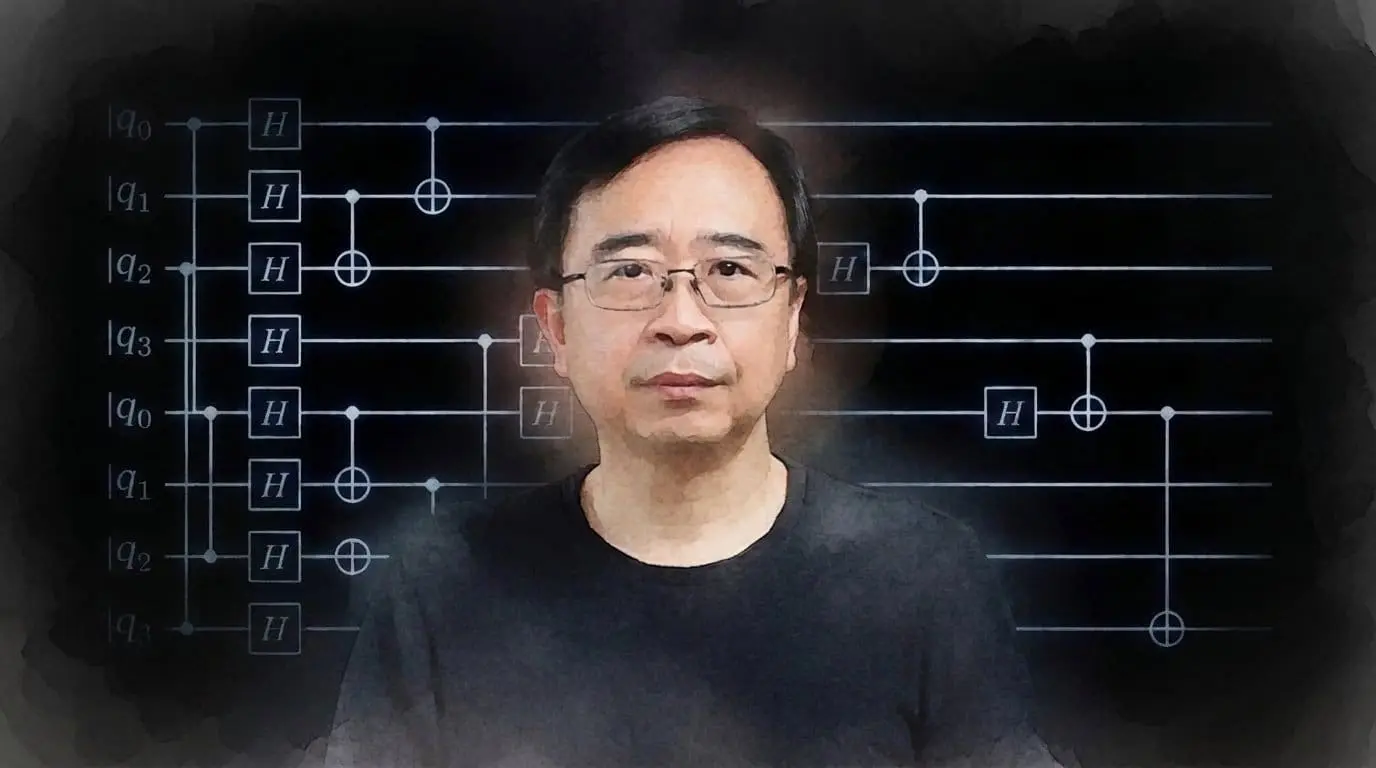
The physicist who trained under Anton Zeilinger, launched the world’s first quantum satellite, and turned China into a leader in quantum communication and computing. His work spans entanglement records, a national network, and two quantum advantage machines.
Pan Jianwei is the Chinese physicist most responsible for his country’s rise in quantum science. He trained in Vienna under the future Nobel laureate Anton Zeilinger, then returned home to build a program that launched the Micius satellite, distributed entanglement across more than a thousand kilometres, and produced two separate quantum advantage machines. Chinese media call him the father of quantum, though he has never won a Nobel Prize himself.
The scientist who moved China to the front
Pan Jianwei is the physicist most associated with China’s arrival as a quantum power. Over three decades he moved from a promising student to the architect of a program that produced world firsts in quantum communication and quantum computing. His name now stands for a national ambition, the goal of making China the leading country in the science of the very small.
What makes his story unusual is the breadth of it. Pan did not settle on a single result and defend it; he built entanglement records, a quantum satellite, a national fibre backbone, and two different kinds of quantum advantage machine. Few researchers anywhere have spanned so much of a field, from delicate tabletop optics to hardware launched into orbit.
He did this while training a generation of Chinese physicists and turning the University of Science and Technology of China, known as USTC, into one of the world’s busiest quantum laboratories. The reach of Pan is a reason the term quantum race is now used so often. Understanding his career is a good way to understand how China’s quantum sector came to matter.
From a Zhejiang town to USTC
Pan Jianwei was born on 11 March 1970 in Dongyang, a town in the eastern province of Zhejiang. He has spoken warmly about a childhood in which he was free to follow his interests rather than being pushed toward a fixed path. That freedom, he later suggested, mattered as much as any single lesson he was taught.
In 1987, at the age of seventeen, he enrolled at USTC in Hefei, a university known for its intensity and its focus on the physical sciences. He earned a bachelor’s degree in physics in 1992 and a master’s degree in 1995. The subject that gripped him most was quantum mechanics, a theory whose strangeness he found compelling rather than off-putting.
Pan has recalled being puzzled and fascinated by the idea that a particle could be in more than one state at once. That puzzlement did not fade with study; it sharpened into a research direction. By the time he finished his master’s work he wanted to test the strange predictions of quantum theory directly, in the laboratory rather than only on paper.
There was a practical problem with that ambition. China in the mid 1990s had little of the specialised equipment that experimental quantum optics demands, and few groups working at the frontier. If Pan wanted to build entangled states of light with his own hands, he would have to go where that work was already being done.
Vienna, Zeilinger and quantum teleportation
To pursue experiments at the frontier, Pan Jianwei left for Austria in 1996 and joined the group of Anton Zeilinger, then at the University of Innsbruck and later at the University of Vienna. Zeilinger was one of the leading figures in experimental quantum optics, and his laboratory was a natural home for a student who wanted to manipulate single photons. The choice shaped everything that followed.
The 1997 teleportation experiment
In December 1997 Pan was a co-author on the first experimental demonstration of quantum teleportation, published in Nature by Dieter Bouwmeester, Pan, Klaus Mattle, Manfred Eibl, Harald Weinfurter and Zeilinger. The experiment was carried out at Innsbruck, and it transferred the polarization state of one photon onto a distant photon without moving the photon itself. If you want the underlying idea, our explainer on quantum teleportation lays out how the trick works.
The method rested on three ingredients that recur throughout Pan’s later career. A source produced a pair of entangled photons through parametric down conversion, a joint measurement known as a Bell state measurement linked the incoming photon to one half of that pair, and a classical message told the receiver how to recover the original state. The authors described it as the first experimental realisation of a way to transmit quantum information itself, and the result reshaped a young and fast moving field.
Entanglement swapping and GHZ states
Teleportation was only the start of what the Vienna years produced. In 1998 Pan Jianwei was first author on a Physical Review Letters paper that demonstrated entanglement swapping, entangling two photons that had never met or interacted. This is the physical trick that a future quantum repeater would rely on, and it made Pan a name to watch among younger experimentalists.
In 1999 he shared in the first observation of three photon Greenberger-Horne-Zeilinger entanglement, a state named for a trio that includes his own mentor. These GHZ states are a sharper test of quantum theory than the two particle case, and they became a specialty of the group. Pan completed his doctorate in Vienna in 1999 on experimental quantum teleportation and multiparticle entanglement, the two threads that would run through everything he did next.
The bond with Zeilinger
The relationship between the two men went beyond a routine supervision. Zeilinger recognised early that his Chinese student had an unusual gift for building experiments, and Pan absorbed not only technique but a way of thinking about ambitious long range goals. Their bond would later be displayed on a world stage, when a satellite carried a secure call between them across two continents.
Zeilinger has been unusually direct about his former student’s importance to the field. “I can’t imagine the emergence of quantum technology without Jian-Wei Pan,” he wrote in Time magazine in 2018, a striking judgement from a scientist who went on to win a Nobel Prize. The teacher and the student remained linked in the public mind long after Pan returned home.
Accounts of their early relationship describe a young man who arrived with an outsized goal. By several tellings Pan told Zeilinger at their first meeting that he wanted to build a world leading quantum laboratory back in China, an aim that must have sounded improbable at the time. Two decades later the satellite call between Beijing and Vienna would make that ambition look almost modest.
Coming home to build a program
In 2001 Pan Jianwei returned to USTC as a professor and began to assemble a research team almost from scratch. China still had little of the specialised equipment and few of the trained hands that a modern quantum laboratory needs. He set about importing both, drawing on funding from the Chinese Academy of Sciences and the National Natural Science Foundation of China.
A laboratory built across two continents
For several years his effort was deliberately split across two countries. From 2003 he also led a group at the University of Heidelberg in Germany, using a well equipped European laboratory to train people and refine methods. By around 2008 he had moved his full attention back to China, and the talent he had cultivated came with him.
The approach became known as a reverse brain drain. Pan sent promising young students to top laboratories in Germany, Britain, Switzerland, the United States and Austria, then recruited them back to Hefei once they had mastered a technique the home lab lacked. That pipeline, rather than any single experiment, is what let the group grow so quickly, and it became a template that other Chinese fields would later copy.
First results on home soil
The strategy showed early fruit. In 2004 the USTC team reported the entanglement of five photons and a form of open destination teleportation, work that appeared in Nature and announced that serious quantum optics was now being done in China. The group was no longer only learning from abroad; it was setting marks of its own.
A 2005 result pointed straight at the mission that would define Pan Jianwei. His team distributed entangled photon pairs across 13 kilometres of open air near Hefei, the first time such a link had exceeded the effective thickness of the atmosphere. That distance was chosen for a reason, because it suggested that entangled photons could in principle survive the trip between the ground and a satellite. Within a decade the group at USTC had become a fixture in the history of quantum computing.
The Chinese state backed this vision generously, treating quantum science as a strategic priority and funding it on a scale few countries matched. Pan has been open that this support was decisive, giving him the freedom to plan a satellite mission and a national network years before either could pay off. Ambition on that timescale is rare without a patient source of money.
That patience took concrete form near Hefei. In 2017 China announced a national laboratory for quantum information sciences on a large new campus, a project widely reported in the billions of dollars, with figures ranging from around one billion to as much as ten billion depending on what construction and co-funding one counts. Whatever the exact sum, the scale signalled that quantum information had become a state priority rather than a niche academic pursuit, and the group of Pan Jianwei sat at its centre.
Setting the entanglement record
The first phase of the home program was a long climb up what physicists call the entanglement ladder. Entangling two particles is now routine, but linking many particles into a single fragile quantum state is far harder, and each extra particle multiplies the difficulty. Pan Jianwei made this climb a specialty of his group.
After the five photon result of 2004, the team pushed the record to six and then eight photons over the following years. In 2016 it reached ten entangled photons, and in 2018 it set a new mark of eighteen entangled qubits by exploiting six photons across three properties at once, their path, their polarization, and their orbital angular momentum. Each step was a small feat of engineering as much as physics.
The eighteen qubit result of 2018 was a particularly neat piece of engineering. Rather than simply add more photons, the team squeezed extra quantum information out of each one by using three of its independent properties at once, so six photons could stand in for eighteen qubits. It was a reminder that progress in this field comes as much from clever encoding as from brute scaling.
These are not abstract trophies. Large entangled states are the raw material of quantum networks and quantum computers, and building them at scale proved the group could control light with the precision that later missions would demand. The record chasing was really a rehearsal for the satellite to come, and it is described in more depth in our overview of quantum entanglement. Every later triumph drew on this patient groundwork.
Micius, the first quantum satellite
The boldest idea of Pan Jianwei’s career was to move quantum experiments off the ground entirely. Photons sent through optical fibre are absorbed within a few hundred kilometres, which caps how far entanglement can travel on Earth. A satellite beaming photons through the thin upper atmosphere could leap over that limit, and Pan had argued for exactly such a mission since the early 2000s.
In August 2016 the satellite launched on a Long March 2D rocket from the Jiuquan centre in the Gobi Desert and entered a sun synchronous orbit about five hundred kilometres high. The spacecraft weighed roughly 600 kilograms and carried a source that produced pairs of entangled photons, along with hardware for quantum key distribution and teleportation. Reported at a cost of around 100 million dollars, it was the first satellite built specifically for quantum communication.

Named after Mozi
The satellite was named Micius, the Latinised form of Mozi, an ancient Chinese philosopher of the fifth to fourth century before the common era. Mozi founded the Mohist school, and the writings attributed to it contain one of the earliest known descriptions of the pinhole camera effect, along with the observation that light travels in straight lines. Choosing that name tied a cutting edge machine to a scientific tradition more than two thousand years old.
The symbolism was deliberate. By reaching back to a Chinese thinker who studied light in antiquity, Pan Jianwei framed his satellite as the latest chapter in a very long story rather than a sudden import from the West. The gesture resonated widely in China and gave the mission a name that stuck.
An engineering ordeal
Making Micius work was as much an engineering problem as a physics one. The onboard source generated close to six million entangled pairs every second using a nonlinear crystal in a compact interferometer, yet only a tiny fraction of those photons would ever reach the ground. The rest were lost to distance, to the atmosphere, and to the sheer difficulty of aiming.
The heart of the payload was a source built around a nonlinear crystal in a compact loop of optics, tuned to emit pairs of photons whose polarizations were linked. Micius carried three scientific tasks in one body, entanglement distribution, quantum key distribution, and teleportation, each needing its own detectors and precise timing electronics. Packing that much delicate optics into a satellite that could survive the shock of launch and years in orbit was itself a considerable feat.
That aiming was the hard part. The satellite had to steer its beam onto a telescope hundreds of kilometres below while both were moving at high speed, holding the lock to within a fraction of the width of a hair seen at arm’s length. An acquisition and tracking system, guided by beacon lasers, kept the two ends pointed at each other. Pan spent years with his team solving these pointing, timing and background light problems before any science could begin, and our coverage of quantum satellite links has followed the field since.
Entanglement over 1,200 kilometres
In 2017 the mission delivered a run of results that reset the field. The headline came in the journal Science, where the team led by Pan Jianwei reported distributing entangled photon pairs from Micius to two ground stations, at Delingha and Lijiang, separated by 1,203 kilometres. That distance dwarfed anything achieved on the ground and showed that entanglement could survive the trip from orbit.
The numbers behind the record
The scale of the loss makes the result easier to appreciate. The satellite created about six million pairs per second, yet after the two downward beams passed through some 64 decibels of loss the ground stations recovered only around one pair per second. From that thin trickle the team still measured a clear violation of a Bell inequality, with a value of 2.37 where the classical limit is 2, confirming that the surviving photons were genuinely entangled.
Pan did not understate what this meant. The satellite link, he told Scientific American, was “a trillion times more efficient than using the best telecommunication fibers,” and he added that his team had “done something that was absolutely impossible without the satellite.” The comparison was not rhetorical, because on the ground the same photons would have been absorbed long before they travelled a thousand kilometres.
The distributed pairs were not perfect, and the team was candid about that. The shared state matched the ideal to a fidelity of about 0.87, high enough to prove entanglement had survived the journey yet a reminder of how much the atmosphere and the optics degrade a signal along the way. Closing that gap, rather than merely setting a distance record, is the slow work that a practical network still requires.
Three links in one year
Two further papers in Nature filled out the picture. One demonstrated secure quantum key distribution from the satellite down to a ground station over roughly 1,200 kilometres, at a key rate of about a kilobit per second. The other showed teleportation of a quantum state from a ground station in Tibet up to Micius, across a distance as great as 1,400 kilometres, on the harder uplink direction where turbulence disturbs the beam at launch.
Together the three experiments proved that every basic link of a space based quantum network could work, from entanglement sharing to key distribution to teleportation. For Pan Jianwei it was vindication of a gamble that many had thought premature. The results still sit at the heart of the quantum internet that researchers now chase, and they remain the reference point for the field.
A quantum call to Vienna
The most theatrical demonstration came on 29 September 2017. Using keys generated by Micius, the Chinese Academy of Sciences held a video call with the Austrian Academy of Sciences, linking Beijing and Vienna across roughly 7,600 kilometres. The president of the Austrian academy on the call was Anton Zeilinger, the very teacher under whom Pan Jianwei had studied two decades earlier.
The seventy five minute call was encrypted with keys the satellite had distributed to a station near Beijing and to Graz in Austria on separate passes overhead. In one short window Micius generated enough secret key to protect the entire conference, and the resulting exchange became the first intercontinental quantum secured video conference. A student who had gone abroad to learn now hosted his mentor on a link that China had built.
The reach and its limits
Behind the ceremony was a serious message about reach. A single satellite in low orbit can only connect two ground stations when it is overhead, so a global service will need many satellites and clever relaying. Yet the Beijing to Vienna call showed that the pieces could be stitched together, and it made Pan a public figure well beyond physics.
There is an important caveat that Pan Jianwei has stated plainly. Because Micius bridged two separately distributed keys, the satellite itself had to be trusted for that particular link, so the security did not extend end to end through the spacecraft the way a direct point to point exchange would. Removing that need for trust is one of the goals that drives his interest in quantum repeaters, a technology still under development.
How quantum communication stays secure
To see why these experiments drew such attention, it helps to understand what quantum key distribution actually does. Two parties use single photons to agree on a secret string of numbers, a key, that they can then use to encrypt ordinary messages. The security does not rest on the difficulty of a mathematical puzzle, as most encryption does today.
Instead it rests on a law of physics. Measuring a quantum particle disturbs it, so any eavesdropper who intercepts the photons leaves a detectable trace, and the two parties simply discard a key that shows signs of tampering. This is the property that makes the approach appealing to banks and governments, and it is the property Pan Jianwei carried into orbit.
The photon-number-splitting attack
Real hardware is messier than the ideal picture, and that gap once opened a serious loophole. A perfect scheme would send exactly one photon per pulse, but practical transmitters use dim laser flashes whose photon count varies, so a small fraction of pulses carry two or more identical photons. That surplus is what a clever eavesdropper can exploit.
The attack is known as photon number splitting. An eavesdropper measures how many photons a pulse contains without disturbing their encoded state, then quietly siphons off a spare photon from every multi photon pulse, stores it, and lets the rest continue. Over a lossy channel the legitimate users see only the losses they already expected, so the intruder stays hidden while holding a perfect copy of part of the key. Naive laser based key distribution is therefore not secure over long distances.
How decoy states close the loophole
The fix, called the decoy state method, is elegant, and Pan Jianwei’s satellite relied on it. The sender randomly varies the brightness of her pulses between a normal signal level and dimmer decoy levels, keeping each choice secret. An eavesdropper cannot tell which pulse was which, because a pulse carrying a given number of photons is physically identical whichever setting produced it.
The trap lies in the statistics. Signal and decoy pulses contain different proportions of single and multi photon events, so any attack that treats multi photon pulses differently distorts their transmission and error rates in a way that shows up when the two classes are compared afterward. By checking those numbers the users can bound how much an intruder could possibly know and discard the rest, which is exactly what makes secure long distance and satellite key distribution practical. Our companion piece on how quantum teleportation works covers the related trick of moving a state rather than a key.
An integrated national network
Space was only half of the plan. On the ground, China completed a fibre trunk line of more than 2,000 kilometres between Beijing and Shanghai in 2017, running through Jinan and Hefei and secured by quantum key distribution at a chain of relay stations. The backbone gave banks and government offices a way to exchange keys over the terrestrial network.
In early 2021 Pan Jianwei and his colleagues published in Nature the result that tied the two halves together. They fused the fibre backbone with two satellite to ground links into a single system spanning about 4,600 kilometres, serving more than 150 users across the country. It was described as the first integrated space to ground quantum communication network, and it moved the field from isolated demonstrations toward working infrastructure.
Real traffic and a real caveat
The users were not laboratories but working institutions, including state and local banks, power grids, and government websites. That made the network a rare example of quantum communication carrying real traffic rather than test data. For Pan it was proof that his field could produce infrastructure, not only papers, a point our overview of Chinese quantum companies reinforces.
The network has an important limitation that Pan has acknowledged openly. The fibre backbone relies on trusted relay stations, points where the key is briefly handled in ordinary form, which means the endpoints must trust those relays. Removing that requirement will need quantum repeaters, devices that can extend entanglement without ever exposing the key, and building them is one of the next big goals of the program.
Jiuzhang and photonic advantage
Around 2020 Pan Jianwei opened a second front, in quantum computing rather than communication. His group and its partners built a machine called Jiuzhang that used light to perform a task known as Gaussian boson sampling, a calculation that is easy to state but believed to be extremely hard for ordinary computers. The name honours an ancient Chinese mathematical text, keeping to the habit of naming machines after the country’s scientific past.
How Gaussian boson sampling works
The task begins not with single photons but with squeezed light, the quietest state a light field can occupy, prepared so that its quantum noise is pushed below the normal vacuum level in one variable. Injecting this squeezed light into many input ports is what makes the problem hard to imitate. The light then passes through a large fixed network of beam splitters and mirrors that mixes the modes without adding or removing energy.
At the output, detectors count how many photons land in each channel. The probability of any given pattern is governed by a quantity mathematicians call the hafnian of a matrix, a cousin of the permanent that appears in ordinary boson sampling. Computing hafnians is believed to be extraordinarily hard, in a class that grows exponentially with the number of detected photons, so a machine that simply produces the samples can in principle outrun any classical computer that tries to calculate them. Our guide to quantum supremacy explains what these sampling benchmarks do and do not prove.
Verifying the output is subtler than it sounds. Fully checking that a machine sampled the correct distribution is itself a hard problem, so experimenters lean on statistical cross checks and correlation tests that build confidence without proving the result outright. This is one reason the advantage claims invite so much scrutiny, since the evidence is statistical rather than a single clean answer that anyone can confirm by hand.

Four generations of a machine
The first version, reported in Science in 2020, sent squeezed light through a 100 mode interferometer and detected up to 76 photons. The team claimed it solved in minutes a sampling problem that would take a leading supercomputer an impractical length of time, a milestone often called quantum advantage. It was the second such claim in the world, after Google’s superconducting result, and the first based on photons.
The comparison numbers were deliberately vivid. The team argued that the fastest classical supercomputers of the day would need somewhere between hundreds of millions and billions of years to match what the machine did in a couple of minutes, the exact figure depending on which classical algorithm one assumed. Numbers of that size are estimates rather than measurements, and they shift as classical methods improve, a point the criticism section returns to.
Pan Jianwei did not stop there. Jiuzhang 2.0 reached 113 photons in 2021, Jiuzhang 3.0 detected up to 255 photons in 2023 with a task the authors estimated would take the Frontier supercomputer many billions of years, and a 2025 machine described as Jiuzhang 4.0 injected more than a thousand squeezed light states into a circuit of over eight thousand modes and detected up to 3,050 photons in a single run. Each extra photon roughly doubles the difficulty for a classical rival, so the jumps were enormous, as our report on the earlier Jiuzhang 3 speed record described.
Researchers have proposed practical uses for boson sampling machines, from analysing certain graph problems to modelling how molecules vibrate, though these applications remain largely aspirational. Pan Jianwei has been measured about them, treating Jiuzhang first as proof that photonic hardware can reach the advantage regime and only second as a possible tool. The honest position is that a clear practical application for this style of machine has yet to arrive.
It is worth being clear about what Jiuzhang does and does not do. The machine is not a general purpose computer; it performs one fixed sampling task extremely fast, and it cannot be reprogrammed to run arbitrary algorithms. Pan has presented it as evidence that quantum hardware can outrun classical machines, not as a device ready for everyday problems.
Zuchongzhi and the superconducting road
Photons were only one of the two roads Pan Jianwei chose to travel. In parallel his teams built superconducting processors, the chilled circuit chips that Google and IBM also favour, under the name Zuchongzhi. This let the group compete on the same terrain as the leading Western hardware, rather than only on a photonic track of its own.
Random circuit sampling
The superconducting machines run a benchmark called random circuit sampling, the superconducting cousin of boson sampling. A random sequence of gates drives the processor into a highly entangled, scrambled state, and the pattern of output bit strings that results is believed to be very hard for a classical computer to reproduce. Fidelity is scored against a simulation of the ideal circuit, so the same task doubles as a test of how well the hardware behaves.
In 2021 Zuchongzhi 2.0 used 56 of its 66 superconducting qubits to run such a task, and an upgraded version the following year, Zuchongzhi 2.1, pushed the claimed classical cost to around a million times harder than Google’s earlier Sycamore result. The two lines of work meant Pan could claim quantum advantage twice over, once with light and once with superconducting circuits. That double claim was unusual for any single research program.
Zuchongzhi 3.0 and the Willow comparison
The line reached a new peak in early 2025. Zuchongzhi 3.0, described in Physical Review Letters, carried 105 qubits and ran a sampling task on 83 of them that the authors estimated would take the Frontier supercomputer on the order of six billion years to reproduce, some six orders of magnitude beyond Google’s 2024 Sycamore experiments. Our coverage of the 105 qubit Zuchongzhi 3.0 and of its error correction work tracked how quickly the design matured.
The comparison with Google’s Willow chip is often muddled, so it is worth stating carefully. Willow, unveiled in December 2024, also uses 105 qubits, but its headline achievement was a milestone in error correction rather than a sampling record, showing that adding qubits could lower the error rate. The two machines were never benchmarked head to head, and Pan Jianwei’s honest claim for Zuchongzhi 3.0 is measured against Google’s published sampling runs, not against Willow’s separate error correction result.
The Zuchongzhi processors also improved in the mundane but vital ways that decide whether a chip is usable. Each generation lifted the fidelity of its gates and the accuracy with which qubits could be read out, the metrics that determine how long a computation can run before noise swamps it. Sampling records grab the headlines, yet these quieter gains are what a future error corrected machine will actually be built on.
The people behind the results
It would be wrong to picture Pan Jianwei working alone, and he has never claimed to. The output from USTC is the product of a large and specialised group, and several of his former students now lead major projects in their own right. Pan has often described his role as setting direction and assembling talent rather than performing every measurement.
The photonic work leans heavily on Lu Chaoyang, a long time collaborator on the Jiuzhang machines and on the single photon sources they depend on, whose contributions earned him the European Physical Society’s Fresnel Prize in 2017. The superconducting effort is led by Zhu Xiaobo, while the satellite and network programs owe much to Peng Chengzhi, a vice chief designer of the Micius mission, and to Chen Yu-Ao, who works on the cold atom memories a future repeater will need.
Several of these colleagues have become leaders in their own right, not merely assistants. Lu Chaoyang is now a prominent figure in optical quantum computing, Chen Yu-Ao earned his own doctorate in Heidelberg before returning to run cold atom research, and Zhu Xiaobo appears as a corresponding author on the superconducting papers. The group functions less like one professor’s laboratory and more like a federation of specialists who trained together and now direct their own lines of work.
A team built to run many fronts
Other senior figures round out the group, among them Zhang Qiang and Bao Xiaohui, who have pushed fibre and device independent key distribution to new distances. This depth is a deliberate design, not an accident. Rather than chase a single breakthrough, Pan Jianwei built an organisation that could pursue communication, photonic computing, superconducting computing and cold atom research at the same time.
The breadth is unusual, and it is a large part of what people mean when they credit him with China’s rise. A record can be broken and a rival can catch up, but a laboratory that keeps producing skilled people and new results is harder to overtake. In that sense the community he trained may be his most durable creation.
Honours and the father of quantum label
Recognition arrived steadily. Pan Jianwei was elected an academician of the Chinese Academy of Sciences in 2011, at the age of 41, among the youngest ever chosen. He won China’s State Natural Science Award, first class, in 2015 for his work on multiphoton entanglement and interferometry, and he received the Future Science Prize in 2017, an award sometimes described as China’s answer to the Nobel.
International honours followed too. The journal Nature named him one of its ten people who mattered in 2017, in a profile that gave him the nickname father of quantum, a label that Chinese media adopted eagerly. Time magazine listed him among its hundred most influential people in 2018, he shared the 2019 Micius Quantum Prize with Anton Zeilinger and other pioneers of quantum communication, and in 2024 he was elected a foreign member of the Royal Society in London.
The list runs longer than any single prize suggests. Pan Jianwei won the European Physical Society’s Fresnel Prize as a young researcher in 2005, became a fellow of the World Academy of Sciences in 2012, and later received the Willis Lamb Award and the ZEISS Research Award. Taken together the honours span three decades and several countries, tracing a career that kept producing at the top level rather than resting on one early result.
Why the Nobel point matters
It is worth being precise about one thing, because it is often blurred. Pan Jianwei has not won a Nobel Prize. His doctoral advisor Anton Zeilinger shared the 2022 Nobel Prize in Physics, with Alain Aspect and John Clauser, for experiments on entangled photons, and the two men remain linked in the public mind.
The nickname father of quantum is a media honour rather than a formal citation, and Pan himself has been careful not to overstate his role. He tends to credit his teams and the patient funding that made long range planning possible. The distinction matters because the label, however affectionate, can flatten a career that is really about building institutions as much as winning prizes.
Export controls and geopolitics
Because his work touches secure communication and computing, Pan Jianwei sits inside a tense geopolitical story. Quantum key distribution is attractive to governments precisely because it resists interception, and quantum computing could one day threaten the encryption that protects the internet. That combination has drawn the attention of policymakers well outside the laboratory.
The Entity List and QuantumCTek
In November 2021 the United States added several Chinese quantum entities to its export control list, among them the company QuantumCTek, its Shanghai arm, and the Hefei National Laboratory, all closely tied to the USTC quantum program. The stated rationale was that the technology could support military uses and the ability to break or strengthen encryption. The listing restricted their access to certain American components.
QuantumCTek grew directly out of Pan Jianwei’s research, founded in 2009 to commercialise quantum communication. It became the first quantum technology company to list on China’s markets when it floated on the Shanghai STAR Market in 2020. In May 2024 a further round of United States restrictions swept in more institutions, including USTC itself, in the same week that Pan’s election to the Royal Society was announced.
The market reaction to the 2020 flotation was striking. On its opening day the stock leapt many times over its offer price, one of the largest first day gains China’s markets had recorded, a sign of how much national appetite had built around quantum technology. Pan Jianwei kept a personal holding in the company, an unusual and much noted link between a leading academic physicist and a publicly traded firm.
Pan has generally framed his work as scientific and civilian, aimed at secure networks and fundamental discovery. The wider debate about whether quantum research is a national security matter or a shared scientific endeavour is unlikely to settle soon. What is clear is that his results helped turn quantum technology into a subject for diplomats as much as for physicists.
Criticism and open questions
No career this prominent escapes scrutiny, and Pan Jianwei has drawn his share. The sharpest technical challenges concern the quantum advantage claims, where improved classical algorithms have repeatedly narrowed the gap that machines like Jiuzhang were meant to open. These debates are healthy, and they are the normal way a contested frontier settles.
The classical fightback
For Gaussian boson sampling, faster classical methods have chipped away at the early claims. One study cut the estimated cost of simulating a leading experiment by around nine orders of magnitude, and a 2024 result in Nature Physics showed that photon loss, an unavoidable flaw in real machines, can actually make an approximate classical imitation easier. The lesson is that imperfections in the hardware can hand a classical rival an opening, which is part of why Pan Jianwei’s group kept raising the photon count.
A related story played out for superconducting sampling, and it carries a detail worth flagging. When Google’s Sycamore claim was undercut by a clever tensor network simulation in 2022, the work came from a Beijing team led by two physicists who also share the surname Pan, Feng Pan and Pan Zhang, and who are not related to Pan Jianwei or based at his laboratory. The coincidence of names has confused more than one reader, but the theorists who spoof these circuits and the experimentalist who builds them are entirely separate.
What the milestones really mean
There is also a broader debate about what the sampling results prove. Beating a supercomputer at one carefully chosen task is not the same as building a useful, error corrected computer, and Pan has been careful to describe his machines as steps rather than finished products. The honest reading is that these advantage claims are contested and eroded at the edges, yet none has been cleanly overturned, and each new machine answers the latest classical method rather than conceding to it.
This back and forth is how a young field matures. Independent groups probe each claim, the original team responds with better hardware or a tighter analysis, and the true boundary between quantum and classical machines slowly comes into focus. Seen that way the criticism is not a mark against Pan Jianwei but a sign that his results are consequential enough to be worth attacking, which is what serious science does to its biggest claims.
Others raise a familiar tension between speed and openness. Fields that move quickly and carry national prestige can become guarded, and rivals sometimes complain that key details are hard to reproduce. These concerns are not unique to Pan Jianwei; they apply across the competitive frontier of quantum hardware, where every group protects its methods to some degree.
What Pan Jianwei wants next
The thread running through all of it is a single destination, a global quantum internet. Speaking to the journal National Science Review in 2019, Pan described the goal in plain terms. “The quantum internet is the equivalent for quantum information,” he said, drawing the analogy with the classical network that carries ordinary data today.
He has been candid that the first uses will be modest and security focused. “The near-term target is indeed to make telecommunication more secure,” he told the same interviewer, placing unbreakable key sharing ahead of more exotic applications. It is a pragmatic vision from a scientist who prefers working hardware to speculation, and it fits a man who once called China a follower with a chance to lead.
At the same time Pan Jianwei leaves room for surprise. “The quantum internet of the future might be completely different from what we imagine now,” he added, acknowledging that a mature quantum network could enable things no one has yet pictured. That mix of near term realism and long term openness is characteristic of how he talks about his field.
Pan Jianwei has spoken about launching further satellites, including higher orbiting craft that would stay in view of a ground station for longer than the few minutes a low orbit allows. A small constellation could hand off from one satellite to the next, knitting together a service that works around the clock rather than only during brief overhead passes. Turning that sketch into working hardware is the challenge he has set for the years ahead.
The practical roadmap points toward more satellites, higher orbits that stay connected for longer, and better ways to store and relay quantum states. Each of these is a hard problem, and Pan has framed the coming decade as the work of turning demonstrations into dependable infrastructure. You can follow the newest results from the Pan Jianwei research group at USTC as they appear.
Why Pan Jianwei matters
Pan matters because he showed that a latecomer could lead. When he returned to China the country was a minor presence in quantum science, and within twenty years it held records in communication and computing that rivals scrambled to match. That shift changed how the world thinks about where scientific frontiers are pushed.
He also matters as a builder of people and systems, not only of experiments. The laboratory he raised at USTC keeps producing results long after any single record is broken, and its graduates now staff companies and universities across China. In an interview he framed the stakes for his country simply, noting that China had been “only the follower and the learner at the birth of modern information science” and now had “a chance to be a leader.”
His influence reaches into policy and public life as well. As a member of China’s political advisory bodies, Pan Jianwei has argued for sustained investment in basic science, and his visibility has helped make quantum technology a point of national pride. Few scientists in any country have shaped both a research field and its public standing so directly.
Finally, Pan matters for the questions his work forces into the open. Who should control unbreakable communication, how far quantum computers can really reach, and whether science at this frontier can stay open across borders are all live issues that his career made urgent. The related USTC line of ultracold atom processors shows the breadth of the program he helped seed. Whatever comes next, the father of quantum has already earned a place in the story of the field.
Frequently asked questions
Who is Pan Jianwei?
Did Pan Jianwei win a Nobel Prize?
What is the Micius satellite?
What did Pan Jianwei study and under whom?
What are Jiuzhang and Zuchongzhi?
What is Gaussian boson sampling?
Why is Pan Jianwei called the father of quantum?
Where does Pan Jianwei work now?
What is Pan Jianwei trying to build next?
How is Pan Jianwei linked to Anton Zeilinger?
See today’s quantum computing news on Quantum Zeitgeist for the latest breakthroughs in qubits, hardware, algorithms, and industry deals.