Quantum satellite communication is a key technology for secure global networks and long-distance quantum connectivity. Omar Alnaseri and colleagues at Baden-Württemberg Cooperative State University, in collaboration with College of Engineering and Information Technology, University of Technology, College of Engineering, University of Dubai, American University, and SDU University, thoroughly review the challenges currently impeding widespread adoption of this technology. These hurdles include atmospheric loss, precise beam alignment, limitations in payload capacity, synchronisation difficulties, scalability concerns, and seamless integration with existing ground-based infrastructure. The review consolidates current understanding of the field, surveys recent progress in areas like advanced protocols and turbulence mitigation, and identifies key research areas to enable the development of practical and robust quantum satellite communication systems.
Overcoming terrestrial range limits with space-based quantum entanglement distribution
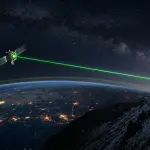
Entanglement distribution extends the reach of quantum communication beyond the limitations of fibre optic cables, which typically suffer significant signal attenuation beyond approximately 100km. The technique generates pairs of entangled photons, particles linked in such a way that they share the same fate regardless of the distance separating them; measuring the property of one instantly reveals the property of the other, a phenomenon described by Einstein as ‘spooky action at a distance’. Jian-Wei Pan and his colleagues at the University of Science and Technology of China utilised this principle by creating entangled photon pairs on board the Micius satellite, then transmitting one photon to a ground station while retaining its partner. The Micius satellite mission, launched in 2016, represents a key milestone, demonstrating quantum key distribution and teleportation over 1,200km. This achievement was facilitated by the satellite’s ability to generate and distribute entanglement across vast distances, circumventing the signal loss inherent in terrestrial fibre networks. The system comprises three core segments: a space segment utilising low Earth orbit satellites, typically at altitudes between 500km and 2,000km, a ground segment for signal reception and processing, including highly sensitive single-photon detectors, and a network segment integrating these components through advanced protocols. Choosing a satellite-based approach extends secure communication beyond terrestrial fibre optic cable range and establishes a global quantum network, offering the potential for unconditionally secure communication channels.
Adaptive optics and AI overcome atmospheric turbulence for 1200km quantum key distribution
Mitigation strategies have reduced atmospheric loss, a primary impediment to quantum satellite communication (QSC), from initial estimates exceeding 30dB to levels now enabling key distribution over 1,200km. This threshold is critical because it surpasses the limitations of terrestrial fibre optic cables and opens the possibility of intercontinental quantum links. Larger aperture telescopes, typically exceeding 1.5m in diameter, and shorter photon wavelengths, such as 780nm, are countering diffraction loss, concentrating the quantum beam and increasing signal strength. Adaptive optical systems and AI-assisted turbulence forecasting, such as the TAROCCO recurrent neural network model developed by the European Southern Observatory, counteract wavefront distortion and proactively adjust for atmospheric conditions, allowing for more effective signal transmission. These systems employ deformable mirrors to compensate for the rapid fluctuations in the refractive index of the atmosphere, effectively ‘undoing’ the blurring effect of turbulence.
These systems tackle atmospheric turbulence, inducing beam wandering and wavefront distortion, compensating for real-time distortions, particularly in downlink configurations where photons travel through a greater volume of turbulent air. Optimised wavelength selection, utilising bands like C-band (1530-1565nm) and Si-band (around 850nm) based on atmospheric transparency and fibre compatibility, and tailored optics with polarization-preserving films also contribute to signal stability. Polarization is a crucial property of photons used in QKD, and maintaining its integrity during transmission is vital for secure communication. However, point-ahead angles exceeding the isoplanatic angle, the maximum angle over which atmospheric turbulence is correlated, still hinder accurate beam alignment during uplink communication, meaning further refinement of these techniques is needed to improve performance in these scenarios. The isoplanatic angle is typically limited to a few arcminutes, requiring extremely precise tracking and compensation mechanisms. Furthermore, the effects of scintillation, the rapid fluctuations in signal intensity caused by turbulence, also need to be addressed through advanced signal processing techniques.
Navigating the technical and geopolitical challenges of unified global quantum networks
Establishing genuinely global quantum networks demands more than overcoming atmospheric disruption and payload limitations; it requires a fundamental rethink of how satellite systems integrate with existing communication infrastructure. A recent review highlights potential hybrid architectures combining space and terrestrial components, such as utilising satellite links for long-distance connections and fibre optic cables for local distribution, yet seamless convergence remains elusive, particularly concerning standardisation. The lack of universally accepted protocols and interfaces hinders interoperability between different quantum systems, potentially creating isolated islands of quantum communication. This presents not merely an engineering challenge, but a political one, as differing national standards and regulatory frameworks could fragment the envisioned quantum internet, creating isolated networks instead of a unified global system. The development of international standards, similar to those governing the internet, is crucial for realising a truly global quantum network.
Dismissing quantum satellite communication as impractical would be premature, given its potential for unhackable data transmission and the fact that the first global networks could materialise within the decade. This detailed review provides an important roadmap for engineers navigating these complexities, pinpointing specific areas needing urgent attention. Quantum key distribution (QKD), a secure communication method using the principles of quantum mechanics, promises unhackable data transmission, justifying continued investment despite the challenges. The security of QKD relies on the laws of physics, specifically the no-cloning theorem, which prevents the perfect copying of an unknown quantum state. The review consolidates understanding of quantum satellite communication, moving beyond demonstrations like the Micius mission which achieved quantum key distribution over 1,200km. It identifies key limitations, beyond signal degradation, that impede building practical systems, including the need for precise beam alignment and manageable payload sizes. Addressing these technical bottlenecks will be essential to integrate quantum networks with current infrastructure and ultimately realise a future quantum internet, with further research now focusing on daylight operation, as background solar noise interferes with single-photon detection, and the potential of space-based repeaters to extend network reach beyond the limitations of direct satellite-to-ground links. These repeaters would act as trusted nodes, receiving and re-transmitting quantum signals, effectively extending the range of the network.
This review identified significant technical hurdles to overcome before widespread quantum satellite communication becomes feasible. Atmospheric loss, precise beam alignment, and payload limitations on satellites currently restrict the development of resilient and scalable systems. The authors highlight the importance of establishing international standards to prevent fragmentation of a potential global quantum internet. Future research is concentrating on enabling daylight operation and exploring space-based repeaters to extend the range of these networks beyond current limitations.
👉 More information
🗞 A Review on Quantum Satellite Communications: Challenges and Future Directions
🧠 ArXiv: https://arxiv.org/abs/2605.02272


See today’s quantum computing news on Quantum Zeitgeist for the latest breakthroughs in qubits, hardware, algorithms, and industry deals.