Embedded within a cubic kilometer of Antarctic ice, the IceCube Neutrino Observatory has detected an unexpected feature in the distribution of neutrinos arriving from across the cosmos. Scientists at the Wisconsin IceCube Particle Astrophysics Center recently reported a feature in the expected smooth energy distribution of these weakly interacting particles.
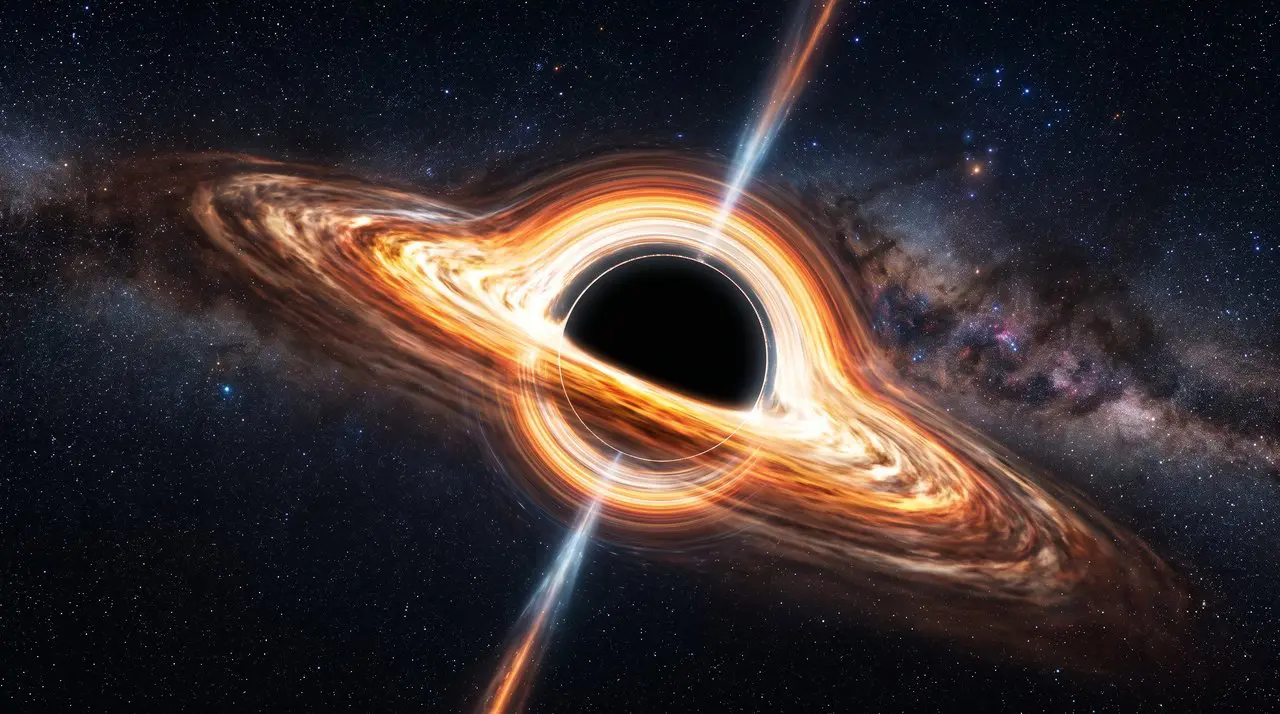
This anomaly, not predicted by standard particle acceleration theories, may originate from proton interactions with X-ray radiation near supermassive black holes, creating a short-lived particle called a delta baryon. “It turns out when protons hit light, they can turn into other subatomic particles,” explains Dan Hooper, a professor of physics at UW-Madison and WIPAC Director.
IceCube Data Reveals Spectral Break in High-Energy Neutrino Distribution
Ke Fang, an associate professor of physics at UW-Madison, explains that the high-energy neutrino spectrum was previously consistent with a power law, a simple, featureless energy distribution expected from many standard particle acceleration processes. This consistency has now been disrupted by the identification of a distinct “break” in the spectrum, prompting investigation into its origin and potential implications for understanding neutrino production. Their analysis, submitted to The Astrophysical Journal Letters, suggests that collisions between protons and photons create a short-lived particle known as a delta baryon, ultimately influencing the neutrino spectrum.
Arifa Khatee Zathul, a PhD graduate student at UW-Madison, detailed that they explored the multimessenger consequences of the neutrino spectral break at 30 TeV, finding that a soft X-ray target with an energy of approximately 0.3 keV is needed to produce such a diffuse spectrum. The researchers acknowledge the possibility that the sources of these neutrinos may also emit high-energy gamma rays, a factor they continue to investigate. Future observations with IceCube and its planned extension, IceCube-Gen2, are expected to refine the understanding of the neutrino spectrum and pinpoint the precise origins of these high-energy particles.
We explored the multimessenger consequences of the neutrino spectral break at 30 TeV, notably showing that a soft X-ray target with an energy of ~0.3 keV is needed to produce such a diffuse spectrum.
Arifa Khatee Zathul, PhD Graduate Student at UW-Madison




See today’s quantum computing news on Quantum Zeitgeist for the latest breakthroughs in qubits, hardware, algorithms, and industry deals.