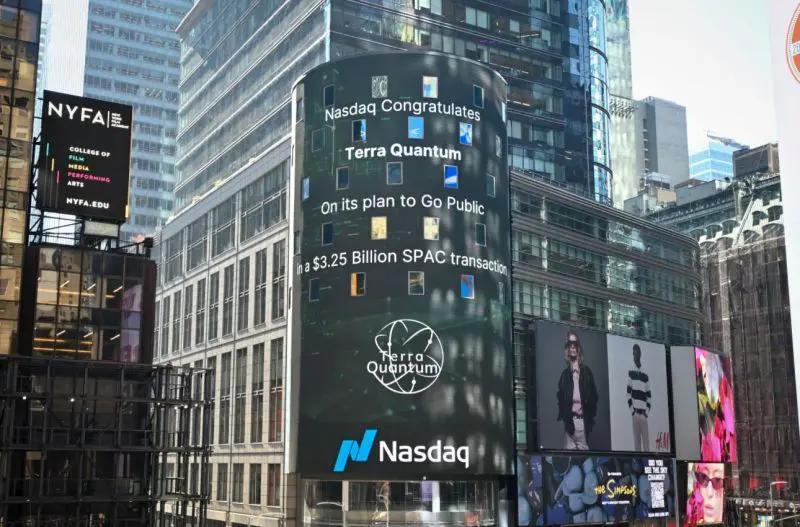
Terra Quantum AG Quantum will list on Nasdaq following a non-binding agreement to merge with Mountain Lake Acquisition Corp. II, establishing a 3.25 billion valuation for the Swiss-German firm. This move marks the fifth quantum company, joining Xanadu, IQM Quantum Computers, Infleqtion, and Pasqal, to announce a special purpose acquisition company (SPAC) combination since November 2025, a resurgence of this funding method after a period of decline. Unlike previous publicly traded firms focused on quantum hardware, Terra Quantum specializes in software and algorithms for applications in defense, finance, and pharmaceuticals. CEO Markus Pflitsch stated that reduced exposure to initial public offering volatility and competition for investor attention drove the decision to pursue a SPAC, signaling a strategic shift toward accessible growth capital for European quantum companies increasingly listing on U.S. markets.
Terra Quantum AG Quantum Nasdaq Listing at 3.25 Billion
Terra Quantum, a Swiss-German firm founded in 2019 and based in St. Gallen, will merge with Mountain Lake Acquisition Corp. II (Nasdaq: MLAA), a SPAC that completed its initial public offering in January with approximately 360 million in gross proceeds, creating a pathway to a Nasdaq listing. The company focuses on software and algorithms, including quantum optimization, hybrid quantum-classical solutions, and quantum security, with existing commercial applications in defense, finance, pharmaceuticals, and logistics, unlike earlier publicly traded quantum companies that prioritized hardware development. The 3.25 billion valuation is significant given this emphasis on software, potentially indicating a shift in investor priorities toward the computational aspects of quantum technology rather than solely the physical infrastructure. IonQ, Rigetti Computing, and D-Wave, all publicly traded quantum computing companies, reported net losses for the fourth quarter of 2025, highlighting the financial challenges inherent in early-stage quantum commercialization.
This move also reflects a broader trend of European quantum companies seeking capital in the United States, with IQM Quantum Computers (Finland) and Pasqal (France) also choosing U.S. listings in recent months, demonstrating the depth of the American investor base for deep technology ventures. Internal communications indicate that building a quantum company from Switzerland to a Nasdaq listing in six years is a considerable achievement. The final terms of the deal, including potential dilution and redemption risks, will determine the ultimate success of this venture.
European Quantum Firms Favor U.S. SPACs for Capital Access
The resurgence of special purpose acquisition companies, or SPACs, as a funding mechanism for quantum firms signals a shift in the financial strategies of European companies within the sector. Since November 2025, five firms, Xanadu, IQM Quantum Computers, Infleqtion, Pasqal, and now Terra Quantum, have announced intentions to list on U.S. markets via SPAC combinations, a pace unseen since the initial wave of quantum SPACs in 2022 experienced a downturn. This renewed interest coincides with a more than 50 percent rise in share prices for companies like IonQ, Rigetti Computing, and D-Wave, effectively reopening a previously stalled funding route. This focus on the computational side presents a different investment profile, requiring investors to assess the value of intellectual property and commercial traction across industries like defense and finance, rather than simply tracking qubit counts.
IQM Quantum Computers (Finland), Pasqal (France), and Terra Quantum AG Quantum (Switzerland/Germany) are gravitating toward U.S. markets. While the $3.25 billion valuation is currently non-binding and subject to final deal terms regarding dilution and redemption risk, the move demonstrates a willingness to navigate the complexities of U.S. markets to fuel growth and expansion.
CEO Markus Pflitsch framed the SPAC choice explicitly as reduced exposure to IPO-window volatility and competition for investor attention.
Source: https://terraquantum.swiss/
Disclaimer. This article is for informational purposes only and does not constitute investment, financial or professional advice. The quantum technology industry evolves rapidly and information may become outdated. Always conduct your own research and consult qualified advisers before making investment decisions. Investing in quantum computing companies involves significant risk, including the potential loss of your entire investment, and past performance is not indicative of future results.


See today’s quantum computing news on Quantum Zeitgeist for the latest breakthroughs in qubits, hardware, algorithms, and industry deals.