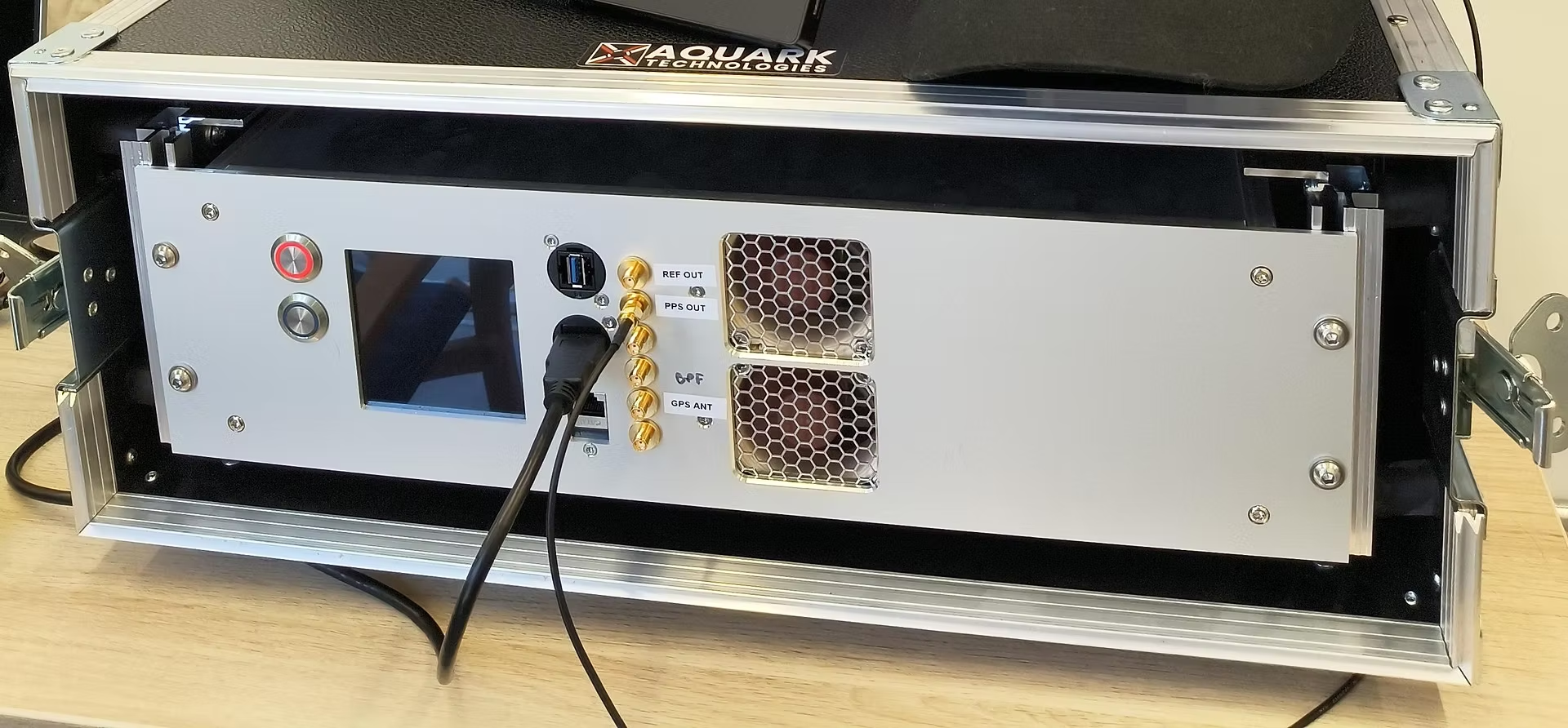
A single 24-hour disruption to civilian security, aviation, shipping, and financial markets could cost £1.42 billion, highlighting the vulnerability addressed by Aquark Technologies’ recent trial of networked radars augmented with quantum-based timing. In June 2026, Aquark partnered with the Royal Navy, Saab UK, Qinetiq, and DSTL, utilizing radars at Saab and Qinetiq sites alongside the Royal Navy’s XV Patrick Blackett, to demonstrate a distributed, high-performance military radar network independent of global navigation satellite systems.
Matthew Aldous, Timing Lead at Aquark Technologies, said, “This trial is a milestone in the development of UK sovereign quantum technology and a first-of-its-kind application of a UK atomic clock.” This demonstration marks the first deployment of British-built cold atom systems responding to a genuine defense challenge.
Quantum Timing Augments Networked Radars in UK Trial
£1.42 billion represents the estimated cost of a single 24-hour disruption to critical infrastructure due to global navigation satellite system outages, a vulnerability Aquark Technologies aimed to address in a recent UK trial by linking networked radars with quantum-based timing technology. The core innovation lies in the use of a device enhanced by frequency information derived from a cold-atom clock, specifically Aquark’s AQlock, to provide exceptionally precise and stable timing signals.
Time servers are fundamental to modern infrastructure, synchronizing clocks across diverse systems from financial markets to security protocols; ensuring their continuous accuracy is paramount to resilience. Two AQlock 2.0 units were deployed to geographically separate locations and achieved an acceptable timing signal in under 30 minutes, a speed critical for rapid deployment in dynamic operational environments.
These units then enabled two operational radar systems to create a unified air picture relying solely on AQlock for timing, effectively simulating conditions of GNSS denial or spoofing. This capability is particularly relevant given the increasing frequency of jamming and spoofing incidents, with investigations tracing unexplained GNSS blackouts across Europe to Russian early-warning satellites.
The trial demonstrated predictable performance degradation when timing signals were disrupted, and rapid recovery upon re-establishment of synchronization, showcasing the robustness of the quantum-based system. “It’s the first known time that a pair of British built cold atom systems has been deployed in answer to a genuine defence challenge, and we’re very proud to work with Saab and the Royal Navy in this way.” The cooperative nature of the radars used in the trial further enhanced situational awareness by coordinating multiple sensors, a function facilitated by the precise timing provided by the AQlocks.
DSTL played a key role in this coordination, functioning as network rebroadcast nodes to distribute the timing signals across the network. Andy Fraser Moore, Group Managing Director at Saab UK, emphasized the collaborative aspect of the project, stating, “This trial is a great example of how collaboration can accelerate innovation.
By combining quantum timing technology with Saab’s advanced Giraffe 1X radar system, we have demonstrated a practical capability that could help customers continue to operate effectively when it matters most.” Aquark’s work, initiated in December 2025, culminated in the construction of two viable prototype cold atom clocks by the end of June 2026, demonstrating a rapid development cycle for this critical technology. The AQlock utilizes Aquark’s proprietary ‘Super-Molasses Trap’, a technique that allows for the trapping of atoms without a magnetic field, offering benefits for miniaturization and scalable deployment across land, naval, and aerial platforms.
This builds on previous successful trials of the AQlock’s performance at sea aboard the HMS Pursuer, solidifying its potential for real-world applications. The trial’s focus on GNSS-independence, long-term timing performance, and situational awareness in the face of spoofing and jamming distinguishes it from other research efforts, such as those at the University of Birmingham which prioritize low phase-noise oscillators for enhanced doppler resolution.
This trial is a milestone in the development of UK sovereign quantum technology and a first-of-its-kind application of a UK atomic clock. It’s the first known time that a pair of British built cold atom systems has been deployed in answer to a genuine defence challenge, and we’re very proud to work with Saab and the Royal Navy in this way.
Matthew Aldous, Timing Lead at Aquark Technologies
Saab’s Giraffe 1X Radar Demonstrates Coherent Picture Creation
Saab’s Giraffe 1X radar system successfully integrated with quantum timing technology during a June 2026 trial, demonstrating a crucial step toward resilient radar operation in contested environments. This integration of the AQlock with Saab’s Giraffe 1X wasn’t merely a technical exercise; it explored new concepts of sensor operation by decoupling the radars from GNSS-delivered timing. This decoupling allowed for a better understanding of situational awareness and positioning in environments where traditional satellite-based timing is unreliable.




See today’s quantum computing news on Quantum Zeitgeist for the latest breakthroughs in qubits, hardware, algorithms, and industry deals.