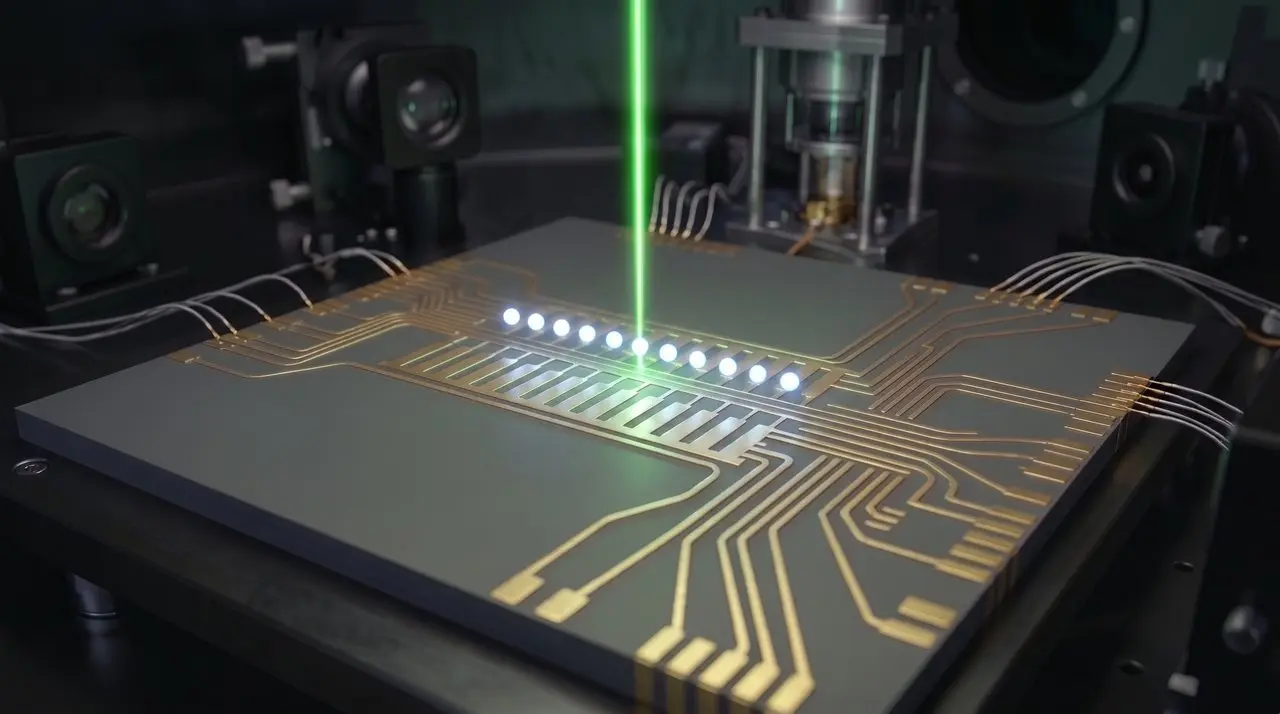
New tools evaluate gate sets using Mølmer, Sørensen multiqubit gates native to trapped-ion quantum computers. These findings identify key hardware requirements for when such multiqubit operations offer advantages over standard two-qubit entangling gates. By employing unitary synthesis as a benchmark, the work investigated various strategies concerning connectivity and sizes of the multiqubit gates used in computation. New tools assess how well different combinations of quantum operations perform; these focus on Mølmer, Sørensen multiqubit gates naturally suited to trapped-ion quantum computers.
The research clarifies when using more complex multiqubit interactions actually improves performance over standard two-qubit methods by benchmarking gate sets with a technique called unitary synthesis. Identifying specific hardware needs will help engineers design better systems for achieving practical quantum computation. New tools evaluate how well different combinations of quantum operations perform; these focus on Mølmer, Sørensen multiqubit gates, operations naturally suited to trapped-ion quantum computers.
This work clarifies when using more complex interactions actually improves performance over standard two-qubit methods by benchmarking gate sets with a technique called unitary synthesis, which is akin to building complex LEGO structures from simple bricks: any desired operation is broken down into basic components. The research particularly focuses on understanding if linking multiple qubits together and manipulating them simultaneously, like conducting an orchestra instead of playing each instrument separately, offers genuine advantages; but what precise hardware requirements must be met before these multiqubit gates truly outperform existing technologies.
Four-Qubit Interactions Substantially Reduce Quantum Circuit Complexity
Unitary circuits built using only two-qubit entangling gates twenty-six layers, a measure of circuit depth. In contrast, those utilising four-qubit Mølmer, Sørensen (MS) interactions achieved comparable results in just fifteen layers. This improvement requires MS gate fidelity exceeding approximately ninety percent, a level previously unattainable with standard hardware configurations. Before now, constructing complex quantum operations relied heavily on decomposing them into sequences of simpler two-qubit gates, limiting scalability and introducing significant overheads.
Tools evaluate how efficiently combinations of native trapped-ion gates, single qubit rotations alongside the flexible MS interaction, can build any desired operation using unitary synthesis as an application-agnostic benchmark. Further examination showed that deliberately employing these multiqubit gates reduces circuit complexity by enabling more direct connections between qubits, bypassing costly ‘swap’ operations common in other quantum computing architectures like superconducting systems. Full register MS gates connect every qubit indirectly with single qubit rotations alone, creating a universal set without additional complex steps.
Rigorous assessment defines necessary advancements in multiqubit gate fidelity for practical quantum
Researchers at Technische Universität Berlin have developed tools assessing the potential benefits of more complex multiqubit gates for trapped-ion quantum computers, systems promising advantages due to their inherent connectivity and long coherence times. Realising genuine gains depends on meeting specific hardware performance thresholds not yet consistently achieved; simply having access to sophisticated operations isn’t enough. Still, this work remains valuable even though achieving those challenging hardware thresholds proves difficult, establishing clear benchmarks for progress within trapped-ion systems.
The analysis helps focus development efforts where improvements will yield real gains, avoiding wasted investment in sophisticated but impractical gates. The team’s findings clarify how hardware advancements genuinely benefit complex calculations with trapped-ion quantum computers by unlocking potential through focused development on key performance thresholds. Their approach employs unitary synthesis, breaking down any desired operation into fundamental components and revealing the demands for improved performance, establishing a framework for evaluating gate sets without algorithmic or connectivity limitations, offering insights applicable across various system architectures.
Researchers developed tools to evaluate multiqubit gates within trapped-ion quantum computers, which offer long coherence times and inherent qubit connections. This work demonstrates that using these more versatile gates can reduce circuit complexity, achieving equivalent results in twenty-six layers compared to systems relying only on two-qubit operations, by enabling direct connections between qubits and reducing costly steps.
The analysis establishes benchmarks defining necessary improvements in hardware performance so gains from complex gates are realised; it provides an application-agnostic framework for evaluating gate sets regardless of algorithm or connectivity limitations. These findings help focus development efforts where they will have the greatest impact on improving calculations with this type of quantum computer.
👉 More information
🗞 Comparison of entangling strategies for unitary synthesis
✍️ Jonas Wunder, Hendrik Weimer and Ricardo Costa de Almeida (Technische Universität Berlin)
🧠 ArXiv: https://arxiv.org/abs/2610.40642




See today’s quantum computing news on Quantum Zeitgeist for the latest breakthroughs in qubits, hardware, algorithms, and industry deals.