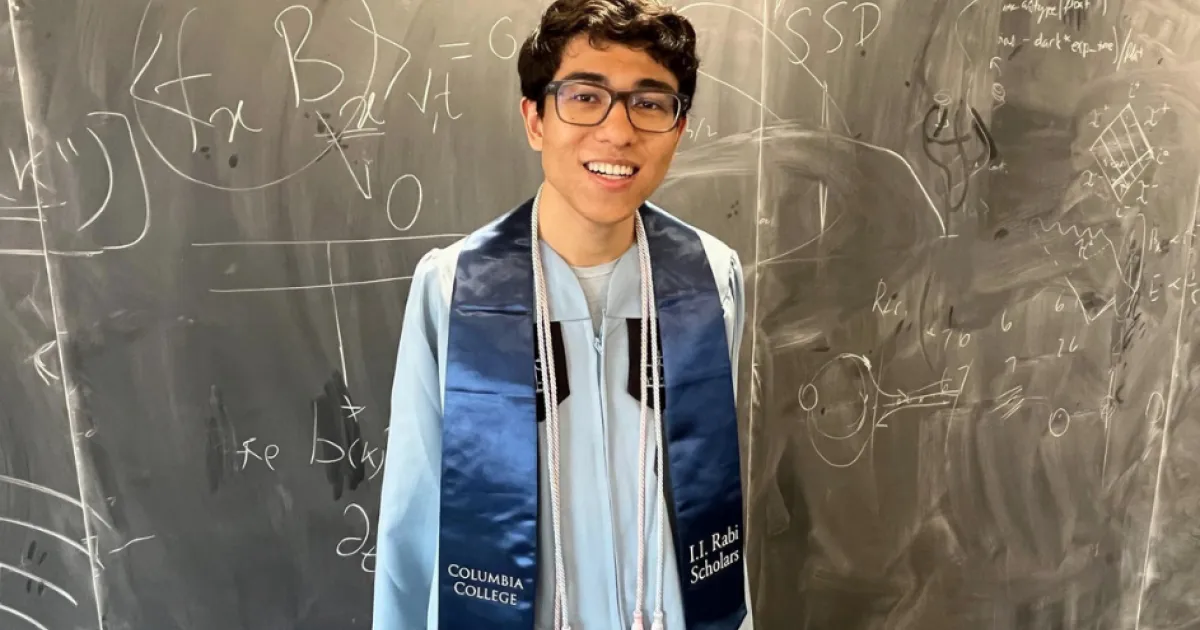
Luca Nashabeh of Columbia College will pursue physics at two Cambridge locations: the University of Cambridge in the UK as a Churchill Scholar, and then at MIT in Cambridge, Massachusetts. Nashabeh joined Columbia as a Rabi Fellow, an opportunity that “really opened the door to research for me,” and earned a Goldwater Scholarship before receiving the Churchill Scholarship.
His initial fascination with physics began in third grade with the Basher Science comic books, which introduced him to concepts like protons and neutrons. He intends to apply modern computational tools to explore controllable systems, focusing on neural network quantum states.
Rabi Fellowship & Early Research in Quantum Materials
Luca Nashabeh’s path from a third-grade fascination with comic books to a Churchill Scholarship demonstrates the impact of early exposure to scientific concepts. This early curiosity led him to pursue physics and mathematics at Columbia College, where the Rabi Fellowship provided a key opportunity. The Rabi Fellowship was instrumental in facilitating Nashabeh’s entry into research, allowing him to connect with Professor Abhay Pasupathy and Morgan Thinel, a graduate student working with a cryotemperature scanning tunneling microscope.
Nashabeh’s work extended across several quantum materials, including palladium and chromium disulfur bromide. He then transitioned into theoretical work, collaborating with Professor Raquel Queiroz and research scientist Hector Ochoa to model strain relaxation in rhombohedral graphene. “That’s a really nice example of how great the Rabi Fellowship is: The program even supported my work at another university,” Nashabeh stated, highlighting the program’s commitment to fostering research beyond Columbia’s campus.
He notes that Monte Carlo techniques, though developed decades ago, continue to yield remarkably accurate results for understanding ground-state phase diagrams. This focus on computational methods reflects a broader trend in condensed matter physics, a field experiencing growth in areas like topology, moiré theory, and two-dimensional materials, all with potential applications. He will continue his research at Cambridge University and then MIT, building on the foundation established at Columbia and supported by the Rabi Fellowship.
From Graphene to Theory: Condensed Matter Physics Focus
This initial spark led to a focused pursuit of research opportunities during his undergraduate studies at Columbia College. Nashabeh’s research at Columbia spanned diverse quantum materials, beginning with the exfoliation of graphene under the guidance of Professor Abhay Pasupathy. He then contributed to projects investigating palladium and ‘bound states in the continuum,’ alongside work on charge density waves in chromium disulfur bromide and imaging transition metal dichalcogenides.
Neural Network Quantum States & Computational Goals
Nashabeh views this as a young but promising field with substantial potential for future development. His interest lies in leveraging computation to understand fundamental behaviors within simplified, yet controllable, physical systems. Nashabeh’s goal is not simply to model complex systems, but to identify underlying principles governing their behavior.
He emphasizes the importance of direct experimental verification, appreciating that condensed matter physics allows for lab-bench experiments and measurable results. He plans to continue this research at Cambridge University in the UK, completing a Part III in Mathematics before moving to MIT, and hopes to continue working with colleagues he’s met throughout his undergraduate research for years to come, valuing the cohesive community within Columbia Physics.

See today’s quantum computing news on Quantum Zeitgeist for the latest breakthroughs in qubits, hardware, algorithms, and industry deals.