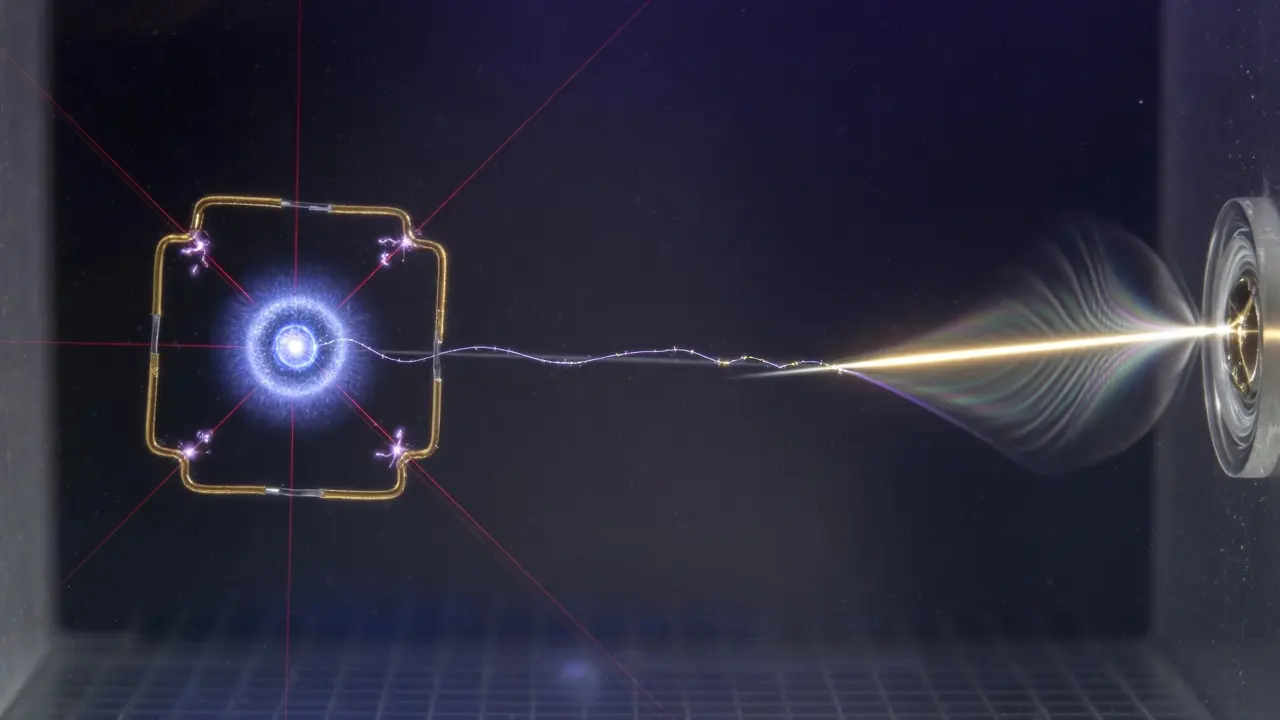
Infleqtion UK is developing a deployable quantum radio frequency direction finding system using Rydberg atoms, a departure from traditional antenna-based detection. The Innovate UK-funded project will bring quantum RF sensing from laboratory research to operational environments. “By advancing quantum sensing from laboratory research to practical deployment, this project will help establish the United Kingdom as a leader in radio frequency sensing technologies,” said Colin Sullivan, Managing Director, UK at Infleqtion.
Rydberg Atom Technology Enables Compact RF Direction Finding
Infleqtion UK is significantly reducing the size of radio frequency (RF) direction-finding systems through the application of Rydberg atom technology, a departure from traditional antenna-based methods. The company’s Quantum Spectrum-DF product, currently in development, aims to deliver high-performance signal detection in a form factor suitable for platforms previously unable to accommodate such capabilities, Infleqtion says.
This advancement addresses a key limitation of current systems, which often require large antenna arrays, particularly at lower frequencies, hindering their deployment in mobile or space-constrained scenarios. The core of this innovation lies in the use of Rydberg atoms, which allow for the detection of radio signals using optical techniques rather than conventional antennas.
The potential extends beyond simply shrinking existing systems; the technology is envisioned to unlock new capabilities in areas like spectrum surveillance, passive radar and resilient navigation, functions currently unattainable with conventional methods. “Technologies based on Rydberg-atom sensing could enable new levels of performance in environments where traditional antenna-based approaches face practical limitations,” said Dr. Oliver Sims, Electronic Warfare Chief Technologist at Leonardo. Leonardo is collaborating with Infleqtion on this project, recognizing the potential for quantum-enabled RF sensing to transform future sensing capabilities, according to the company.
The reduction in size, weight, and power consumption is particularly valuable for defence platforms, where maintaining operational effectiveness is paramount. The project builds upon earlier work where Infleqtion successfully designed and tested a prototype system. The implications of this technology reach beyond military applications, with potential dual-use benefits across both defence and civilian markets.
Infleqtion’s system is designed to not only detect signals but also to characterize and geolocate them with exceptional sensitivity and precision. “By applying atomic sensors to detect, characterize, and geolocate HF signals with exceptional sensitivity and precision, this UK-based project can strengthen sovereign awareness of spectrum, improve the ability to identify and track potential threats, and enhance national resilience against increasingly sophisticated state and non-state actors,” Sullivan explained.
This enhanced situational awareness is important in an increasingly contested electromagnetic environment. The current phase of development focuses on validating the system in realistic operational environments, ensuring its robustness and ease of use. This commitment to practical deployment reflects a broader trend toward translating quantum sensing research settings into tangible, real-world applications. The project’s roots trace back nearly a century to the UK’s development of high-frequency direction finding, but Rydberg sensing offers a chance to reinvent that capability for modern challenges.
The Quantum Spectrum-DF system is not simply an incremental improvement. It represents a fundamental shift in how RF signals are detected and located. The ability to achieve high performance in a smaller, more deployable form factor opens up new possibilities for a wide range of applications, from enhancing national security to improving emergency response capabilities.
By advancing quantum sensing from laboratory research to practical deployment, this project will help establish the United Kingdom as a leader in next generation radio frequency sensing technologies.
Colin Sullivan, Managing Director, UK at Infleqtion



See today’s quantum computing news on Quantum Zeitgeist for the latest breakthroughs in qubits, hardware, algorithms, and industry deals.