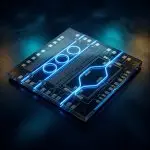
Researchers at the University of Copenhagen and Aarhus University have demonstrated a new approach to building high-fidelity quantum gates for photons. The scheme relies on repeatedly scattering photons off a single two-level quantum emitter embedded within a specially designed waveguide. This simplifies previous methods that often required multiple complex components to mediate interactions between photons, which do not naturally interact. Through numerical optimization, the team shows that a control-Z gate fidelity of approximately 99.2% and a success probability of 99.6% for a Bell-state measurement are reachable with 17 scatterings.
Chiral Waveguide Enables Single-Emitter Photon Gates
A harmonic trap, created through sequential application of dispersive elements and temporally varying phases, now confines photonic pulses to a Gaussian shape within a chiral waveguide, a key component in achieving high-fidelity quantum gate operations. This confinement mitigates wavepacket deformation, a longstanding challenge in manipulating photons for quantum information processing, and allows for precise control over their interaction with a two-level quantum emitter.
The system’s architecture moves beyond earlier methods that relied on cascading scattering from multiple emitters to induce the necessary non-linear phase shifts. The ability to construct a near-deterministic Bell-state analyzer is another significant outcome of this research, offering a substantial reduction in resource costs for both fault-tolerant photonic quantum computing and long-distance quantum communication.
This analyzer, built upon the photon sorting device, relies on the principle that the | ± ⟩ states bunch in one mode while | ± ⟩ states separate into two after passing through a 50/50 beam splitter. The core of the approach involves repeatedly scattering photons off the embedded two-level quantum emitter, building up a π phase shift incrementally rather than attempting to achieve it in a single interaction.
This cascading technique, combined with the harmonic trap, allows for precise manipulation of the photonic state despite the inherent challenges posed by the multimode nature of photon wavepackets. Researchers describe input photons using Gaussian mode functions, ϕ(k) =, with spectral width σk and central wave-number k0. The fidelity of the resulting gate is then calculated by comparing the actual wavefunction, Ψ(k,p), to the ideal wavefunction, Φ(k)Φ(p), of two independent photons after cascading.
This one-sided nature of the waveguide, coupled with the carefully engineered dispersion and temporal phase shifts, effectively creates a potential well that confines the photons, preventing them from spreading out and losing their shape. The researchers note that the optimal parameters for the harmonic trap used in the control-Z gate are identical to those used in the Bell-state analyzer, suggesting a clear relationship between the two applications.
The fidelity calculation relies on comparing the actual and ideal wavefunctions, a process that accounts for the distortions introduced by the scattering process and the effectiveness of the harmonic trap in mitigating them. The resulting fidelity metric provides a quantitative measure of the quality of the gate operation, allowing for optimization of the system parameters to maximize performance.
This work demonstrates a pathway toward building more practical and scalable photonic quantum technologies, addressing a critical need for high-fidelity gate operations and efficient state preparation. The researchers present a scheme for implementing a high-fidelity non-linear phase shift on a photonic state based on repeated scattering off a two-level quantum emitter embedded in a chiral waveguide. The ability to achieve these results with a single quantum emitter further simplifies the complexity of the system, making it more amenable to integration into larger-scale quantum devices.
Cascaded Scattering Builds π Phase Shift for Qubit Control
The ability to sculpt photonic wavefunctions relies on precise control of phase shifts, and a new approach achieves a control-Z gate fidelity of 99.2% through repeated photon scattering. The scheme uses a two-level quantum emitter within a chiral waveguide to induce a π phase shift not through a single interaction, but through a cascade of scattering events. This method allows for the creation of distinguishable two-photon mode functions, critical for manipulating quantum states.
The design hinges on the differing responses of photons depending on whether they arrive simultaneously or separately at the quantum emitter. When photons arrive together, they access the non-linearity of the emitter, altering their combined wavefunction. Conversely, photons arriving at different times bypass this interaction, remaining in independent modes. This distinction is then exploited to direct photons along different pathways within the circuit, effectively implementing the control-Z gate.
The researchers demonstrate that achieving a π non-linear phase shift without distorting the two-photon wavepacket, resulting in Ψ(k,p) = -Φ(k)Φ(p), directs photons through a specific output mode. The cascading process is not merely a means to amplify a weak interaction. It’s a method to precisely engineer the phase shift. By repeating the scattering, the researchers can accumulate the desired π phase shift, even with a relatively weak non-linear interaction from the quantum emitter.
Beyond gate operations, this cascaded scattering technique enables a near-deterministic Bell-state analyzer. This analyzer, as the researchers explain, “would greatly reduce the resource costs for fault-tolerant photonic quantum computing or long-distance quantum communication.” Traditional linear-optical Bell-state analyzers succeed with only a 50% probability, requiring significant overhead to ensure reliable quantum communication.
By using the non-linear phase shift to create a photon sorter, the new scheme aims to discriminate between all four Bell states deterministically. The photon sorter, comprised of beam splitters and the cascaded scattering device, directs single-photon pulses through the same mode they entered, while entangled photons are routed to a different output. The success of this approach relies on the careful manipulation of the photon wavepackets.
The scattering process can distort the incoming wavepackets, introducing frequency-dependent phase shifts and spectral entanglement. However, the researchers have demonstrated that these distortions can be minimized, preserving the integrity of the quantum information. By relying on a single emitter and a carefully designed waveguide, the researchers have created a more streamlined and potentially scalable architecture for photonic quantum computing. The team’s work demonstrates that the same emitter can be used for each scattering event, further reducing the complexity of the system.
High-Fidelity Control-Z Gate Exceeds 99.2%
A control-Z gate fidelity of approximately 99.2% can be reached through numerical optimization, and a success probability of 99.6% for a Bell-state measurement is demonstrated. The system’s design incorporates elements inducing second-order dispersion and temporal phase shifts, effectively creating a harmonic trap that confines incoming photon pulses to a Gaussian shape, a feature that demonstrably improves performance.
This is particularly important when considering the challenges of fabricating and controlling multiple identical quantum systems, a hurdle that has historically hampered the scalability of photonic quantum technologies. The researchers found that their approach imparts a photon number dependent phase shift, aiming for a π difference between the single-photon and two-photon phase shifts, an important step in implementing the control-Z gate.
The implementation of the control-Z gate begins with incident photons directed onto a 50/50 beam splitter, inducing bunching through the Hong-Ou-Mandel effect for specific mode combinations while allowing others to propagate independently. These photons then undergo the cascaded scattering and harmonic oscillator evolution, where the component acquires a phase φ(NL), while other combinations receive a phase . Another beam splitter reverses the bunching, completing the control-Z operation.
The researchers used the Choi-Jamiolkowsky fidelity to characterize the gate’s performance, detailing the calculation process in supplementary materials. The high-fidelity control-Z gate, they add, will also enhance the capabilities of photonic quantum simulations.
The researchers acknowledge the contributions of Stefano Paesani, Kasper Nielsen and Peter Lodahl for their fruitful discussions during the development of this work. This scheme, relying on repeated scattering off a single quantum emitter embedded in a chiral waveguide, offers a pathway toward realizing high-fidelity non-linear phase shifts on itinerant light pulses, and represents a step forward in the development of scalable photonic quantum technologies.
Two-Level Quantum Emitter Mediates Deterministic Phase Shifts
A control-Z gate fidelity of 99.2% is now achievable through a new approach using repeated photon scattering off a single two-level quantum emitter, a result demonstrating significant progress toward reliable photonic quantum computing. The harmonic trap effectively counteracts distortions to input pulses, ensuring they remain undistorted after accumulating the desired phase shift. This single-emitter approach is enabled by the chiral waveguide, which confines light and facilitates the repeated scattering process, and the carefully engineered harmonic trap, which mitigates the spectral entanglement that would otherwise degrade the signal.
The team’s analysis focused on implementing a control-Z gate, a fundamental operation in quantum computing, and a deterministic Bell-state analyzer for photonic qubits demonstrating the practical application of this scheme. Achieving a 99. The researchers found that the same optimal parameters used to create the harmonic trap for the control-Z gate also apply to the Bell-state analyzer, streamlining the design and implementation.
This optimization is critical, as distortions to the incoming wavepackets, specifically, frequency-dependent phase shifts for single photons and spectral entanglement for two-photon pairs can significantly reduce gate fidelity. The underlying principle relies on the unique properties of a two-level quantum emitter, which can only absorb one photon at a time, providing an inherent non-linearity. This non-linearity is harnessed to mediate an interaction between photonic qubits, offering a deterministic pathway for quantum operations.
The team describes the photons using states |1⟩ and |2⟩, where the input and output mode functions are transformed by a linear transmission coefficient and a scattering matrix, respectively, for the two-level emitter. The process can also be modeled as the dynamic evolution of a time-dependent quantum pulse scattering off the two-level system, integrating the master equation to describe the interaction.
The ability to confine the photon pulses to a Gaussian shape is essential for minimizing distortion and maintaining the integrity of the quantum information. By addressing the challenges of distortion and spectral entanglement, this scheme offers a promising approach to building high-fidelity quantum gates and analyzers. The researchers emphasize that the harmonic trap is essential for realizing the non-linear phase shift on the itinerant light pulse, enabling the repeated scattering process with minimal degradation of the quantum state.
The success of this approach hinges on the precise control of the waveguide elements, inducing the necessary second-order dispersion and temporal phase shifts to form the harmonic trap. This careful engineering allows the quantum emitter to be used repeatedly, simplifying the system and reducing the overall complexity.
👉 More information
🗞 High fidelity photon-photon gates by scattering off a two-level quantum emitter
✍️ Love A. Pettersson, Victor R. Christiansen, Klaus Mølmer and Anders S. Sørensen
🧠 DOI: http://link.aps.org/doi/10.1103/szts-rbjy



See today’s quantum computing news on Quantum Zeitgeist for the latest breakthroughs in qubits, hardware, algorithms, and industry deals.