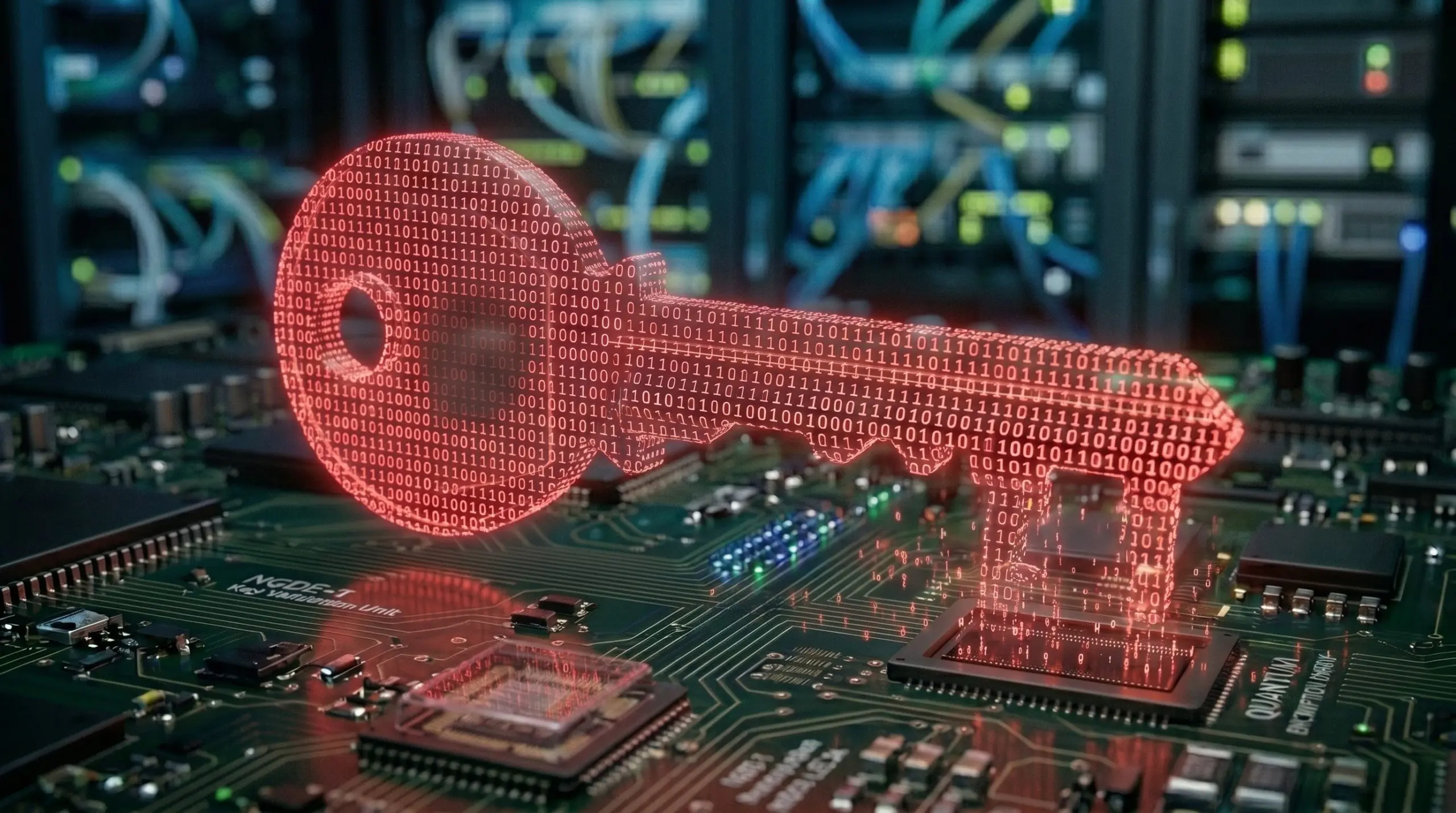
The team implemented a source-independent quantum key distribution protocol between two nodes, evaluating whether correlated photons can support secure communication as a key component of future quantum repeaters. Their work employs a deterministic photon source, a strain-tuned GaAs quantum dot within a photonic cavity, and shows high-resolution temporal post-selection enables secure key exchange, with potential for further improvements.
GaAs Quantum Dot as Entangled Photon Source
Researchers achieved this improvement using photons originating from a single, deterministic source, a strain-tuned gallium arsenide (GaAs) quantum dot embedded within a photonic cavity. The team’s experimental setup involved exciting the quantum dot twice, generating sequential entangled photon pairs with a 1.6 nanosecond delay between pulses. Central to the experiment was a Bell state measurement (BSM) setup, achieving 50% efficiency, where two photons from the sequentially generated pairs interfered. The outcome of this BSM, indicating successful entanglement swapping, was then shared between the communicating parties, Alice and Bob, establishing an entangled link between the remaining photons. The researchers achieved this result without employing entanglement distillation, a complex process used to improve entanglement quality. Instead, they relied on temporal post-selection, a technique that filters out unsuccessful swapping events by analyzing the timing of photon detections.
Theoretical modeling predicts that a source with these characteristics should be capable of demonstrating a significant violation of Bell’s inequality using swapped photons. Before validating quantum key distribution, the team assessed the fidelity of the swapped state preparation, confirming the quality of the entanglement transfer. The integration of semiconductor quantum dots into quantum repeater architectures represents a step forward, providing a benchmark for future development of these emitters and motivating further research. This work addresses a fundamental challenge in building long-distance quantum networks, extending the range of quantum key distribution (QKD). While QKD is a cornerstone of quantum-safe communication, its range is limited by signal loss. Quantum repeaters, still under development, offer a solution by enabling entanglement distribution over longer distances. The team’s demonstration of entanglement swapping supporting secret key distribution is an important step towards realizing viable quantum repeater schemes.
Entanglement Swapping for QKD Protocol Validation
Employing a quantum emitter, researchers achieved successful entanglement swapping combined with a quantum key distribution (QKD) protocol, a configuration designed to integrate with future entanglement-distribution networks. The team’s implementation relies on semiconductor quantum dots, demonstrating compatibility with multiple quantum memory platforms, positioning them as viable components for solid-state quantum network nodes. This approach bypasses the need for complex entanglement purification steps, instead using temporal filtering to isolate successful swapping events. Assessing the fidelity of the resulting swapped state is critical, and the team’s measurements indicate the accuracy of the entanglement swapping operation directly correlates with the characteristics of the photon source.
Post-Selection Enhancement of Key Exchange Rate
High-resolution temporal post-selection enabled secure key exchange, with further rate improvements expected through realistic device and protocol optimizations. The team benchmarked the system to determine how this technique could improve key distribution rates using entanglement-swapped photons, a critical step toward viable quantum repeaters. While larger coincidence windows yielded lower fidelity, reaching only 0.69 ± 0.01, narrower windows, though reducing the overall coincidence rate, demonstrably improved the quality of the entangled state. The study also investigated the potential for information leakage to an eavesdropper, finding that any extracted information was negligible. Researchers computed the mutual information between the keys held by Alice and Eve, confirming a high degree of security. The largest opportunity for further improvement, according to the team, lies in increasing the brightness of the photon source. The source’s performance was assessed using 4-fold coincidences, reaching 22958 events with a rate of 6.4 for a 400 picosecond window. The team’s work highlights an important tradeoff between coincidence rate and fidelity, demonstrating that a narrow temporal window is essential for achieving a positive SKF.
QKD Implementation with Entanglement-Swapped Photons
Employing entanglement swapping is critical for extending the reach of quantum key distribution, as it offers a path toward unconditional security levels not achievable with direct transmission methods. Recent demonstrations of device-independent secure QKD have used entanglement swapping between spin qubits mediated by photons, but an all-photonic implementation using quantum emitters remains a key advancement for efficient, chained protocols. Successful operation of an entanglement swapping protocol depends not only on the fidelity of the entangled state but also on the indistinguishability of the photons involved, a factor important for efficient two-photon interference in polarization-encoded Bell State Measurements (BSM). Researchers assessed indistinguishability by measuring interference visibility in a Hong-Ou-Mandel (HOM) experiment, using photons from an exciton to ground-state transition with a 1.6 nanosecond delay between emissions.
The fidelity of the generated biexciton photons to the expected state was then analyzed as a function of the coincidence time window applied to BSM events, revealing a direct relationship between retained coincidence counts and the quality of the entangled state. To test the protocol, the team randomly separated XX photons via a beam splitter, distributing them to Alice and Bob to probabilistically establish an entangled pair. This work demonstrates a viable elementary operation for quantum repeaters, a technology still under development but essential for long-distance quantum-safe communication.
Compatibility with Quantum Memory Platforms
These semiconductor-based emitters offer a pathway toward solid-state quantum network nodes, an important element for scaling quantum communication infrastructure beyond limited distances. High-resolution temporal post-selection proved instrumental in enabling secure key exchange, a technique that refines the timing of detected photons to improve signal clarity. The team achieved a visibility of 0.79 ± 0.02 in a Hong-Ou-Mandel experiment by narrowing the coincidence window, a measurement of the overlap in time between photon detections. The system registered 22958 four-fold coincidences within a 400 picosecond window, corresponding to a coincidence rate of 6.4 per second. Six single-photon avalanche photodiodes with similar resolution were used to verify Bell inequality violation, further confirming the entanglement quality. The ability to perform full quantum state tomography on the remaining photon pairs, conditioned on the detection of one outcome of a Bell state measurement, demonstrates the fidelity of the swapped entanglement.
The team anticipates further improvements in key rates through realistic device and protocol optimizations. This integration of a deterministic photon source with entanglement swapping and a source-independent QKD protocol is an important advancement, moving beyond theoretical concepts toward tangible, long-distance quantum networks.
Addressing Range Limitations in Quantum Communication
High-resolution timing enabled secure key exchange in an entanglement-swapped quantum key distribution system, a benchmark achieved using photons generated from a single quantum dot. The system’s performance hinges on the ability to precisely identify and isolate genuinely entangled photons from background noise, a task accomplished through temporal post-selection. This technique involves analyzing the arrival times of photons and discarding those that fall outside a narrow time window, effectively filtering out spurious detections. The work validates the potential of using entanglement swapping to extend the range of quantum communication without compromising security, a critical step toward practical quantum networks. This demonstration is particularly significant as it occurs without the need for trusted intermediate nodes, a vulnerability inherent in many existing long-distance QKD schemes. The compatibility of this photon source with a variety of quantum memory platforms further enhances its appeal for future network architectures.
The team anticipates that improvements in both device characteristics and protocol optimizations will yield even higher key rates. “This result demonstrates that the current figures of merit of QD-based photon sources could already support secure communication in a scenario where entanglement is further distributed using entanglement swapping protocols,” the researchers write. This suggests that existing quantum dot technology is closer to practical application than previously assumed, potentially accelerating the development of long-distance quantum-safe communication systems. The study benchmarks the system and presents how high-resolution temporal post-selection can enable secure key exchange, with further rate improvements expected through realistic device and protocol optimizations.
👉 More information
🗞 Quantum key distribution with entanglement-swapped photons from a quantum emitter
✍️ Michele B. Rota et al.
🧠 DOI: http://link.aps.org/doi/10.1103/68f1-cjfk
See today’s quantum computing news on Quantum Zeitgeist for the latest breakthroughs in qubits, hardware, algorithms, and industry deals.