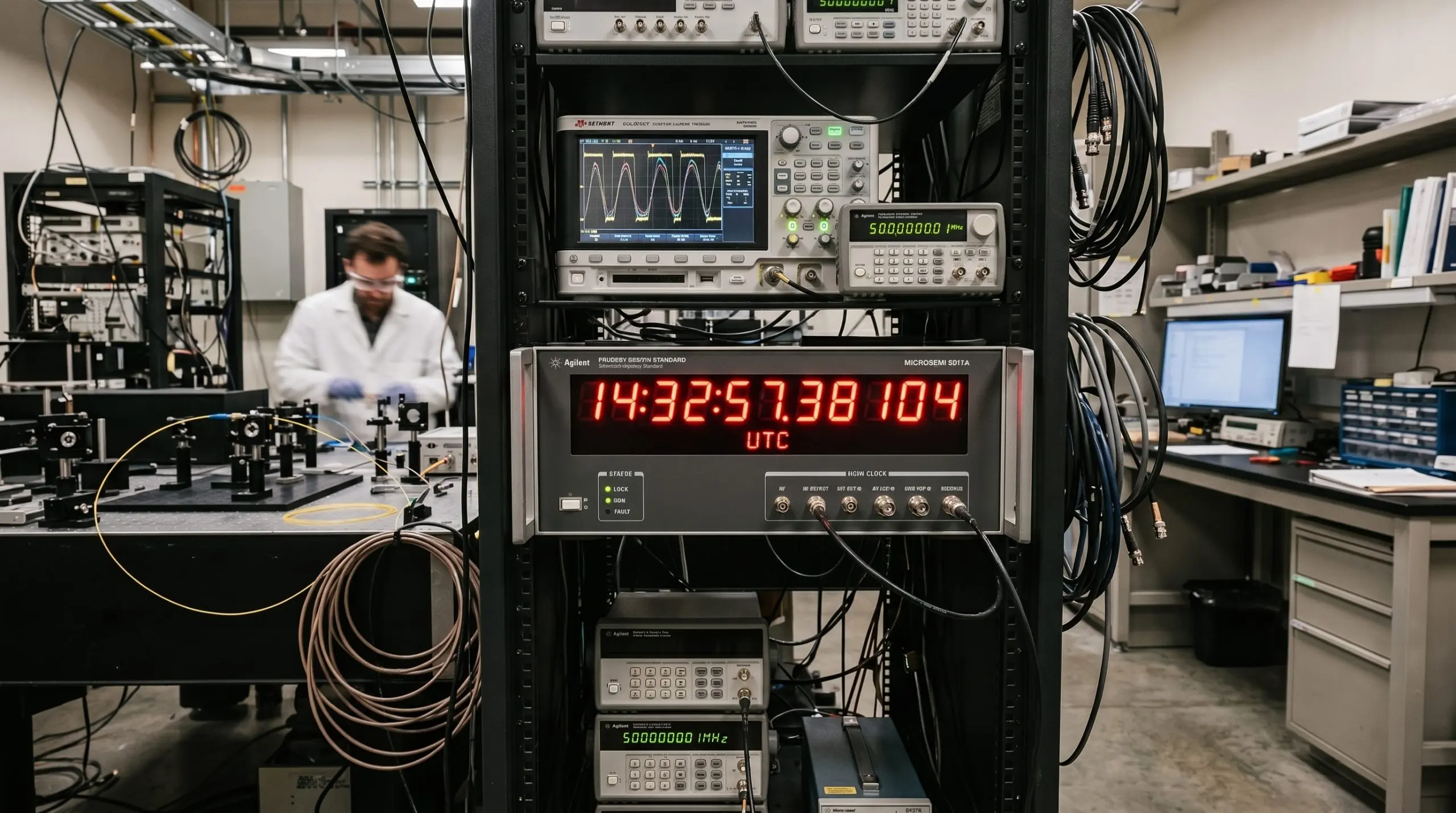
Infleqtion operated its Tiqker optical atomic clock continuously for two weeks aboard the U.S. Navy’s RV Merlin support vessel, enduring large temperature swings and sustained vibration during both the Maritime Big Play Pacific and BARB-26 exercises. The demonstration evaluated the clock’s precision timing technology in a challenging maritime environment, assessing its potential for naval integration and operation independent of GPS, Infleqtion says.
“The Navy needs dependable timing to navigate, communicate and coordinate operations in the field,” said Matthew Kinsella, CEO of Infleqtion. This sustained at-sea operation builds on previous trials and informs the development of resilient timing solutions for forward-deployed forces.
Tiqker Atomic Clock Tested During Maritime Big Play Pacific Exercise
Infleqtion’s Tiqker optical atomic clock endured large temperature swings and sustained vibration while operating continuously for over two weeks at sea, demonstrating resilience beyond laboratory settings. The sustained at-sea operation occurred aboard the U.S. Navy vessel. This combined testing provided an extended period to gather operational data that will help advance the clock’s integration into naval platforms. The MBP-P exercise, sponsored by the Office of the Under Secretary of War for Research & Engineering, included participation from the U.S. Navy, U.S. Marine Corps and partners from Australia and the United Kingdom.
Infleqtion participated in this event, alongside BARB-26, focused on subsea and seabed warfare, to assess Tiqker’s performance across various operational conditions, including both above and below the surface, and with manned and unmanned systems. This demonstration highlights the potential for precision timing independent of GPS, a capability critical for forward-deployed forces seeking to project power and deter adversaries.
Tiqker itself is a compact, rugged optical atomic clock that uses the precise optical transitions of atoms to generate a highly stable timing reference. According to Infleqtion, the exercise validates quantum capabilities for real-world applications and highlights how reliable timing supports the Joint Force’s operational needs.
The Navy needs dependable timing to navigate, communicate and coordinate operations in the field.
Matthew Kinsella, CEO of Infleqtion
Two-Week Sea Trial Validates Tiqker’s Operational Timing Capabilities
Infleqtion’s extended at-sea testing of its Tiqker optical atomic clock coincided with two U.S. This international collaboration provided a complex environment for evaluating Tiqker’s ability to maintain precise timing signals, which is important for coordinated naval operations. Infleqtion views this demonstration as a key step toward validating quantum capabilities for practical applications, noting that the sustained testing at sea provides operational data previously unavailable in other settings.




See today’s quantum computing news on Quantum Zeitgeist for the latest breakthroughs in qubits, hardware, algorithms, and industry deals.