A collaborative effort between Quemix, Toyota Motor Corporation, Toyota Central R&D Labs., and The University of Tokyo has yielded new guidelines for efficiently dividing work between classical and quantum computers in complex quantum chemistry calculations. Researchers tackled the persistent challenge of generating accurate initial conditions for these simulations by combining the Density Matrix Renormalization Group (DMRG) method with the Probabilistic Imaginary-Time Evolution (PITE) method. This approach aims to maximize the strengths of both types of computing, addressing a critical bottleneck in achieving high-precision molecular simulations. The proof-of-concept study, with results scheduled to be presented at Q2B Tokyo on June 4-5, demonstrates a pathway to reduce computational costs and error risks in quantum chemistry, potentially accelerating the development of advanced materials.
DMRG-MPS Method Enhances Classical Ground-State Preparation
A new computational strategy is reducing the resources needed to prepare initial states for quantum chemistry calculations, enabling more efficient hybrid quantum-classical simulations. Researchers at The University of Tokyo have demonstrated a method that leverages the strengths of both classical and quantum computing to tackle the notoriously difficult challenge of optimizing initial conditions for quantum algorithms, a critical step in accurately modeling molecular behavior. The collaborative team addressed a fundamental problem: the exponential increase in computational cost when attempting to generate high-quality initial states on classical computers as system size grows. DMRG, a well-established classical technique, was used to approach the true ground state as closely as possible within the constraints of classical hardware. This optimized state was then encoded into a quantum circuit as a Matrix Product State (MPS) and fed into Quemix’s proprietary PITE algorithm.
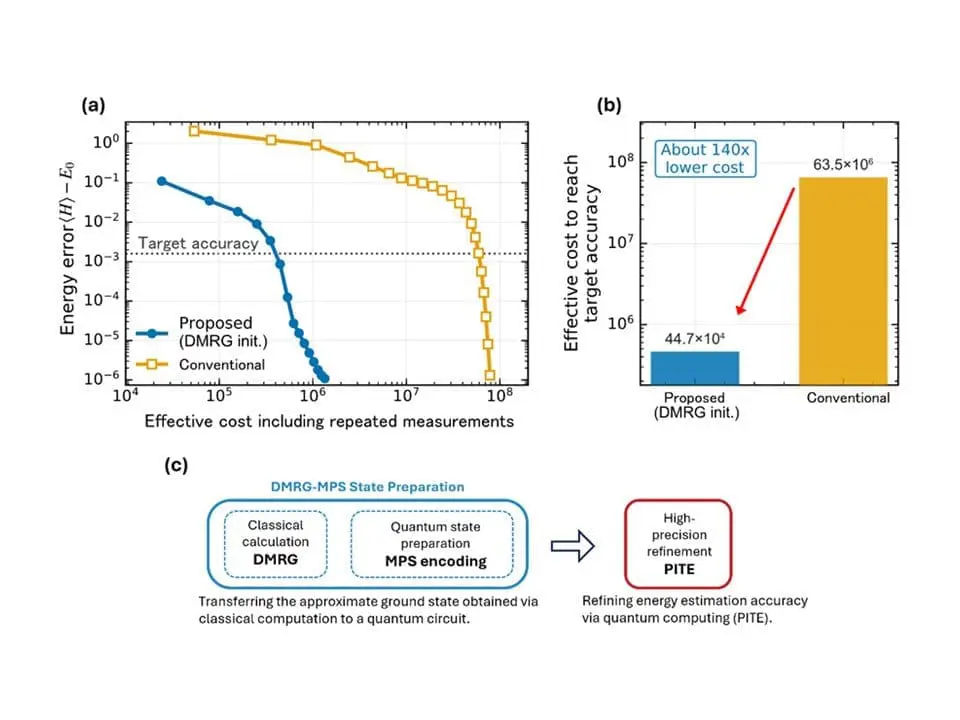
The proof-of-concept study, conducted one day ago, revealed that maximizing classical-side processing directly contributes to overall efficiency gains in ground-state calculations. In a one-dimensional Heisenberg model example with 16 spins, the researchers achieved a significant reduction in computational cost, approximately one-one-hundred-fortieth of the conventional approach when using a Néel initial state. This approach combines DMRG-MPS initial states with Probabilistic Imaginary-Time Evolution (PITE) to improve the efficiency of ground-state calculations, allowing quantum computers to focus on the most computationally challenging aspects of the problem after classical methods have already brought the system close to the solution. The results are scheduled to be presented at Q2B Tokyo on June 4-5, underscoring the importance of careful task allocation in hybrid computing architectures. The researchers suggest that the quality of the initial state is critical to realizing the full potential of quantum computers for applications in materials development and beyond.
PITE Algorithm Accelerates Quantum Chemistry Calculations
The pursuit of accurate molecular simulations has long been constrained by the limitations of classical computing, but a recent collaborative effort is demonstrating how to strategically blend classical and quantum resources to overcome these hurdles. This work, detailed in a proof-of-concept study conducted one day ago, moves beyond simply applying quantum algorithms and instead addresses how to best utilize both computational paradigms. The researchers presented new guidelines for efficient task allocation to maximize the strengths of both classical and quantum computing devices by combining the Density Matrix Renormalization Group (DMRG) method with the Probabilistic Imaginary-Time Evolution (PITE) method. A central challenge in quantum chemistry lies in finding the lowest energy configuration of a molecule, as this unlocks the ability to predict its properties. While Quantum Phase Estimation is a common approach, Quemix has been developing its proprietary “Probabilistic Imaginary-Time Evolution (PITE)” method to accelerate these calculations.
However, the quality of the initial state fed into the quantum computer significantly impacts efficiency; a poor starting point demands more quantum processing time and increases error risks. The researchers found that maximizing processing on classical computers directly contributes to overall efficiency improvements. This approach allows researchers to push classical computers to their limits, approaching the true solution before leveraging quantum computation for the final, computationally intensive steps. The significance of this research extends beyond algorithmic improvement; it provides practical guidelines for hybrid operation, reaffirming that even powerful quantum computers require well-prepared initial states to deliver on their potential.
By providing concrete guidance on how computational resources should be allocated between classical and quantum computers in future quantum chemistry calculations, this research represents a significant step toward practical application.
Classical Optimization Reduces Quantum Computational Cost
Toyota Motor Corporation and its research partners are actively reshaping quantum chemistry calculations by strategically maximizing classical computational power before engaging quantum processors. The core challenge lies in generating an initial quantum state that minimizes the computational burden on the quantum computer itself. This isn’t simply about brute-force classical processing, but a refined strategy. The researchers demonstrated that maximizing processing on classical computers directly contributes to overall efficiency improvements, specifically by employing the Density Matrix Renormalization Group (DMRG) method to approach the true ground state as closely as possible within the limits of classical computational memory and cost. In a one-dimensional Heisenberg model example with 16 spins, the researchers achieved a significant reduction in computational cost compared to the conventional approach using a Néel initial state, approximately 1/140. The highly accurate state obtained on the classical computer side was encoded into a quantum circuit as a Matrix Product State (MPS) through state preparation and subsequently passed to Quemix’s proprietary quantum algorithm, PITE.
This study demonstrated the possibility of reaching the “true solution,” which could not be achieved by classical computation alone, by assigning the remaining computationally challenging region to quantum computers after first approaching the true solution as closely as possible using classical methods.
Hybrid Computing Achieves Solutions Beyond Classical Limits
The pursuit of viable quantum chemistry calculations has yielded a crucial insight: maximizing classical computation before engaging quantum processors dramatically improves efficiency. The team tackled the persistent challenge of state preparation, a bottleneck that often undermines the potential benefits of quantum processing. DMRG, a well-established classical technique, was leveraged to generate highly accurate initial states, pushing classical processing to its limits. For large-scale problems where classical methods falter, the team demonstrated the ability to reach solutions unattainable through classical computation alone by first refining the initial state using classical resources and then assigning the most computationally challenging aspects to the quantum processor.
As a result, quantum computers are expected to accelerate the development of high-performance new materials.




See today’s quantum computing news on Quantum Zeitgeist for the latest breakthroughs in qubits, hardware, algorithms, and industry deals.